
Editorial Note
Extracted, OCR’d from 1925 Lehre und Wehre, vol. 71, Feb., Mar. April, May, July, August issues.
A book by the same name was published in 1925 by Concordia Publishing House with the following title page information: “Originally published in ‘Lehre und Wehre’, Volume 71” (German text). Wallace McLaughlin used this to instruct his ULC congregation before he joined the Missouri Synod.- see his A Former ULC Pastor… p. 2, Archive copy here;
Part 1: Introduction – Fundamentalists, non-Fundamentalists, Foundation, Fundament
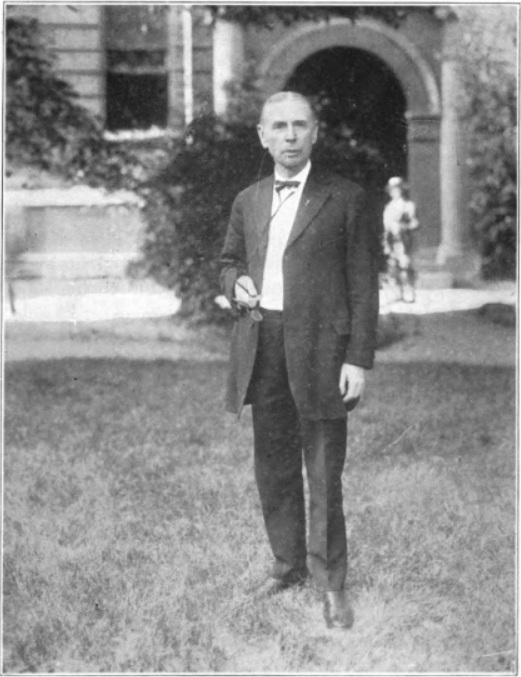
Das Fundament des christlichen Glaubens. [by President Franz Pieper, Concordia Seminary, St. Louis, Missouri]
The present time offers ample opportunity to deal with this topic in more detail. Our church papers have reported on the dispute that is currently taking place in the sectarian churches of our country between fundamentalists and modernists. We also remember that in earlier times many pamphlets had been exchanged on whether the doctrines by which the Reformed Church is separated from the Lutheran Church are touching the Foundation of the Christian faith or not. 1) The Reformed were in general always inclined to answer the question with no, while the Lutherans represented a decided yes. In our time, then, the claim has come to the fore, that the question of the foundation [Fundament] of the Christian faith should not be treated at all, because its treatment, as the past taught, necessarily ends without result. So for example, the Erlangen theologian [J.C.K.] von Hofmann, who is reckoned among the more positive modern theologians, suggests that “on the difference between the fundamentalists and the non-fundamentalists, there has been fruitless dispute up to this day”. 2) The situation claimed by von Hofmann would naturally be catastrophic for the Christian faith. Faith without a foundation [Fundament] would no longer be faith, but constant doubt, the opposite of faith. (Rom. 4:20, 21; Heb. 11:1 ff.) But the matter stands, thanks to God, not so. We can only remain uncertain of the foundation of our Christian faith as long as we have not yet recognized, or have forgotten, what is the content or object of God's infallible Word, Holy Scripture, and thus also the foundation [Fundament] of faith whereby a person becomes a Christian and remains a Christian. The Christian faith does not consist of the teaching that there is a God who rewards the good and 1) Here belongs Nicholas Hunnius’ writing Diaskepsis Theologica: de fundamentali Dissensu Doctrinae Lutheranae et Calvinianae . Witteb. 1626. 2) Der Schriftbeweis 2 I, 9-10.
punishes the evil. This belief is also found among the Gentiles. (Romans 1 and 2) The Christian faith is faith in the Gospel of Christ, (Mark. 1:15) that is, faith in the forgiveness of sins, which Christ, the incarnate eternal Son of God, through his vicarious satisfaction (satisfactio vicaria) has acquired for all men and has proclaimed through his Word until the Last Day in the Christian Church and by the Christian Church in the world so that it may be believed by men. When the apostle of Christ calls to the jailer of Philippi terrified by his sins, "Believe on the Lord Jesus Christ," [Acts 16:31] he names the foundation of the Christian faith. He means Christ, the Savior crucified for the sins of the world, as he also summarizes the contents of his Christian sermon of 1 Cor. 2 as follows: “For I determined not to know any thing among you, save Jesus Christ, and him crucified.” [1 Cor. 2:2] But this sermon generates the Christian faith in a human heart and becomes eo ipso the content or object or foundation of the Christian faith. The foundation of the Christian faith is described by Luther in his classic explanation of the second article: “I believe that Jesus Christ, true God, begotten of the Father from eternity, and also true man, born of the Virgin Mary, is my Lord, who has redeemed me, a lost and condemned creature, purchased and won me from all sins, from death, and from the power of the devil, not with gold or silver, but with His holy, precious blood and with His innocent suffering and death.” For faith in the forgiveness of sins for the sake of Christ's satisfactio vicaria can we also use faith in divine justification without the works of the Law, because Scripture expresses the forgiveness of sins and justification as synonyms, Rom. 4:6-8: “Even as David also describeth the blessedness of the man, unto whom God imputeth righteousness without works, Saying, Blessed are they whose iniquities are forgiven, and whose sins are covered. Blessed is the man to whom the Lord will not impute sin.” Our righteousness before God is the forgiveness of our sins for Christ's sake. Whoever does not believe this Scripture doctrine of the forgiveness of sins for Christ's sake or the justification without works, is not faithfully in Christ in the meaning of Scripture. His faith does not have the foundation God has given. He is still, or again, outside the Christian church. As Paul so powerfully warns the Galatians: “Christ is become of no effect unto you, whosoever of you are justified by the law; ye are fallen from grace.” (Gal. 5:4) On the other hand, Paul confesses his and all Christians faith [page 35] at all times and in all places so: “Knowing that a man is not justified by the works of the law, but by the faith of Jesus Christ, even we have believed in Jesus Christ, that we might be justified by the faith of Christ, and not by the works of the law: for by the works of the law shall no flesh be justified.” (Gal. 2:16) This article of the forgiveness of sins for the sake of Christ, or of justification without works, by faith, is known to Luther as “the chief part and cornerstone which alone produces, nourishes, builds, sustains and defends the Church, without which the Church of God cannot exist one hour”. 8) And in another passage he adds, "those in the world who do not teach it are either Jews or Turks or papists or sectarians.” 9) 8) Erlangen Opp. var. arg. VII, 512; St. L. XIV, 168. [not in Am. Ed.] 9) Ad Gal. Erl. I, 20; St. L. IX, 29. [Am. Ed. 26, p. 9]
Now let us see what position the religious fellowships around us have on the foundation of the Christian faith, namely a. the Unitarians, b. the Roman Church, c. the Calvinist and Arminian Reformed sects and the synergistic Lutherans, d. the deniers of the God-ordained means of grace and e. the deniers of the inspiration of the Holy Scriptures.
Part 2: Unitarians
The Unitarians and the Foundation of the Christian Faith.
The Unitarians deny the Holy Trinity. This includes the denial of the eternal essential (metaphysical) deity of Christ and, consequently, the denial of the vicarious satisfaction of Christ (satisfactio vicaria). As surely that the Christian faith is not faith in a mere man, but faith in the living Son of God, (Matt. 16:16) and not only faith in Christ as a model of life, but is faith in the only mediator between God and man, who has given himself a ransom (ἀντίλυτρον) [1 Tim 2:6] for all for that such would be preached in his time, (1 Tim. 2:5-6) so surely have all Unitarians, the Unitarians of former times and in our day, completely abandoned the foundation of the Christian faith. They stand outside the Christian Church, extra ecclesiam, as the first article of the Apology of the Augsburg Confession says. The Unitarian religion is, according to Scripture, blasphemy and idolatry. Unitarianism has also spread widely in our country, in the United States. It has also generally penetrated the Reformed sects, formerly called “Orthodox” sects, in contrast to Unitarianism, and already holds the majority in some of these sects. At the Northern Baptists’ gathering last year in late May and early June [page 36] in Milwaukee, the “modernists”, that is, the Unitarians, won out across the board. Unitarianism, as the Baptist fundamentalists in Milwaukee testified, had also invaded the Baptist mission to heathens, and Dr. Stratton of New York made the correct observation that the Christian Church certainly had no advantage from this Baptist missionary activity. The heathen were “converted” not to Christ, but away from Christ. — Furthermore, we must also not forget that the Unitarian religion is in a large part of our American classics literature. S.J. Barrows, the author of the article “Unitarianism” in Samuel Macauley Jackson's Concise Dictionary of Religious Knowledge, for example, uses Emerson, Irving, Hawthorne, George W. Curtis, Longfellow, Holmes, Bryant, and historians Prescott, Bancroft, Motley, and others. Therefore, our teachers at our colleges are staggered off their position when reading from these Unitarian writers. The same applies, of course, to reading German classics such as Lessing, Schiller and Goethe. Furthermore, we must not overlook the fact that Unitarianism also approaches us in the form of the religion of the Lodge, and especially to our congregations. The official Lodge religion of the main lodges is decidedly Unitarian. It’s content is that every man can go to heaven on account of one's own virtue, with the explicit rejection of the Christian belief that only faith in the crucified Christ is the way to heaven. Thus in Webb’s Monitor of Freemasonry by Robt. Morris, p. 280 [1959 ed., p. 385] : “So broad is the religion of Masonry, and so carefully are all sectarian tenets excluded from the system, that the Christian, the Jew, and the Mohammedan, in all their numberless sects and divisions, may and do harmoniously combine in its moral and intellectual work with the Buddhist, the Parsee, the Confucian, and the worshiper of Deity under every form.” According to Mackey, Lexicon of Freemasonry (p.404) [1860 ed., p. 287], the lodge members are also committed to a religion. But it is a commitment to the lodge religion with the express exclusion of the Christian religion. “They [the lodge members, including those who still want to be Christians] are not permitted to introduce them [namely their “peculiar opinions”] into the lodge or to connect their truth or falsehood with the truth of Masonry.” This establishes the practice of our congregations against the lodges. The practice of our churches against the lodges is based on this. If lodge members notify us for church fellowship, e.g. at the Lord's Supper, we do not have the right to consider them Christians. Because they are members of a society that confesses the Unitarian religion in the most pronounced and abrupt form, they must first prove their Christianity. And this can only happen if their involvement with the Lodge’s religion and any participation in the [page 37] exercise of Lodge religion is renounced. That's not asking too much. Even the weakest Christian sees the justification of this demand. We must not underestimate the work that the Holy Spirit has in every one, even the weakest Christian. If a person has recognized himself as a damnable sinner before God and trusts in God's atoning blood of Christ—and only such a person can Pastor and congregation hold as a Christian and admit to Communion—he recognizes the lodge religion as a direct denial of Christianity and participation in the Lodge worship as idolatry, with which he wants to have nothing to do. Where in a congregation the Lodges have gained room, it is usually the case that at the first registration for the Lord's Supper, the report of the examination of Christian status is missing. There was no need to inquire whether the person in question recognizes himself as a poor sinner and that the foundation of his confidence before God is the blood of Jesus Christ, the Son of God, which makes us clean from all sin. It is obvious that this test concerning the Christian faith of those who seek communion with us belongs to the concern of the souls and conscientious administration of the sacrament. In this way of dealing with the so-called Lodge Question, hundreds, even thousands of pastors of the Synod have either managed to keep their congregations completely free of lodges or, if individuals have strayed into the camp, return them to the communion of the Christian Church. They acted in the knowledge that the Lodge religion is Unitarian, clearly and boldly pushes aside the foundation of the Christian faith, namely the forgiveness of sins alone for the sake of the blood of the Redeemer. Our pastors acted and will act so in the knowledge that not postponing serious pastoral care is proper here, because it is the life and death of the souls who were purchased by Christ's blood for their life. F.P.
Part 3: The Papacy and the Lodges
The Papacy and the Foundation of the Christian Faith.
Rome, unlike the Unitarian fellowships, confesses the Triune God. Rome teaches the eternal Godhead of the Son and the Holy Spirit. It teaches the incarnation of the Son of God and also speaks of the fact that this incarnation was necessary and for the good of mankind. But Rome denies in the most decisive way the fruit of the incarnation of the Son of God. It denies that by the grace of God alone, without works of our own, by relying on Christ's merit alone, we human beings attain forgiveness of sins and salvation. And Rome not only denies this, but also pronounces the curse on all those who do not also want to be justified and saved by the works of the law, but only by trusting in God's mercy in Christ. Thus, in the twelfth canon of the sixth session of the Council of Trent, it says: “If any one saith, that justifying faith is nothing else but trust in the divine mercy which remits sins for Christ's sake, or that this trust alone is that whereby we are justified, let him be anathema”. [On Justification, Canon XII] And in the twentieth [page 76] canon it is explicitly documented with an anathema that the Gospel is a mere and perfect promise of eternal life, without the condition of keeping the commandments of God and the commandments of the Church. As certain as the Gospel, that is, the message of the forgiveness of sins for the sake of Christ's satisfactio vicaria, without the works of law, is the object or foundation of the Christian faith, so certain it is that the Pope's Church denies the foundation of the Christian faith and not only denies it, but also expressly places it under the curse. Rome's official religion is completely identical in essence with the religion of the Unitarians or Lodges. Rome and the Unitarians belong to one class, to the class of the religions of works. The difference is limited to the outer form of the works, which are prescribed on both sides as a means of attaining salvation. Rome urges the works prescribed by the Roman Church, that is, by the Pope. The Lodges urge the works in which, supposedly by virtue of the light of human reason, all men, the Christian, the Jew, the Mohammedan, the Buddhist, the Parse, the Confucian, etc., agree. The papacy and the lodges are known to fight each other. If the Knights of Columbus occasionally fraternized with the lodges in recent years, they were sharply rebuked by the superiors. But deceivingly. The Knights of Columbus felt an inner kinship. The battle between the Papacy and the Lodges is merely a game of the devil's jugglery. The activity in both camps is aimed at keeping mankind, which was lost but was redeemed by Christ, away from the foundation of the Christian faith, namely from Christ, the Saviour crucified for the sins of the world, and to lure those who already stand on this foundation away from it. In the battle between Rome and the Lodges, the devil is always the winner. In every case — whichever side wins — he wins a comrade of eternal damnation. If the lodges win a soul from Rome for their religion, “in which all men agree”, then the soul remains lost. For of the universal religion of the lodges God says in his word: “Darkness shall cover the earth, and gross darkness the people”. (Isaiah 60:2) If Rome wins a soul from the lodges for the Roman doctrine of works, only an outer re-quartering occurs in the kingdom of spiritual darkness. The soul remains equally lost. For so God judges in His Word about the Roman doctrine of works: "You have lost Christ, whom you would do justly by the law, and have fallen from grace" (Gal. 5:4) and: "Those who deal with the works of the law are under the curse". (Gal. 3:10) Nevertheless, we wish to draw a distinction between Rome and [page 77] the Lodges, so we must say that Rome's insolence and blasphemy, however, surpasses that of the lodges. The Lodges appear sufficiently brash and blasphemous against Christianity, so brash and blasphemous that we are rightly surprised when a Christian who is introduced to the facts does not very soon recognize the dramatic contrast between Christianity and the Lodge religion. Christ commands his Church to go with his (Christ's) Gospel among all nations, “to open their eyes, and to turn them from darkness to light, and from the power of Satan unto God, that they may receive forgiveness of sins, and inheritance among them which are sanctified by faith that is in me”, Christ. (Acts 26:18) According to the Lodge religion this is not necessary. According to them, Christian, Jew, Mohammedan, Brahmin, etc. “unite around one common altar,” as we've already heard. The blasphemy is also gross, which lies in the fact that the Lodges misuse the Bible and the ways of speaking of the Bible to conceal their hostility towards Christ. This is a Lodge prayer according to the Manual of the Lodge by A. G. Mackey, p.15: “Most holy and glorious Lord God, the great Architect of the Universe, the Giver of all good gifts and graces! Thou hast promised that where two or three are gathered in Thy name, Thou wilt be in the midst of them and bless them. In Thy name we assemble, most humbly beseeching Thoe to bless us in all our undertakings, that we may know and serve Thee aright, and that all our actions may tend to Thy glory aud to our advancement in knowledge and virtue. And we beseech Thee, O Lord God, to bless our present assembling and to illuminate our minds that we may walk in the light of Thy countenance and, when the trials of our probationary state are over, be admitted into the temple not made with hands, eternal in the heavens. Amen.” Those are almost all clear Bible words. But they are abused blasphemously. What is said about Christ's presence in those who are gathered in his name – in Christ's name – is applied to the lodge assemblies in which Christ's name and Christian religion are not merely excluded by statute, but forbidden. They defy Christ in His capacity as judge of the world. While Christ, referring to the Universal Judgment, says: “Whoever confesses me before men, I will confess him before my heavenly Father; but whoever denies me before men, I will also deny him before my heavenly Father,” (Matt.10:32-33) Freemasons have the impudence to prescribe to those of their members who want to be Christians: “They are not permitted to introduce them [namely their opinions of Christ] into the lodge or to connect their truth or falsehood with the truth of Masonry.” (Mackey, Lexicon of Freemasonry, p.404.) That's truly outrageous enough! But this [page 78] outrage is outdone by the Papacy.
Part 4: Papacy 2 – outrage of Lodges outdown by Papacy.
But this [page 78] outrage is outdone by the Papacy. The lodges do not claim to represent the Christian faith at all. On the contrary, they expressly reject it. The Papacy, on the other hand, claims to be the Christian Church, the Church, except for which there is no salvation, extra quam salus nulla est. The Pope sits down in the temple of God, in the Christian Church, and claims to be Christ's vicar (vicarius Christi) on earth, to whom everyone who wants to be saved must be subjected. [Some claim Vatican II changed Roman doctrine but Rome says not] He also supports this claim with a tremendous expenditure of external Christian pomp, with the signs of the cross behind and in front and with all sorts of lying powers and signs and miracles. And in so doing he curses the Christian doctrine of justification, the doctrine by which alone the Christian church, the congregation of believers, comes into existence and is preserved in this existence. God in His Word praises the blessed, who believe, “that the blessedness of the man, unto whom God imputeth righteousness without works”: “Blessed are they whose iniquities are forgiven, and whose sins are covered. Blessed is the man to whom the Lord will not impute sin.” (Rom.4:6-8) But what God blesses is cursed by the Church of the Pope, as we have already heard, in the Council of Trent, where the curse is pronounced on all who place their trust in the divine mercy, which for Christ's sake remits their sins without the condition of keeping the commandments of God and the Church. That is why Luther calls the Papacy and those who adhere to it “the highest enemies of the Christian Church, angrier and more harmful than any pagans or Turks are”. (St. L. XII, 496. Sermon on Easter Monday on Acts 10:34 ff. [Am. Ed. ?; Lenker v. 8, p. § 14]) Pagans and Turks—we add also the Unitarians and the Lodges—stand extra ecclesiam, they are enemies of the Christian Church from outside. The Papacy is the enemy from within, who has sat down in the temple of God and does his spiritual work of murder under Christ's name and Word. “The Pope”, says Luther, “confesses this word: ‘Christ is coming into the flesh’, but he denies its fruit.… He denies the power of his future (his coming into the flesh), which is that our heart should place its trust in the righteousness of Christ alone and thereby become just. The Pope condemns this article in his bulls that we would be justified by the righteousness of Christ alone, which is nevertheless the effect of his Incarnation. . . . The Pope takes away the core of Christ and leaves only empty words. He leaves him the shell and takes out the core. For he confesses Christ's righteousness, but that our righteousness will not be abolished. And that's as much as confessing nothing… Nobody has the qualities of the Antichrist so cunning, so deviously [page 79] fulfilled as the Pope. Manichaeus indeed, Marcion, Valentinus also came roughly when they said that the flesh (the body) of Christ was only a deception (φάντασμα) [“a ghost”, phantom Matt. 14:26] and had seemed only as if it were flesh; and the enthusiasts say: Christ's flesh is no good. But the Pope's spirit is the most subtle of all, as he, while confessing the future [the Incarnation] of Christ, and retains the apostolic words and apostolic sermons, has taken out the core which consists in Christ coming, in making sinners blessed.… He left everything to appearances, but in fact he took everything. This requires art and deceit to stain everything under the best of appearances and to say that Christ suffered for us, yet at the same time teach that we must do enough. All other heretics are only in certain parts antichrists, but this one is the only and true Antichrist.” (St. L. IX, 1472 ff. [Am. Ed. 30, p. 285-287]) This raises the question of how it is possible that even under the Papacy there are still true Christians, dear children of God. And yet this is a fact. Our Lutheran confession also repeatedly points this out. After the Apology of the Augsburg Confession characterized the papist mass as an abomination “against all Scripture, against all prophets and apostles”, it continues: “As in Israel a false divine service was done with Baal, also false divine services were under the glow of the divine service which God ordered, so the Antichrist in the church also made a false divine service out of the Supper of Christ. And yet, just as God under Israel and Judah has nevertheless kept his Church, that is, quite a number of saints, so God has nevertheless kept his Church, that is, quite a number of saints, under the papacy, that the Christian Church has not completely perished”. (M. 270, 98. [based on German text; Latin text base Trigl. p. 416, § 98, BoC here])
And before that, 21) according to the Latin text
“Even though Popes, or some theologians, and monks in the Church have taught us to seek remission of sins, grace, and righteousness through our own works, and to invent new forms of worship, which have obscured the office of Christ, and have made out of Christ not a Propitiator and Justifier, but only a Legislator, nevertheless the knowledge of Christ has always remained with some godly persons.” (21) M. 151, 271. [Trigl. p. 224, § 271-272, BoC here]) Luther's words are also well known: “I contend that in the Papacy there is true Christianity, even the right kind of Christianity”. Luther adds the reason: “Listen to what St. Paul says to the Thessalonians [2 Thess. 2:4): ‘The Antichrist takes his seat in the temple of God.’ If now the pope is (and I cannot believe otherwise) the veritable Antichrist, he will not sit or reign in the devil’s stall, but in the temple of God. No, he will not sit where there are only devils and unbelievers, or where no Christ or Christendom exist. [page 80] For he is an Antichrist and must thus be among Christians. And since he is to sit and reign there it is necessary that there be Christians under him. God’s temple is not the description for a pile of stones, but for the holy Christendom (1 Cor. 3:17), in which he is to reign.” (St. L. XVII, 2191. [Am. Ed. 40, p. 232]) But here it is to be noted that the official teaching and activity of the Antichrist is not aimed at the preservation but at the destruction of Christianity. “The Pope persecutes us, curses us, banishes us, chases us away, burns us, slaughters us and treats us poor Christians like a right Antichrist should treat Christianity.” His business is soul murder. As little as someone who believes the Unitarian religion can be a Christian, so little can someone who has the official Roman religion of righteousness from one’s own works in his heart be a Christian. There is no such Christian faith, which relies partly on Christ, partly on its own righteousness. This Christian psychology is explicitly taught in Scripture: “But if by grace, then is it no more of works: otherwise grace is no more grace.” (Rom. 11:6) But now all the religions of works have the characteristic that they refute themselves in the serious case, namely in the time when consciences are rightly struck by God's law. So there were and still are souls under the papacy who, in fear of conscience and death, oppose the prohibition of the sixth session, twelfth canon of the Council of Trident and trust only in divine mercy which for the sake of Christ forgives their sins. In the Papacy there is still the text of the Gospels and Epistles, as Luther often remembers.
Part 5: Papacy 3 (Luther’s experience)
Luther reports from his own experience: 24) “I once saw a monk who took a cross into his hand and, when the other monks praised all their works, said: ‘I know of none of my merits but only of the merits which died for me on the cross’ and in reliance on that merit he also died.” The Roman Church also has the right baptism, through which is always born spiritual children in Christ. And Luther comments: “Now if a baptized child lives and then dies in his seventh or eighth year, before he understands the whorelike church of the pope, he has in truth been saved and will be saved—of that we have no doubt.” 25) But then begins the spiritual killing of the souls who have been baptized into Christ's kingdom. Luther continues: “But when he grows up, and hears, believes, and obeys your preaching with its lies and devilish innovations, then he becomes a whore of the devil like you and falls away from his baptism and bridegroom—as happened to me and others—building and relying on his own works, … whereas, by contrast, the child is baptized to rely and build on his one dear bridegroom and Lord, Jesus Christ, who gave himself for us!” And on this doctrine of works, through which is the apostasy from Christ, 24) St. L.VII, 1949 f. [Am. Ed. 22, 360] 25) St. L. XVII, 1335. [Am. Ed. 41, 207-208]
the dear bridegroom of souls, furthermore the whole life is set under the papacy. Those who have fallen from baptismal grace (the lapsi) must not return to their baptismal grace in repentant faith, but instead are referred to their baptism on the “second plank” (secundam tabulam), namely on “penance”. (Council of Trent. Sess. XIV, de poenitentiae sacramento) By “penance” the Papists do not mean the knowledge of sins and faith in the forgiveness of sins acquired by Christ and promised in the Gospel and in Baptism, but three human works: contritio cordis, confessio oris, satisfactio operis: self-made repentance, aural confession and satisfaction through one's own works. This is vain murder of the soul because it leads away from the foundation of the Christian faith, which is nothing other than divine grace and mercy, which forgives sins for Christ's perfect merit and does not require any merit or worthiness for the forgiveness of sins. As far as the treatment of souls under the papacy is concerned, it has been compared with the result when “the elephant gets into a china shop”. Luther in his writing against Duke Heinrich of Braunschweig 27) recalls another but very old picture. He writes: “When the painters of old painted the Last Judgment, they pictured hell as a great dragon’s head with vast jaws, in the middle of which, in the fire, stood the pope, cardinals, bishops, priests, monks, emperors, kings, princes, all kinds of men and women, but never a young child. I really do not know how one should, or could, paint or describe the church of the pope better, more to the point, or more clearly. It represents indeed the jaws of hell, and through the mouth of the devil, that is, through its devilish preaching and teaching [of works righteousness], it swallows into the abyss of hell first and foremost the pope himself, and then all the world.” (St. L. XVII,1334. [Am. Ed. 41, 206]) Luther therefore says l.c.: “Thus it is time to hear the voice of the angel in Revelation 18:4–5, “Come out of her, my people, lest you take part in her sins, lest you share in her plagues; for her sins are heaped high as heaven.’”
But what about our own time within Protestantism? We have repeatedly had to report in our synodical papers that some British and American Episcopals want to unite with Rome. They said that they no longer wanted to share the sin of staying away from Rome. The Leipzig “A.E.L.K.” wrote last year regarding Germany: “It is now Catholic time.” “You can tell from the attitude of governments, you can tell from our literature.” Such and similar statements have encouraged the present Pope, Pius XI, in [page 82] his Jubilee Bull of May 31 last year, to also invite Protestants to Rome. He promises to welcome them lovingly, to forget their secession altogether and to rank them among his most faithful sons. He will grant them complete indulgence, remission and forgiveness of their sins when they receive the holy altar sacraments on ten days and visit the prescribed principal churches of Rome. In all those who feel inclined to follow this papal invitation, is contempt of the divine work of the Reformation by Luther, the work through which God has shown, for the good of all Christianity and the whole world, that the Papal Church, which presents itself as the only blessed Church except for which no one can be saved, is completely detached from the foundation of the Christian faith and, under an external ecclesiastical appearance, is the greatest enemy of the Christian Church. F.P.
Part 6: Reformed, first the Calvinists
(continued April, 1925.) The Reformed sects and the Foundation of the Christian Faith.
The Reformed fellowships are divided into Calvinists and Arminians. That's how they divide themselves. The great American Reformed dogmatist William Shedd goes so far as to divide even all Christendom into Calvinists and Arminians. According to Shedd there are only “two great systems of theology which divide evangelical Christendom, Calvinism and Arminianism”. 28) The Lutheran Church, which in its confession rejects both Calvinism and Arminianism, is denied the right to exist. Another important American Reformed dogmatist, Princetonian Charles Hodge, joins Shedd in his judgment. Hodge declares the doctrinal position of the Lutheran Church “illogical” and untenable. 29) Let us now first imagine how the foundation of the Christian faith stands with the Calvinistic Reformed. The characteristic of the Calvinist Reformed is that they deny universal grace (gratia universalis). Calvin thinks that God earnestly wants to make about twenty percent of mankind saved. He had created the remaining eighty percent to damnation. 30) Likewise the Westminster Confession of Faith of the Presbyterians: “Neither are any other redeemed by Christ, effectually called . . . but the elect only.” 31) The Princetonian dogmatist Charles Hodge also very vigorously limits God's will of grace and redemption through Christ to a small part of humanity. Hodge, in terms of expressions, is not such a ruffian as Calvin, who speaks of “excessive ignorance”, “childishness” and “dullness” on the part of those who teach a general will of God's grace in Christ. 32) Hodge 28) Dogmatic Theology, I, 448. 29) Systematic Theology, II, 325. 30) Inst. III, 21, 5; 24, 12. 31) Chap. III, 6. 32) Inst. III, 23, 1.
is more polite in his expressions. But [the doctrines of[ only a partial will of grace of God and only a partial redemption by Christ he also firmly holds to firmly and adds that it is against God's honor and dignity to accept a general serious will of grace of God and a general redemption by Christ. Hodge writes: “It cannot be supposed that God intends what is never accomplished; that He purposes what He does not intend to effect; that He adopts means for an end which is never to be attained. This cannot be affirmed of any rational being who has the wisdom and power to secure the execution of his purposes. Much less can it be said of Him whose power and wisdom are infinite. If all men are not saved, God never purposed their salvation and never devised, and put into operation, means designed to accomplish that end.” And specifically in relation to Christ's merit, Hodge adds: “If equally designed for all men, it must secure the salvation of all.” (Systematic Theol., II, 323) What becomes of the foundation of the Christian faith in this doctrine? Christian faith is, as our confession, the Apology, rightly says, fides specialis, that is, individual faith or personal faith, whereby a person who has come to know his sins refers to his person the grace or forgiveness of sins acquired by Christ for all men. Only “this faith, whereby everyone believes for his person (unusquisque) that sins are forgiven him for Christ's sake and that God is reconciled and gracious for Christ's sake, obtains forgiveness of sins and justifies us”. (M. 94, 45. [Apology IV(II) Trigl. 132-133, § 45, BoC here]) But the Calvinist denial of the general will of grace and of the general reconciliation through Christ's merit deprives this faith of the foundation which is inevitably necessary for it. Admittedly, as long as a person is still in a state of carnal security, has not yet awakened a conscience, it is quite irrelevant to him whether the grace of God extends to only twenty percent of humanity or to all human beings. But when the conscience wakes up, when the terrores conscientiae come, when the condemnation judgment of the divine law is felt in the conscience, then the twenty percent Calvinist grace fails completely. Then, under the pangs of conscience of the divine law, the sinner will count himself among the eighty percent of mankind for whom God will not save them and for whom Christ did not die. He will perish in despair if it cannot be proclaimed to him from the Scriptures that the grace of God in Christ extends to all men without exception. The Reformed themselves admit that. A more recent Reformed theologian, Matthias Schneckenburger, shows in his “Comparative Presentation of the Lutheran and Reformed Concept of Doctrine” 35) [page 99] that the Calvinist Reformed, who is seized by real knowledge of sin, must become Lutheran if he is not to die in despair in the challenge. Schneckenburger says: “The Reformed doctrine is in practice always pushed to the Lutheran side.” In short, the Calvinistic-Reformed doctrine of a grace that extends to only about twenty percent of the people destroys the foundation of the Christian faith. The fact that in the course of time millions of people from the Calvinistic-Reformed camp have nevertheless also been saved has primarily a two-fold reason. Some had never absorbed the deadly soul poison of the [doctrine of] only a partial grace of God, because their preachers were mostly very silent about the official doctrine, which so resolutely reads a denial of the gratia universalis. Others, who had absorbed the poison in themselves, have excreted it again in fear of conscience and death, because they were reproached with scriptural passages that testify to the general grace of God, albeit partly only out of embarrassment. In order to hold fast to the inevitably necessary foundation of the Christian faith, the Lutheran Church therefore confesses in the Formula of Concord: 36) “We must in every way hold sturdily and firmly to this, that, as the preaching of repentance, so also the promise of the Gospel is universalis (universal), that is, it pertains to all men”. How sturdily and firmly Luther held to the gratia universalis in order to hold fast the foundation of the Christian faith can be seen from the following concrete account: 37) “You may say: ‘Who knows whether Christ also bore my sin? I have no doubt that He bore the sin of St. Peter, St. Paul, and other saints; these were pious people. Oh, that I were like St. Peter or St. Paul!’ Don’t you hear what St. John says in our text: ‘This is the Lamb of God, who takes away the sin of the world’? And you cannot deny that you are also part of this world. . . For if you are in the world and your sins form a part of the sins of the world, then the text applies to you. All that the words ‘sin,’ ‘world,’ and ‘the sin of the world from its beginning until its end’ denote—all this rests solely on the Lamb of God. And since you are an integral part of this world and remain in this world, the benefits mentioned in the text will, of course, also accrue to you.” Each one of us has also experienced more or less clearly that the foundation of his faith would have disappeared if he had not been allowed to cling to the one hundred per cent grace that excludes no sinner. 35) I, 200 ff. [or I, 264 here] 36) M. 709, 28 ff. [XI. Election, Trigl. 1070-1, §28, BoC here] 37) St. L.VII, 1717 ff. [Am. Ed. 22, p. 169]
Part 7: (Arminianism, then Synergism in Lutheran Church)
And what about the foundation of the Christian faith in the other division of the Reformed fellowships, the Arminian Reformed? In contrast to the Calvinist Reformed, they want to teach [page 100] the general grace extending to all people. But for their part they now restrict the grace of God in another way, namely in the way that they teach that man's conversion and salvation do not depend on God's grace alone, but also on the fact that man participates in his part for the attainment of grace and salvation. God's grace is only a partial power (vis partialis) for the conversion of the human will. The divine grace can only assert itself successfully with human participation, non posse exire in actum sine cooperatione liberae voluntatis humanae. 38) Thus the attainment of the grace of God and salvation does not come on the sola gratia, but also, and crucially, on man himself, starting to stand for his participation, his self-determination, self-decision, better behavior in comparison with other people. But the grace of God and salvation does not even exist where this is a factor for its attainment, and a faith that is based on this foundation or is dependent on it is a human imagination that plunges into doubt and despair in every serious challenge. And yet, this scripturally unsound and bleak Arminian-Reformed doctrine also emerged within the Lutheran Church. And very soon. Melanchthon was quite a good theologian as long as he followed Luther's guidance from God's Word. But when he learned to feel and strived for independence from Luther, his philosophy “plagued him”. He wanted to be wise beyond God's Word. He did not want to calm himself down by what Scripture teaches, namely that those who are lost are lost only by their own guilt, whereas those who are saved are saved only by God's grace. Rather, he wanted to explain by human reason why not all people are saved. He could have won the explanation sought in Calvin's way by denying, as Calvin did, the general grace of God and the general salvation of Christ. But Melanchthon did not like this “explanation”. But because he thought he had to “explain” (necesse est) it, he chose the explanation that was later officially written on the flag of the Reformed Church by the Arminian party. He denied the “by grace alone,” the sola gratia. He taught: “Since the promise of the Gospel is general and not contradictory in God's will, there must necessarily be in us [men] a cause of difference why Saul is rejected, why David is accepted, that is, there must be in the two a different behavior (actio dissimilis)”. 39) Melanchthon taught three causes of conversion (tres causae conversionis), two outside and one inside man. He made, next to the Holy 38) Thus the Apology of the Confession of the Remonstrants 1630, p.162 b. 39) Loci, ed. Detzer I, 74.
Spirit and the Word of God, the human will (the voluntas non repugnans, the facultas se applicandi ad gratiam) to be a contributing cause of conversion. It was for this reason that in the second half of the sixteenth century the Lutheran Church experienced a hard, more than thirty-year struggle. It was necessary to recoup this “by grace alone” in the doctrine of conversion and eternal election. The truth completely triumphed. In the second and eleventh articles of the Formula of Concord the rubbish of the synergism of Melanchthon and the Philippists is thoroughly swept away. With clear testimony, the Formula of Concord expels the synergistic fog that wanted to settle over the Reformation Church. She calls to the Church of God: No tres causae conversionis, but conversion to God is the work of God the Holy Spirit alone, for which he uses preaching and hearing of the Word of God as the means and instrument ordered by God. The Formula of Concord complains, 40) that “Since also the youths in the schools have been greatly perplexed de tribus causis efficientibus, concurrentibus im comversione hominis non renati, that is, by the doctrine of the three efficient causes of the conversion of unregenerate man to God, as to the manner in which they, namely, the Word of God preached and heard, the Holy Ghost, and the will of man, concur”. And in a positive statement it adds “that conversion to God is a work of God the Holy Ghost alone, who is the true Master that alone works this in us, for which He uses the preaching and hearing of His Holy Word as His ordinary [and lawful] means and instrument. But the intellect and will of the unregenerate man are nothing else than subiectum convertendum, that is, that which is to be converted, it being the intellect and will of a spiritually dead man, in whom the Holy Ghost works conversion and renewal.” The Formula of Concord therefore also calls us into the Church: there is no acquiesce by man to grace (facultas se applicandi ad gratiam), but man, according to his natural nature, resists, also knowingly and willingly (etiam sciens volensque), the action of the Holy Spirit “until he is enlightened, converted and regenerated by the Holy Spirit”. 41) There is therefore also 42) no “different behavior” (actio dissimilis) and no different guilt, but if those who become converted and saved compare themselves with those who remain unconverted, they must confess the same guilt (eadem culpa) and the same evil behavior against God's Word and the action of the Holy Spirit. “Nos cum illis collati et quam simillimi illis deprehensi.” 40) M. 610, 90. Trigl. 915, 90. [BoC here] 41) M. 589, 7; 593, 20. 21. [Trigl. 883, 7; 889, 20-21; BoC here, here] 42) M.716, 57ff. [Trigl. 1081, 57 ff.; BoC here]
If we Christians, in a hired comparison, assume a different behavior and a lesser guilt on our part, we would leave the foundation of the Christian faith, the sola gratia. “For no injustice is done those who are punished and receive the wages of their sins; but in the rest, to whom God gives and preserves His Word, by which men are enlightened, converted, and preserved, God commends His pure [immense] grace and mercy, without their merit.” [§ 61, BoC here] Finally, the Formula of Concord also testifies: what goes beyond these two revealed in God's Word, namely beyond one's own guilt on the part of those who are lost, and beyond sola gratia on the part of those who will be saved, is to be recognized and left unexplored as a mystery in this life which is unsearchable for human knowledge. So thoroughly and all-round, the Formula of Concord sweeps out the synergism of Melanchthon and his followers. It forbids the attempt to explain the way Melanchthon proceeded. It also most emphatically rejects the factors in which Melanchthon found the desired explanation by teaching: There is no tres causae conversionis, no facultas se applicandi ad gratiam, no different behavior and no different guilt on the part of those who convert and become saved, but among them there is the same guilt and the same evil behavior. — Nevertheless, synergism, with its doctrine of different behavior and its different guilt on the part of those who convert and become saved, has repeatedly re-emerged in the Lutheran Church in the seventeenth, eighteenth, nineteenth and twentieth centuries and, as in other countries, especially in the United States, has claimed the right to exist within the Lutheran Church.
Part 8: Synergism 2 – in all its manifestations
What, we ask once again, becomes of the foundation of the Christian faith with synergism? Through synergism in every degree, no matter whether it transfers much or little or very little to man for the attainment of salvation, the foundation of the Christian faith is not only partially, but completely abandoned. God's saving grace in Christ is not a divisible greatness. “Gratia non est gratia ullo modo, si non gratis datur omni modo.” And there is no Christian faith that does not rely entirely, but only partly, on God's grace. “Whenever the Scripture speaks of faith, it means faith built on grace.” 43) In particular, the foundation of the Christian faith is completely abandoned even if someone ascribes a different behavior and a lesser guilt to himself in a comparison with other people. He places himself eo ipso in the class of the Pharisees and thus occupies a position that lies outside the kingdom of grace. 43) Apol. M. 97, 55. [Trigl. 135 ff., § 55, BoC here]
The Pharisee, who thinks he is better than the tax collector before God, goes down to his house unjustified. (Luke 18:9-14) Luther well expressed this most powerfully when he said: 45) Christ “forbids you to rise above any whore though you were equal to Abraham, David, Peter or Paul”. Whoever nevertheless does it is on the way to becoming a last from a first. A Christian may well have thoughts of self-exaltation as a result of the evil flesh still living in him, but he “spits them out like devil's garbage,” as Walther used to express himself roughly. The disaster is quite horrible if someone cancels the “There is no difference” (Romans 3:24) and thinks he is better than others before God. This was the national sin of carnal Israel, whereby it rose above the Gentiles and excluded itself from the kingdom of God. (Matt. 8:11-12) The same sin stirred up among the Gentile Christians, when they themselves also showed a tendency to rise above the Jews, and said: “The branches were broken off, that I might be graffed in.” (Rom. 11:19) But Paul warned and said to the Gentile Christians, “Well; because of unbelief they were broken off, and thou standest by faith. Be not highminded, but fear: For if God spared not the natural branches, take heed lest he also spare not thee. Behold therefore the goodness and severity of God: on them which fell, severity; but toward thee, goodness, if thou continue in his goodness: otherwise thou also shalt be cut off.” [Rom. 11:20-22] Luther calls the thoughts according to which someone seems better or less guilty before God in comparison with others “the sorrowful, secret trick” through which even “great saints” have fallen. “Behold how Saul fell! How he dropped David! How Peter had to fall! How many disciples fell upon Pauli!” “Did not the Pope have the same fate, since he did not mean otherwise with his own, for he was the governor of God and the neighbor of all, did he also talk the world into it? But in the same he became governor of the devils, and of the farthest places of God, that no man under the sun should have raged and ravaged against God and his Word. And yet he saw not the abominable treachery: for he was sure, and was not afraid of this subtle, sharp, high, excellent judgment: 'The first are the last. For it is the very deepest in the heart that hits, the spiritual arrogance of one's own, which also considers itself the first in poverty, dishonour, misfortune, yes, then most of all.” And what Luther warns others, he also says to himself and to his own. He adds: “Therefore it is also necessary to preach this Gospel [on Sunday Septuagesima] in our times to those who now know the gospel, to me 45) St. L. XI, 515. [§ 14; not in Am. Ed.; Lenker v. 11, p. 112, § 14]
and my kind, who can teach and master the whole world and pay attention to it, we who are nearest and have eaten the Spirit of God clean with feathers and bones.” 49) According to this, the harmfulness of synergism is to be assessed. Because it has made its slogan to be betterment and lesser guilt in comparison with others, it thus withdraws the foundation of the Christian faith, which “builds on pure grace”. Synergism in any form is mistaken in a primary fundamental article.
But then there can be no Christians among the synergists! And we would also have to, for example, deny the Christian faith to the later Melanchthon. The possibility that those whom we have to classify as synergists nevertheless stand in the Christian faith lies in the fact that they do not believe in their heart and before God that which their mouth speaks and their hand writes. There are such cases. We call this “the happy inconsistency” according to common usage. Thus the newer theologian Frank (Erlangen) judges with reference to the later Melanchthon that he himself had not believed for his person what he taught from the lectern and wrote publicly. 50) We agree with this judgment of Frank. Luther also assumes a “happy inconsistency”. On the one hand Luther teaches very firmly that synergism in every form and to every degree prevents the emergence of the Christian faith and, if it later creeps in, brings with it the falling out of faith. On the other hand, Luther also points out that practice can well be better than theory. 49) St. L. XI, 513-514. [not in old series Am. Ed.; Lenker v. 11, p. 111 § 12] 50) Theology of the Formula of Concord I, 135.198 f.
Part 9: Synergism 3: What about the saints and Fathers?
When Erasmus, for the protection of synergism, pointed out that such people, whom Luther also regarded as “saints”, had taught human “free will” in matters of salvation in their speeches and writings, Luther explained these thoughts in his writing De Servo Arbitrio [The Bondage of the Will or “Bound Choice”]: The saints are completely different people “inter disputandum”, that is, when they speak or write in front of the audience, than when they step in the small room before their God, pray to God and deal with God. In front of the audience, they attribute to man a fortune to behave correctly towards grace (vim, quae ad gratiam sese applicat); But as soon as they step before God, they completely forget (penitus obliti) their own assets, despair of themselves, count themselves among the damnable sinners with all other men and cry out only for mercy (desperantes do scmet ipsis ac nihil nisi solam et puram gratiam longe alia meritis invocantes) and speak like Saint Bernard on his deathbed: “I have lived godlessly,” “Perdite vixi.” And how does Luther explain this contradiction between theory and practice in the saints as well? This way: In the public debate, they would [page 105] please people (verbis et disputationibus intenti sunt); for example, when it is necessary to assert an earlier position. But as soon as they step before God, their actual Christian attitude (affectus), which is still in them, asserts itself, according to which they not only do not praise their own good behavior, but even accuse their whole natural being of being hostile to God. 51) Chemnitz has in his examination Concilii Tridentini the section “Veterum Testimonia de Justificatione”, 52) in which he proves that also such church fathers, who falsify the Christian doctrine of justification before the greater public and from the safe lectern (in declamatoriis rhetoricationibus and in otiosis disputationibus) by mixing it with one’s own works, forget all their own works and praise the sola gratia when they stand in front of God’s judgment seat in temptation and distress of death (quando in tentationibus et meditationibus quasi ad Dei tribunal sistunt). Chrysostom and Basil speak synergistically in writings on the human will in conversion. The Formula of Concord 53) therefore warns against this talk: “As to the expressions of Chrysostom and Basil: Trahit Deus, sed volentem trahit; tantum velis, et Deus praeoccurrit, [‘We need only to will, and God has already come to us.’] likewise, the saying of the Scholastics (and Papists), Hominis voluntas in conversione non est otiosa, sed agit aliquid, that is, God draws, but He draws the willing; likewise: Only be willing, and God will anticipate you” and judges of these expressions, “they are not in harmony with the form of sound doctrine, but contrary to it, and therefore ought to be avoided when we speak of conversion to God.” But Chrysostomus is another man in his communion prayer. Gerhard 54) communicates this prayer, in which Chrysostom not only stands beside but also under a whore. Chrysostom prays: “As you did not push back a whore and sinner like me (similem mihi) when she came to you and touched you, so you wanted to be moved by the same affect of heartfelt mercy against me a sinner, when I came to you and touched you. And as thou hast not abhorred the unclean and despicable mouth of that with which she kissed thee, abhor not my mouth, which is even more unclean and shameful than the mouth of that sinner”. Likewise Basil is another man in his communion prayer, which Gerhard also communicates (55) and in which he says, among other things: “Accept me, Most Gracious Lord, as the whore, as the thief, as the tax collector, and as the prodigal son, and take from me the heavy burden of my sins, which thou bearest the sins of the world”. [But Pieper adds Copernicus to Chrysostom and Basil] On this point, in the past and in our time, a more lenient 51) Opp. lat. v. a. VII 166 St. L. XVIII, 1730. [Am. Ed. 33, p. 77] 52) Edition of Genevae 1667, p. 141 ff. 53) M. 608, 86. [Trigl. 913, § 86; BoC here] 54) Loci, L. de sacra coena, § 265. 55) Ibid.
assessment of synergism has been pleaded. It was said and is said: “We admit, however, that no synergist, as long as Christian faith is still in his heart, asserts before God his different behavior or his lesser guilt or his omission of wanton reluctance, etc.”. But because there is the possibility of double-entry bookkeeping, that is, because it is possible that someone who teaches synergistically in public actually means the sola gratia in his heart and sits on the same bench of sins with others, synergism should be given a lenient treatment. On the other hand, it must be said that what the Formula of Concord requires, namely the recognition of the same guilt and the same evil behavior in a comparison with other people, is the teaching of Holy Scripture. Scripture teaches: “There is no difference: for all have sinned, and come short of the glory of God; being justified freely by his grace through the redemption that is in Christ Jesus”. (Rom. 3:22-24) Then the “happy inconsistency” of such synergists, who believe better before God than they teach before men, can also easily turn into “unhappy consequence”. It is very obvious that they seduce their own hearts, that is, begin to believe for themselves what they teach others, especially since self-righteousness and elevation above others are also in the flesh of Christians. That is, as we heard from Luther, the “sorrowful secret deceit” through which also “the greatest saints” have fallen, “that is why Christ himself holds it before the apostles”. And what confusion such people have caused in the Christian church by teaching the different behavior and the lesser guilt, even without believing these things themselves! We see this in Melanchthon, who through his synergistic speeches plunged the Lutheran Church into a thirty-year struggle. For this reason the Lutheran Church truly had cause enough, in its Formula of Concord, to sweep out so thoroughly in Melanchthon and his followers the doctrine of a different behavior and lesser guilt, and so enormously put the doctrine of Scripture back on the lampstand: “There is no difference”: those who become saved, when they compare themselves with those who are lost, must in their turn recognize the same guilt and the same evil behavior. Also in the American Lutheran Church there was a tremendous onslaught, which restored the different behavior and the lesser guilt in the doctrine of conversion and election of grace again. If the entire American Lutheran Church had yielded to this onslaught, which was also generously supported from abroad, there would be no faithful Lutheran Church in the United States at that time.
The Church still calling itself Lutheran would have abandoned the sola gratia and thus the foundation of the Christian faith against the protest of Holy Scripture and against the protest of its confession. For only this is Christian faith, “which relies on grace alone”. 57) F.P. 57) Apol. M. 97. [according to German text; Trigl. 187, § 55; BoC here: “the promised mercy”]
Part 10: Means of Grace 1: Deniers of the Means of Grace
(continued from April, 1925.)
The Deniers of the Means of Grace and the Foundation of the Christian Faith.
The primary fundamental [or foundational] teachings also include the teaching of the means of grace. According to Scripture, God has taken everything into his own divine hand as far as the attainment of man’s salvation is concerned. It was only through the vicarious satisfaction of his Incarnate Son that He had the forgiveness of sins and thus the salvation acquired for mankind, which was under the curse of His Law. Then He—God himself—also determined the means by which he appropriated the forgiveness of sins acquired by Christ and thus the salvation of mankind. They are external means in the human sense, namely the Word of the Gospel in its manifold forms of testimony, as a Word heard, read, moved in the heart, spoken as absolution, also expressed in signs. In every form, the Gospel is the divine proclamation of the forgiveness of sins acquired by Christ. In the Gospel, in whatever form and when and where it comes to us, God calls out to each one of us: “Peace be with you”. The apostle Paul summarizes both the acquisition and the manifestation of the forgiveness of sins as follows: “And all things are of God, who hath reconciled us to himself by Jesus Christ, and hath given to us the ministry of reconciliation.” [2 Cor. 5:18] For a more detailed explanation, the apostle adds: “To wit, that God was in Christ, reconciling the world unto himself, not imputing their trespasses unto them; and hath committed unto us the word of reconciliation” [2 Cor. 5:19], that is, of the reconciliation which took place 1900 years ago [now 2000 years] and was directed by Christ. Baptism is also part of God's Gospel, by which he distributes the forgiveness of sins to men, because according to Scripture it also happens “for the forgiveness of sins”, εἰς ἄφεσιν ἁμαρτιῶν (Acts 2:38). [page 130] When the converts on the first feast of Pentecost asked: “Men and brethren, what shall we do?” Peter replied: “Repent, and each of you be baptized in the name of Jesus Christ for the forgiveness of your sins”. [Acts 2:37-38] The Holy Communion also serves the same purpose, namely the distribution of the forgiveness of sins. Christ gives us in the Holy Communion, under bread and wine, the wonderful gift of his body and blood for the continuing remembrance of the fact that through his body given for us and through his blood shed for us we have a reconciled God, that is, the divine forgiveness of sins. “This is my body which is given for you: this do in remembrance of me.” “This is my blood of the new testament, which is shed for many for the remission of sins”, εἰς ἄφεσιν ἁμαρτιῶν (Luke 22:19; Matt. 26:28) It is according to Scripture when we confess in the Apology of the Augsburg Confession (Apology M. 202, 3ff. [Trigl. 398-399, § 3-5; BoC]) that the oral word of the Gospel and the “external signs”, that is, the sacraments of baptism and the Lord's Supper, have the same purpose and the same effect. “Idem est effectus Verbi et ritus.” “The outward signs [the sacraments] have been established for this purpose, that by them the hearts may be moved, namely by the Word and outward signs at the same time, that when we are baptized, when we receive the body of the Lord, they may believe that God truly will have mercy on us through Christ.” [after German text; BoC here, §4-5] In the Latin text, “Certe debent statuere corda, quum baptizamur, quum vescimur corpore Domini, . . . quod vere ignoscat nobis Deus propter Christum.” God promises us in many ways the forgiveness of sins, because He wants it that we sinners believe the forgiveness of sins acquired by Christ. From the forgiveness of sins flow all other spiritual gifts and goods. Hence the multiple forms of his means of grace. To these means ordered by God we men are bound in this life. After we have come to the knowledge of sins through the law, let us ask: “Where do I find God’s own explanation and promise to forgive me my sin for Christ's sake”. The answer is: In the external means ordered by him for the forgiveness of sins, in the Word of the Gospel and in the sacraments of baptism and the Lord's Supper. And let us further ask: “How do I come to believe in the offered forgiveness of sins, and how is my faith, when it is shaken, awakened again and again, strengthened and preserved?” This is the answer: God does this by the same external means by which he offers us the forgiveness of sins and promises it to us. Dogmatists express this in such a way that the means of grace have not only a vis exhibitiva or dativa [effective or giving power], but also a vis effectiva or operativa [working power]. It's like this: Where the divine presentation of forgiveness
of sins, there is also always the Holy Spirit with his effectiveness for the generation and preservation of faith in the offered forgiveness of sins. According to Scripture, it is, so to speak, the “real business” of the Holy Spirit until the Last Day to work faith in men. This is what Christ teaches us when he says in the promise of the mission of the Holy Spirit: “He shall glorify me.” (John 16:14) Glorifying Christ in the hearts of men (δοξάσειν) [John 13:32 – doxasei, glorify], is but nothing else than working in the hearts the faith that they recognize Christ as the only mediator between God and man, who gave Himself a ransom for all (ἀντίλυτρον) [1 Tim. 2:6 – ransom], that is, by whose vicarious satisfaction they have the forgiveness of their sins. But this is also the reason why all those who deny the means by which God distributes to men the forgiveness of sins acquired by Christ, thereby also abandon the foundation of the Christian faith.
Part 11: Means of Grace 2: Luther and “enthusiasts”
Luther's struggle against the enthusiasts (Schwärmer) at the time of the Reformation was nothing less than a struggle for the foundation of the Christian faith. Under the illusion and pretence that they must warn Christianity against an externalization of the Christian faith and stand up for the glory of the great, majestic God threatened by Luther's clinging to the external means of grace, the enthusiasts most emphatically taught a separation of both the divine revelation of grace and the divine effect of grace from the means of grace. They all agree on that: Carlstadt, Zwingli and comrades. This subheading covers Zwingli's well-known assertion that the Holy Spirit does not need a vehicle (vehiculum) to come down to us men. 62) Calvin teaches the same separation of the Holy Spirit from the means of grace when he says that the sacraments do not bring about (advehunt) the Holy Spirit to all without distinction, but only to “his” ones, and that the “inner grace” of the Spirit should be considered and thought of as segregated (seorsum), as distinct (distincta) from the external administration of the means of grace. 63) The same separation of the action of the Holy Spirit from the means of grace is taught almost more decisively by our American “Orthodox” Calvinist dogmatists. Charles Hodge: 64) “The influence of the Spirit acts immediately on the soul. — Efficacious grace acts immediately. — In the work of regeneration all second causes are excluded. — Nothing intervenes between the volition of the Spirit and the regeneration of the soul. — There is here no place for the use of means any more than in the act of creation or in working a miracle.” 62) Niemeyer, Collectio Confessionum, p.24. 63) Inst. IV, 14, 17. 64) Systematic Theol., II, 684 f.
—The outer Word of the Gospel may be present or current, but rebirth or faith is not effected through the Word of the Gospel: “Truth [in the case of adults] attends the work of regeneration, but is not the means by which it is effected.” William Shedd: 65) “The influence of the Holy Spirit is directly upon the human spirit and is independent even of the Word.” Likewise modern theologians, because they deny the satisfactio vicaria and do not want to “identify” the Holy Scripture and God's Word—from Adolf Harnack to the positive circles—have entered with full sails into the port of the Reformed enthusiasts. Adolf Harnack criticizes Luther as follows: “The Christian, as Luther himself knew best (!), does not live by the means of grace; he lives through the personal union with God, which he experiences in Christ”. 66) Harnack means that if a person wants to experience the “personal union” with God in Christ, i.e. to become inwardly and truly pious, he must above all reject the means of grace in the sense that grace is given through them. Through his insistence on the means of grace, Luther had misdirected the Reformation and thus “retreated into the deserted narrow circles of the Middle Ages”. But also Ihmels has expressed himself to the effect that 67) the faith of the first disciples in Christ was not enlisted by the individual sayings of Christ about his person, and adds: “Rather it [faith] grew out of the impression of reality 68) under which the disciples stood daily. Also today is only the real faith in Christ, which is imposed on 68) man by his appearance himself 68). It cannot be said seriously enough that if Jesus really is what the Church confesses Him to be, He Himself must also be able, through His reality, 68) to convict of that reality.” A strange contrast between the impression of Christ's “reality” and Christ's Word! Christ rejects this opposition when he says: “If ye continue in my word, (ἐν τῷ λόγῳ τῷ ἐμῷ), then are ye my disciples indeed and ye shall know the truth” (John 8:31-32) And again: “The words that I speak unto you, they are spirit, and they are life”. (John 6:63) With this assumption of a contrast between the “reality of Christ”, the “historical Christ”, etc., and the Word of Christ, modern theology joins the class of enthusiasts. All discourses of a “personal union with God”, an “experience of the personal Christ”, “the reality of Christ”, etc., apart from the Word of Christ, are based on self-deception and imply a falling away from the foundation of Christian faith. 65) Dogmatic Theol., II, 501. 66) Dogmengeschichte, Abriß, 1905, p. 431. 67) Zentralfragen 2, p. 89. 68) Our [Pieper’s] emphasis.
Part 12: Means of Grace 3:
But then there could be no Christian faith among the Reformed enthusiasts and the like-minded followers of modern theology! However, no Christian faith can be found among them if they are consistent, that is, if they themselves practice what they speak with their mouths and claim in their writings to be the only correct claim. Sacred Scripture describes the faith, that obtains the forgiveness of sins and saves, as faith in the outer Word of the Gospel that Christ commanded his Church to teach. This external Word is the object and thus the foundation of the faith on which it is based. “Repent and believe in the gospel”, πιστεύετε ἐν τῷ εὐαγγελίῳ. (Mark. 1:15) This outer Word, as it is preached and heard, is also the means by which faith arises. “So then faith cometh by hearing, and hearing by the word of God.”, ἡ πίστις πίστις ἐξ ἀκοῆς. (Rom. 10:17) Indeed, Scripture expressly rejects faith that does not have Christ's Word as its object and has not arisen from this Word alone. It describes such wordless faith as a human imagination. “If any man teach otherwise, and consent not to wholesome words, even the words of our Lord Jesus Christ, … he is proud, knowing nothing.” (1 Tim. 6:3-4) That we have Christ's Word in the Word of his Apostles, Christ Himself tells us in high priestly prayer: “For I have given unto them the words which thou gavest me”. (John 17:8) At the same time Christ himself tells us, (Joh. 17:20) that all people until the Last Day who come to believe in Him will attain this faith through the Word of the apostles (διὰ τοῦ λόγου αὐτῶν) [John 17:20- ‘through the word of them’]. Hence the specific explanation regarding the foundation on which the whole Christian Church stands with its faith: “Built upon the foundation of the apostles and prophets”. (Eph. 2:20) Whoever thinks he has faith besides and in addition to the Word of the Apostles and Prophets deceives himself. His faith is not the Christian faith. But even here a “happy inconsistency” is possible. Those who officially so decidedly not only deny the Scriptural Lutheran doctrine of the means of grace, but also fight it as rude against the great God and as a dead Christianity, become inconsistent in their own practice. If they remained consistent, they would have to remain completely silent about the Gospel in word and writings in order not to disturb the alleged immediate effectiveness of the Holy Spirit. But instead of remaining silent, they are very active in word and writing. And if they let the Gospel of Christ be heard, the Gospel of the Christ who by his vicarious satisfaction has reconciled men to God, they give the Holy Spirit the opportunity, through the Gospel they teach [page 134] to work and maintain faith in Christ. This inconsistency on the part of the Reformed enthusiasts in his time is also referred to by Luther in the Smalcald Articles with the words: “Just as also our enthusiasts [at the present day] condemn the outward Word, and nevertheless they themselves are not silent, but they fill the world with their chatterings and writings, as though, indeed, the Spirit could not come through the writings and spoken word of the Apostles, but [first] through their writings and words he must come.” (M. 322, 6. [Trigl. 494-496, § 6; BoC here]) And if they receive so much from God's Word in their “chattering” and writings that the hearers or readers can recognize themselves as both damnable sinners, and sinners reconciled with God through Christ's blood, the Holy Spirit is so faithful that He accepts His own Word and through it works the knowledge of sin and grace in the hearts in spite of the disturbance that comes against him in the mixed human word of the enthusiasts. Here we have the same situation as with the question of the possibility of Christian faith in the papist and synergistic camp. No Christian faith could be found there, if all really believed the officially accepted doctrine of works, because the Christian faith “builds on pure grace”. 78) But fear of conscience and death make them despondent in all their works and in all their good conduct, and flee to sola gratia. In the same circumstances, many in enthusiastic circles base their faith in the forgiveness of sins on the outer, objective, established Word of the Gospel as opposed to the error surrounding it, which warns them against trust in the outer Word of the Gospel and points them to an immediate [i.e. Enthusiastic] revelation and effect of grace. F.P. 78) Apol. M. 97. [Trigl. 136-137, § 56, § 56; BoC here]
Part 13: Means of Grace 4: German theologian vs. Luther’s teaching
Among the teachers whom Christ gave to his Church after the time of the infallible Apostles of his Church, no one has so clearly recognized from his own experience the Christian doctrine of the means of grace in its primary fundamental meaning and taught it so powerfully in his writings as Luther. Adolf Harnack, of course, as we have already heard on page 132, claims that Luther himself knew best that the Christian did not live by the means of grace. Such an assertion should not be possible for a historian. It's an historical monster. In nearly all his sermons, lectures and writings, Luther explains: The Christian lives, as only from the sola gratia, as only from the means of grace. Whoever with the Reformed enthusiasts lets go the external means of grace ordered by God, namely the external Word of the Gospel, Baptism and the Lord's Supper, as the foundation of his faith, thereby with the Papists also lets go the “by grace alone” as the foundation of his faith. He does not understand by saving grace the gracious disposition of God (gratuitus Dei favor), which is present through Christ's vicarious satisfaction for all people and is revealed and offered by the means of grace to the saving faith as the only fixed foundation, but he understands “grace” as with the Papists, a so-called “infused grace” (gratia infusa). He falls back into the Papist works doctrine and thus also into all its evil consequences: into the monstrum incertitudinis gratiae, and he must perish in doubt and despair, unless he, by God's grace, in challenge and need of death, places himself on the only fixed foundation of faith, the objective means of grace. Through Luther, the Reformer of the Church, God has again pointed the whole Church, indeed the whole world, to the fundamental importance of the means of grace ordained by Him. We put a few pronunciations of Luther here. These are words that are generally known in our circles. But it is necessary and useful that also [page 250] we remember them again and again, because even in practice we forget only too easily that God wants to act in spiritual matters only through the means ordered by Him. Luther distinguishes between the kingdom of nature and the kingdom of grace in terms of God's revelation and effect. In the kingdom of nature God works everywhere and distributes his goods and gifts for earthly life. He does that even where his Gospel is not. But in the kingdom of grace, in which he distributes the forgiveness of sins acquired by Christ and thereby satisfies and governs the heart and conscience, God has bound his revelation and efficacy to his Word. This subheading includes Luther's words in his church postille on Luke 2:49: “What is that said: ‘I must be about my Father's business’? Aren't all His father's creatures? All is His; but the creatures He hath given us for our use, that we should reign with them in this worldly life, as we know. But there is one thing he has reserved for Himself, which is holy and God's own, and which we must especially receive from Him. That is his Holy Word, by which He rules the hearts and consciences, makes them holy and blessed. Therefore also the temple of his sanctuary or holy dwelling was called, that he showed Himself present in it by his Word and let it be heard. So Christ is in Him who is His Father, when He speaks to us through His word and thereby also brings us to the Father. Behold, he therefore punisheth his parents, that they may wander so, and seek Him in other things, worldly and human, and business, among acquaintances and friends, and not think that he must be in Him that is his Father. Herewith wants to indicate that his government and the whole Christian being stands alone in Word and faith, not in other outward things (like the outward seeming holiness of Judaism was) nor in temporal worldly being or government. ... This is now that I said that God does not want to suffer, that we should rely on something else or cling with our hearts to something that is not Christ in His Word, however holy and full of spirit it may be. Faith has no other reason to insist. ... We must seek Christ in that which is the Father's, which is that we poorly and merely adhere to the Word of the Gospel which shows us Christ aright and makes it known to us. And learn only in this and all spiritual trials, if you want to comfort others or yourself, so with Christ say: What is it that you run so now and then, that you torture yourself with frightened and sorrowful thoughts, as if God did not want grace for you any more, and as if no Christ were to be found, and you will not be satisfied, you find him then with yourself and feel holy and without sin? [page 251] Nothing will come of it; it is vain lost effort and work. Knowest thou not that Christ does not want to be, nor will be found, but in Him that is of the Father? not in Him that thou, or all men, are, and have? It is not the fault of Christ and his mercy; he is and may remain unlost, and may always be found; but it is wrong in you that you do not seek Him, because He is to be sought, because you judge by your feeling and think to seize Him with your thoughts. You must come here, because it is not yours nor of any man, but the business and the governing of God, where His Word is; there you will meet him, hear him, and see that there is neither anger nor disgrace, as you fear and hesitate, but pure grace and heartfelt love toward you. … But it becomes difficult before it [the heart] comes to it and seizes such; it must first be seen and experienced that everything is called lost and in vain for Christ, and in the end no advice at all, for that, except for yourself and all human consolation, you give yourself to the Word alone.” (On the Gospel of the First Sunday after Epiphany. St. L. XI, 452 ff. [Am. Ed.? McCain’s new edition, p. 286 ff.; Lenker v. 11, p. 17 here])
Part 14: Means of Grace 5: More Luther counsel
Luther also reminds us that it was ever and always God's way to communicate with people by external means and signs, thus making them partakers of His grace and certain of it. Thus, in the time of the Old Testament, the people of Israel saw the light of God's grace in the temple of Jerusalem. “Therefore the holy prophets have written much about the tabernacle, the dwelling place and the tabernacle where God wanted to be present” In the New Testament, God's grace shines on us wherever we have the Word of the Gospel and the sacraments, no matter in which country and in which place we are. In order to obtain complete satisfaction from all our sins, we do not need to wander to Rome or to other papist “places of grace”, nor to move to Palestine and Jerusalem, but our place of grace in the New Testament is wherever God gives His Gospel and His sacraments. There we shall keep ourselves, and there we shall be certain in the faith of the grace of God, and shall satisfy our conscience. On the words Exodus 15:17: “Thou shalt bring them in, and plant them in the mountain of thine inheritance, in the place, O Lord, which thou hast made for thee to dwell in” remarks Luther: (St. L. III,924 f. [not in Am. Ed.?]) “Likewise he has also built for us Christians a temple where He will dwell, namely the oral Word, Baptism and the Lord's Supper, which are bodily things. But our false prophets, divisive spirits, and enthusiasts despise it and throw it away as if it were no good, saying, ‘Yes, I will sit and wait for a flying spirit and revelation to come from heaven.’ But beware of it! We also know that water, bread and wine do not save us; but how do you like that, that in the Lord's Supper bread and wine [page 252] or pure water in baptism are not bad, but God saith that He will be in baptism, that it shall cleanse us from sin, and wash us? And in the Lord's Supper under bread and wine is given the body and blood of the Lord of Christ. Will you then despise God and His sign here and look upon the water in baptism and keep it equal to the water that flows in the Elbe, or that you may cook with? Or do you want the Word of the Gospel equal to the words or speeches as peasants speak in a Kretschmar or tavern? For God said, When the Word is preached by Christ, then I am in your mouth, and I go with the Word through your ears into your heart. Wherefore we have a certain sign, and know that when the Gospel is preached, God is present, and He will be found there; there I have a bodily sign, and I may know and find God. So He is also at baptism and the Supper; for he hath joined himself to be there. But if I go to St. Jacob's or to the Grimmetal, go into a monastery and look for God elsewhere, I will miss Him. And if now the divisive spirits preached: Just as monastic life, invocation of the saints, the mass and pilgrimages are nothing, so Baptism and the Lord's Supper are nothing either: that will yet not work for a long time. For there is a great difference when God ordains and installs something, or when man creates something. Yes, you shall believe God's ordinances and foundations, worship them and hold them in great honour. So he also ordered Moses: Bring them into the land, that is, arrange, and make a certain place, that whosoever cannot worship thee there personally may return his body here, and turn his face to it, and pray. So I have God also in a certain place, here in the Word and sacraments, that though one be in Rome, or wherever else he may be, if he turn his face only to the Word and sacraments, and worship them, there he shall find our Lord God; and if he would also be found in a straw, there he should be sought and honored.” Luther speaks particularly powerfully of the necessity of the means of grace as the foundation of faith in a sermon on John 17:1, (St. L. VIII, 749. [not in old series Am. Ed.]) in which he cites himself as an example. It is, as has been repeatedly mentioned, part of the nature of modern “experience theology”, denying the inspiration of Scripture, to make the “personal Christ” the foundation of faith. In contrast, Luther explains from his experience that salvation certainty and truth certainty disappeared from him as often as he thought about truth and salvation without the outer Word of Scripture. In this case "there was no [page 253] Christ at home”. He says in the sermon mentioned: “I do not know how strong others are in the Spirit; but I cannot become so holy if I were learned and full of the Spirit as some would appear to be. It still happens to me at all times when I am without the Word, when I do not think of it or deal with it, there is no Christ at home, yes, there is no desire or spirit; but as soon as I take a psalm or passage of the Scriptures before me, it shines and burns in my heart that I may gain courage and meaning for others.”
Part 15: Means of Grace 6: “experience theologian”, bad psychologists, “insanity”
Luther is the personified type of the proper “experience theologian”. He advises every Christian and every theologian that “one should think about the letters [of Scripture], how to hold one's fist to a tree or a wall, so that we do not glide or flutter too far, and go astray with one's own thoughts. That is lacking in our enthusiasts, that they think, when they drive into their high spiritual thoughts, they have met it, and do not see how they go the wrong way without the Word, letting vain false wisps seduce them”. In the same sermon, Luther declares all to be bad psychologists who do not know the erratic and torn nature of the human heart corrupted by sin, if they gain the courage to even think about spiritual things without a word of Scripture. Luther cites as an example what was reported about Saint Bernard. “This I must speak of as an example, as one reads of St. Bernard, who had tried such and complained for a time to a good friend that he would be angry to pray aright, and could not pray one ‘Our Father’ without strange hazards. The friend took this very much meaning that that would take no art or work at all. St. Bernard bet with him that he should try, and that he would wager a good stallion, only that he should tell him [immediately confess honestly if other thoughts occurred to him while praying]. He figured to do it without any effort and began to pray: 'Our Father' etc.; but before he got beyond the first petition, it occurred to him that if he gained the horse, whether he also had saddle and bridle for it. In short, he comes so far with thoughts that he soon had to let go and give St. Bernard the win. In short, if you can speak the Lord's Prayer without some other thoughts, I will think of you as a master; I cannot; yes, I will be glad if I think of thoughts that they will fall away again as they have come. I say this because one does not chatter over such texts like the raw spirits, but learns why we need such an outward Word and manner, namely that one holds the heart together with it, that it is not scattered.” “So pitifully torn is the thing about man's heart; it goes, weaves, and wobbles, that no wind nor water is so movable.” In view of this fact, Luther calls it an “insanity” if we ourselves abandon [page 254] the outer Word of Scripture as the only foundation of the Christian faith. (St. L.VIII, 787 ff. [not in old series Am. Ed.]) Luther comments on John 17:8, “For I have given unto them the words which thou gavest me” etc. the following: “Behold how Christ speaks clearly of the outward verbal Word, by the bodily voice, spoken by Christ, and put into the ears, that no one should heed it as little or unnecessary; how many now mad spirits deceive themselves, and think that God must travel with them in a special way, by the secret revelation of the Spirit, etc. [to this belong also the modern theologians who speak of an experience of God and Christ without the means of grace] and thus lead themselves from God and Christ to the devil.” With regard to the opposite proper method, according to which only “Christ's Word” is allowed to be the foundation of faith, Luther adds: “Now I know that I have a gracious, kind Father in heaven, who through inexpressible, cordial love and goodness has sent and given me his dear Son, Christ, with all that He has acquired and directed, that I may fear neither sin nor death nor devil. Only, that one should abide by the word, and reject all other thoughts, and hear not other things of God, nor know without what Christ speaketh. For as I have always said, this is the single way to deal with God, that one should not tarnish, and the right step or bridge, on which one should go to heaven, that one should remain here and cling to this flesh and blood [to Christ as Deus incarnatus], yes, to the Words and letters that go from his mouth, whereby He leads us up to the Father in the finest way, that we may find and feel no wrath nor terrible image, but pure comfort, joy, and peace.” Let us repeat once again: Luther, with his clinging to the outer Word and the means of grace as the foundation of the faith, is the proper, normal “experience theologian” over against all old and modern enthusiasm. May all also listen to the Reformer of the Church sent by God on this matter! From the different positions on the means of grace we can see the fundamental difference between Luther's Reformation and the Reformation which Zwingli and Calvin set in motion and continued alongside and against Luther. Rudolf Kögel judged harshly in his judgment against the lawyer Dr. [Friedrich Julius] Stahl, 83) because Stahl claimed in his paper “The Lutheran Church and the Union” that there is an irreconcilable contradiction between the Lutheran and the Reformed Church, and also justified this irreconcilable contradiction with the fact “that the Lutheran Church believes in the bestowal of grace by means and tools and draws comfort from it, 83) RE.2 XIV, 579-590. About [Friedrich Julius] Stahl see also L. u. W. 6, 141 ff. [“The Lutheran Church and the Union”; on Stahl see German Wikipedia; Jewish Encyclopedia]
the Reformed Church denies it.” [see LuW p. 144] On other points, Stahl did not see clearly concerning “church and state” and “church and union”. [see LuW essay; this holds for Stahl’s follower Peter Drucker] But in this point the “theological dilettante”, as Stahl was well known to be, is right against the “theologian” Kögel that the opposite position on the means of grace implies a difference which makes a doctrinal union or confessional union between the Lutheran and the Reformed Church impossible. Let us once again look back at the contrast between Zwingli and Calvin, on the one hand, and Luther, on the other, in their position in relation to the means of grace that opposed us. According to Zwingli and Calvin, the Holy Spirit has no necessary “vehicle”, that is, no means of grace. According to Luther, the Holy Spirit comes only through the means of grace. Accordingly, we found in Zwingli and Calvin the explicit admonition not to want to judge from God's gracious attitude toward us men from the external Word or even from the sacraments, from baptism and the Lord's Supper, on the grounds that these external things do not bring grace and spirit (advehunt). With Luther, on the other hand, we found the opposite instruction, namely the constant admonition to flee to the objective means of grace, on the grounds that the Holy Spirit brings God's grace only through these external means ordered by God and works and maintains faith in grace. Stahl rightly reminds us that not both can be true: the gift of grace without means and the gift of grace only by means: “It can only be either that is truth and that is error or vice versa”. The Scriptures, as we saw, decide very clearly that the truth is found on Luther's side, while Zwingli and Calvin represent the error. And this Zwinglian-Calvinist error is not located on the periphery, but is of central and far-reaching importance. It means nothing less than an actual reversal of the house rules in God's kingdom of grace here on earth. God wants to offer and appropriate his grace to the sinner through the external means ordered by Him. Zwingli and Calvin together with their appendages to our time reject this method as the majesty of God, are not decent and are harmful to the sinner. This principled rebellion against the divine house rules includes the apostasy from the Christian doctrine of grace, the apostasy from the divine justification by faith without works, and the return to the Papist doctrine of works. Luther rightly says: 84) “The enthusiasts do not take away the confidence of works, but strengthen the works even more and leave the confidence in them.” Why is Luther's judgment correct? We must not let the real situation be obscured by the fact that the enthusiasts often and much use the word “grace”. 84) St. L. XI,1415. [§ 28; not in old series Am. Ed.]
Part 16: Means of Grace 7: Papists’ “infused grace”
Also the Papists are by no means sparing with the use of the word “grace”. They assure us, as often as we want to hear it, that also according to their teachings man becomes righteous and blessed by grace. But they understand by the justifying and saving grace not God's mercy or God's gracious disposition, according to which God forgives sin for Christ's perfect merit—this doctrine is expressly cursed in the Tridentinum—but by “Grace” the Papists understand the so-called “poured in grace” (gratia infusa), that is, a good quality found in man (illis inhaeret); in short, they understand “grace” as sanctification and good works. 86) Also the enthusiasts, if they point away from the external means of grace, cannot understand by “grace” God's graciousness, but only a poured in grace, a good nature or renewal in man, which is worked by the Holy Spirit without means. Why? The reason is this: His graciousness (Luther: “grace or favour”), according to which God forgives our sin or justifies us for the sake of Christ’s satisfactio vicaria, reveals God only in the means of grace ordered by Him and can be believed by us only on the basis of the means of grace. So far as the enthusiasts [the “swarmers”] now set aside the means of grace, they are forced to refer sinners who ask for God's grace to an immediate effective renewal in the heart of man as a basis for confidence in God's grace. But that is a doctrine of works. It should not be forgotten that this immediate spiritual effect, on which the enthusiasts of Zwingli and Calvin up to Hodge and Shedd lead a poor sinner, only exists in man’s imagination. According to Scripture, we men cannot expect any revelation of grace and any effect of grace besides and beyond the means of grace. “The words that I speak unto you,” Christ teaches us, “they are spirit, and they are life.” (John 6:63) Thus, for a man who has fallen under the treatment of a consistent enthusiast, there is nothing left to do but to produce from himself, from his own natural inner being, such soul moods, states, changes and works, which have an external resemblance to the true product of the Holy Spirit, and to base his faith on them. Luther therefore says of the enthusiasts, when they let the Word (the means of grace) go: 88) “They hold and teach just the same as was taught in the Papacy: that a man who does what is in him is saved.” Thus the setting aside of the means of grace of necessity drifts towards the Roman doctrine of works. The 85) Sessio VI, can.12. . 86) Sessio VI, can.11. 88) St. L. II, 1828. [On Genesis 47:26; Am. Ed. 8, p. 134]
enthusiasts didn't want this. They wanted the opposite. By reforming the divine revelation and the grace of the Holy Spirit from the “vehicle” of the external means of grace, they wanted to reform better and more thoroughly than Luther, and sweep away the papist leaven that Luther still overlooked. But by replacing the external means ordered by God with an immediate effect of the Holy Spirit in their own carnal wisdom, which does not even exist, they got stuck in the religion inherent in the flesh, the righteousness of works, and returned to the Papist camp as far as the attainment of grace and salvation was concerned. So the practical result for papists and enthusiasts, if they remain consistent, is the same, namely doubt and despair of the grace of God, because from the works of the Law no flesh becomes righteous before God. That in the camp of the Reformed fellowships, which officially put in the place of the means of grace an immediate revelation and effect of the Holy Spirit, there are Christians who become and are certain of the grace of God, is only because, as has already been stated, contestation and need of death drive them to the Lutheran standpoint. They leave the sandy ground of an immediate action of the Holy Spirit and take hold of their faith in an external Word of the Gospel that promises them the forgiveness of sins for the sake of the Blood of Christ. Even the famous representatives of the immediate effect of the spirit take up the inconsistency even in their positive doctrinal presentation. Calvin can serve as an example. Although Calvin, just like Zwingli, advocates the axiom that the Holy Spirit does not need a “vehicle”, and even expressly warns against judging God's will of grace against mankind from the general vocation that occurs through the external word (per externum Verbi praedicationem), (Inst. III, 24, 8) he can nevertheless – in contradiction with it – occasionally say: (Inst. III, 2, 6) “The Word is the basis by which faith is supported and preserved; if it deviates from it, it falls away. So if you take away the Word, there is no faith left,” so that it is admitted, of course, that the Zwinglian-Calvinist Reformation, to the extent that it was carried out alongside and against Luther's Reformation and was intended to improve it, was actually a pseudo-reformation, a reformation through which the souls were not led to the foundation of the Christian faith, but were led away by it. Finally, we remember that in the setting aside of the means of grace by the enthusiasts, a disease appears, [page 258] which we, too, have to combat throughout our lives. What the enthusiasts officially and fundamentally do, namely to make the “poured in grace” [or “infused grace”] the foundation of the Christian faith, is also done by these Christians, who teach correctly about the means of grace and also believe correctly in the rule, often unofficially and in contradiction with their right teaching. They do this as often as in the knowledge of their sin and damnableness they want to base the certainty of God's grace or the forgiveness of their sins on their personal nature, on the feeling of grace, etc., i.e. on the “poured in grace”, instead of on God's promise of grace in the objective means of grace. “We are all born enthusiasts.” Luther: 91) “Flesh and blood always gropes at other consolations than the Word; for it always wants to have something that it can see and feel and hang on to with senses and reason.”
Part 17: Means of Grace 8: Two religions, and only two.
The religion inborn in us is the religion of the Law, the opinio legis. According to this religion, which is ingrained in us, we consider God gracious when we see good works or what we consider to be good works in us. But because we still sin a great deal daily, and our conscience, together with the divine law, condemns us, we think that God does not want “to have our grace any more”, as Luther puts it. But against the natural religion which is inherent in us, it must be stated that the Christian religion is not a religion of the Law, but of the Gospel, according to which God has mercy on us men solely for the sake of Christ's perfect merit, regardless of our constitution and works. In other words: We have our righteousness, with which to be able to stand before God and obey God's will, not to be sought within ourselves but outside ourselves. [Objective!] As we also confess in the Formula of Concord, 92) “all our righteousness is to be sought outside the merits, works, virtues, and worthiness of ourselves and of all men”, totam justitiam nostram extra nos et extra omnium hominum merita, opera, virtutes atque dignitatem quaerendam. It consists in the righteousness of Christ or, what is the same in substance, in the forgiveness of our sins, which Christ has brought about for us and which He promises and bestows upon us in the means of grace ordered by Him. We therefore base our faith on the right foundation only when we, as Luther tends to say, “go out of ourselves” and “over us,” that is, when we believe God's grace on the basis of the objective means of grace which lie outside of us. The means of grace are the safe place determined by God, where poor sinners, a thief and a public sinner no less than Paul, Peter and John can and should find grace and salvation at all times and under all circumstances. Admittedly, the "poured in grace", in the proper Christian sense of the 91) St. L. XI, 453. [Lenker, v. 2, p. 43, § 28] 92) M. 622, 55. [Trigl. 934-935, § 55; BoC here]
holiness and Christian righteousness of life (justitia inhaerens) worked by the Holy Spirit, is also to be understood the determination of the “sign and witness” of our state of grace, 1 John 3:14: “We know that we have passed from death unto life, because we love the brethren”. But this righteousness of life always remains imperfect and therefore does not serve as the foundation of our confidence in the grace of God at the time of the temptation and in the agony of death. Luther points us to the true Christian practice of faith in the words: “Finally no counsel is to be had, unless you give yourself, outside your own and all human comfort, to the Word alone.” 93) By “Word” Luther understands the outer Word of the Gospel and its seal, Baptism and the Lord's Supper. In the question of the foundation of Christian faith, the special question also surfaced as to how stands the foundation of faith of those Reformed Christians who base their faith in the forgiveness acquired by Christ on the outer word of the Gospel, but know nothing about the sacraments, baptism and the Lord's Supper, as means of forgiving sins. Such Reformed Christians exist because they grew up among teachers who especially fight Baptism and the Lord's Supper as means of grace. Do such Christians now have the whole or only a partial forgiveness of sins? The question then came to a head as to whether the sacraments belong at all to the foundation of faith. The question has already been answered. As certainly as both sacraments are ordained by God for the forgiveness of sins (εἰς ἄφεσιν ἁμαρτιῶν) [Matt. 26:28], so certainly should Christians base their faith in the forgiveness of their sins on baptism and the Lord's Supper. In other words: Baptism and the Lord's Supper belong to the foundation of the Christian faith according to divine order. Quenstedt: Ad fundamentum pertinent. 94) But the Christians who, out of weakness in knowledge, do not know how to use the sacraments as a means of grace, but at the same time base their faith in God's graciousness on the Word of the Gospel heard or read, do not have only a partial one, but the whole forgiveness of sins, because it is not so that by the mere Word of the Gospel only one third, by Baptism the second third, by the Lord's Supper the third third of sins are forgiven, but it is so that by every species of the means of grace all sins are forgiven. Our Lutheran Confession expresses this, as we have already seen: “The effect of the Word and of the rite is the same [irrespectively, in the heart],” idem est effectus Verbi et ritus. [Apology, XIII (VII) § 5 – BoC here] This is explained in more detail in the preceding passage: “For the outward signs have been set up for this purpose, so that thereby 93) St. L. XI,455 [§ 31; not in old series Am. Ed.; Lenker 11, p. 45] 94) Systema (1715) I, 355.
the hearts may be moved, even by the Word and outward signs at the same time, that when we are baptized, when we receive the body of the LORD, they may believe that God truly will have mercy on us through Christ,” [after the German text, here in section [4], § 479 here] Would thus the sacraments be superfluous as means of grace, because already the Word of the Gospel promises and appropriates all the forgiveness of sins? So argued Zwingli and his comrades, however, against Luther in order to persuade him to let Baptism and the Lord's Supper go as a means of grace, at least not to argue hard about this point. In contrast to this, Luther pointed to a twofold point: 95) 1. Baptism and the Lord's Supper are not a human, but a divine order. Whoever declares them unnecessary or useless rises above God. “For whoever asks,” says Luther, “why is it necessary for what God speaks and does, he wants to pass over God, be wiser and better than God.” 2. That God offers and promises one and the same forgiveness of sins acquired by Christ not only through the word of the Gospel, but also through visible signs (verbum visibile) determined by Him, so that He, the gracious God, meets a need of souls. Scripture and experience teach that faith in the forgiveness of sins becomes very difficult for all those who are in living knowledge of their sins. To accommodate this weakness, God has added Baptism and the Lord's Supper to the Word of the Gospel. Holy Baptism is a private absolution in the name of the baptized person. Likewise, the Holy Supper is no less than an individual acquittal of sin in the name of the communicant, confirmed by the presentation of the body and blood of Christ. Luther's words in the Smalcald articles very emphatically point to this: 96) “The gospel does not give counsel and help against sin in only one way; for God is exceedingly rich in his grace. First of all through the oral Word, in which the forgiveness of sins is preached in all the world, which is the actual office of the Gospel. On the other hand, through Baptism. Third, through the Holy Sacrament of the Altar. Fourth by the power of the Keys and also per mutuum colloquium et consolationem fratrum. Matt.18:20: “Ubi duo fuerint congregati” [Matt. 18:20: “where two (or three) are gathered together”] With regard to such Reformed Christians who, out of weakness in knowledge, do not know how to use the sacraments as a medium of justification (εἰς ἄφεσιν ἁμαρτιῶν), two things can be said: 1. By believing in the Word of the Gospel, they have the forgiveness of all their sins and thus life and happiness. 2. but by not knowing how to use Baptism and the Lord's Supper as a means of justification, they have less support for their faith in the forgiveness 95) St. L.XX, 870 ff., 880 ff. 96) M., p. 319. IV. The Gospel. [Trigl. 490-491, BoC here]
of sins, as God, in His exceedingly rich grace, has intended for them. It follows from this that the Lutheran Church would act against God's will and order and would commit a robbery of the Christian if, at the insistence of the Reformed and in the interest of an external unification, it wanted to surrender the means of grace character of the sacraments. The “dilettante” Stahl is right that he finds Luther just as great in Marburg [against Zwingli and Reformed] as in Worms [against the Pope and papists]. Rudolf Kögel, who rebukes Stahl, 97) thus reveals a lesser spiritual and theological knowledge. 97) RE.2 XIV, 589. The article by Kögel on Stahl has passed also into RE.3.
Part 18: Means of Grace 9: Luther’s summary and proof
We place here a few words in which Luther summarizes and proves that the Christian faith has the means of grace as its necessary foundation. After Luther had shown that Christ, as the Lamb of God who bears the sin of the world, is our righteousness before God, he continued: (St. L. XI, 1735 ff. [Not in old series Am. Ed.; Lenker 14, p. 223-225, § 28-32]) “How and by what means we may appropriate such righteousness, so that we may bring home the treasure acquired by Christ. Here also we need to give heed that we take the right way, and not make the mistake, which certain heretics have made in times past, and many erroneous minds still set forth, who think that God ought to do something special with them. These imagine that God will deal separately with each one by some special internal light and mysterious revelation, and give him the Holy Ghost, as though there was no need of the written Word or the external sermon. Consequently we are to know that God has ordained that no one shall come to the knowledge of Christ, nor obtain the forgiveness acquired by him, nor receive the Holy Ghost, without the use of external and public means; but God has embraced this treasure in the oral word or public ministry, and will not perform his work in a corner or mysteriously in the heart, but will have it heralded and distributed openly among the people, even as Christ commands, Mark 16:15: ‘Go ye into all the world and preach the Gospel to every creature,’ etc.. He does this in order that we may know how and where to seek and expect his grace, so that in all Christendom there may be the same custom and order, and not every man follow his own mind and act according to his own notions, and so deceive himself and others, which would certainly happen. As we cannot look into the heart of any man, each one might boast of having the Holy Ghost and set forth his own thoughts as divine revelation which God had inspired and taught him in a special manner; as a result, no one would know whom or what to believe. Therefore this part also, namely the external word or preaching, belongs to Christianity as a channel or means through which we attain unto the forgiveness of sins, or the righteousness of Christ, with which Christ reveals and offers us his [page 262] grace or lays it into our bosom, and without which no one would ever come to a knowledge of this treasure. For whence should any man know, or in what man's heart would it ever come, that Christ, the Son of God, came from heaven for our sake, died for us, and rose from the dead, acquired the forgiveness of sins and eternal life, and offers the same to us, without publicly having it announced and preached? And although he acquired this treasure for us through his suffering and death, no one could obtain or receive it, if Christ did not have it offered, presented, and applied. And all that he had done and suffered would be to no purpose, but would be like some great and precious treasure buried in the earth, which no one could find or make use of. Therefore I have always taught that the oral word must precede every thing else, must be comprehended with the ears, if the Holy Ghost is to enter the heart, who through the Word enlightens it and works faith. Consequently faith does not come except through the hearing and oral preaching of the Gospel, in which it has its beginning, growth and strength. For this reason the Word must not be despised, but held in honor. We must familiarize and acquaint ourselves with it, and constantly practice it, so that it never ceases to bear fruit; for it can never be understood and learned too well. Let every man beware of the shameless fellows who have no more respect for the Word than if it were unnecessary for faith; or of those who think they know it all, become tired of it, eventually fall from it, and retain nothing of faith or of Christ. Behold, here you have all that belongs to this article of the righteousness of Christ. It consists in the forgiveness of sins, offered to us through Christ, and received by faith in and through the Word, purely and simply without any works on our part. Yet I do not mean that Christians should not and must not do good works, but that they are not to be mingled and entwined in the doctrine of faith, and decorated with the shameless delusion that they avail before God as righteousness, whereby both the doctrine of works and of faith are besmirched and destroyed.” We heard under the previous section, in the subdivision [p. 100 ff] where we were dealing with the relationship of synergism to the foundation of faith, that Luther was talking about a “sorrowful, secret trick” that makes us last of the first. This tiresome, secret treachery occurs when we do not simply coordinate ourselves with publicans and sinners, but attribute to ourselves, in comparison with them, a privilege before God, a lesser guilt or a “different behaviour”, and thus slip away from the foundation of the Christian faith, the sola gratia. We [page 263] also heard that Luther held this up as a warning to himself with the words: “Therefore it is also necessary that this Gospel [on Sunday Septuagesimä] should be preached at our times to those who now know the Gospel, to me and my kind, who imagine they can teach and govern the whole world, and therefore imagine they are the nearest to God and have devoured the Holy Spirit, feathers and bones.” So we can also speak of a “sorrowful, secret trick” that easily creeps into our personal practice with regard to the means of grace. We do not lack the right knowledge. Also we in our times can teach all the world the divine truth that the Holy Spirit comes to us only through the means of grace. But despite this knowledge, we practice enthusiastically, that is, we act as if the Holy Spirit does not need a vehicle when we are not diligent with God's Word and the means of grace. We lament and moan because of our low confidence in God's grace and because of the low status of our spiritual life in general. What is the deficiency? A self-examination shows that we are careless in our handling of the means of grace, that is, we actually expect the Holy Spirit to enlighten us immediately, to preserve us in faith and to fill us with spiritual joy. And this actual abandonment of the divine order can always only result in spiritual trouble. As in relation to this point also Luther confesses of himself, and at the same time refers to the only means by which the inner spiritual drought is lifted again and again: “If I am without the Word, if I do not think of it, if I do not deal with it, there is no Christ at home, yes, there is no desire or spirit; but as soon as I take a psalm or a passage of the Scriptures before me, it shines and burns in my heart that I may gain other courage and meaning. I also know that every one of us should experience it daily with ourselves.” F. P. (End follows.)
Part 19: Deniers of Inspiration 1
(Conclusion.)
The Deniers of the Inspiration of Scripture and the Foundation of Christian Faith.
It is well known that one of the characteristics of modern theology is that it denies the inspiration of Scripture. In the class of deniers of the inspiration of Scripture belong all theologians who do not want to “identify” Scripture and God's Word, that is, deny that Sacred Scripture is inspired by God to the holy scribes and is therefore God's own infallible Word in all its parts. These theologians, from their position on Scripture, also draw the natural consequence. Just as they reject the inspiration of Scripture, they also reject the view and treatment of Scripture as the only source and norm of Christian doctrine. They rather consider it imperative to flee from the allegedly unreliable Holy Scripture into one's own heart, into the so-called “Christian consciousness” or “experience”, as the only storm-proof castle. [page 283] They teach a “self-assurance” of the Christian faith. They give instructions to base faith on faith. Thus they completely abandon the foundation of the Christian faith. Christ, the Lord and Saviour of his Church, declares Holy Scripture the firm and indestructible foundation of the Christian faith. [Eph. 2:20] And He gives this explanation both in relation to the Scriptures of the Old Testament and in relation to the Scriptures of the New Testament. He testifies of Old Testament Scripture that it can not be “broken”. (John 10:35) And he does not do this merely for the purpose of establishing theoretically that a scripture exists in which there is no error or weak point, but has an exceedingly practical purpose. He wants to remind the Jews that they should not judge Him on the basis of their human opinion, but on the basis of Scripture. On the basis of Scripture they should judge and believe that He, the Messenger of God κατ' εξοχήν, “whom the Father has sanctified and sent into the world”, does not blaspheme God when he previously said to them: “I am the Son of God”, ὅτι εἶπον Υἱὸς τοῦ Θεοῦ εἰμι (John 10:36) Furthermore, Christ testifies of the Scriptures of the Old Testament, and to all false foundations of faith sought by men: “They have Moses and the prophets; let them hear them.” (Luke 16:29) Even when the Emmaus disciples themselves could not find a Messiah in the one who died on the cross and resurrected from the dead, Christ leads them back to the Scriptures of the Old Testament as the right foundation of faith in the words: “O fools, and slow of heart to believe all that the prophets have spoken: ought not Christ to have suffered these things, and to enter into his glory?” (Luke 24:25-27) But also for the Scriptures of the New Testament as the foundation of the Christian faith, we have Christ's testimony when He teaches us in His high priestly prayer that all people who come to faith until the Last Day, “shall believe on me through their”—that is, His apostles— “Word”. (John 17:20) According to Christ's further teaching, the Apostle's word is not their own human word, but God's or Christ's Word. (2 Tim. 3:16; 2 Pet. 1:21; 1 Pet. 1:10-12; Acts 28:25) As the prophets of the Old Testament did not speak and write their own word, but that of God or the Holy Spirit or the word of Christ, so Christ also declares with reference to his Apostles of the New Testament: “I have given them thy word.” (John 17:14) And the apostles were very clearly aware of the fact that they were not speaking their own word, but the Word of Christ. [page 284] Paul reminds the Corinthians not only that Christ speaks through him, δοκιμὴν ζητεῖτε τοῦ ἐν ἐμοὶ λαλοῦντος Χριστοῦ, (2 Cor. 13:3) but also declares every teacher who does not remain with the saving Words of our Lord JEsu Christ, as Paul speaks them and communicates them in writing, (1 Cor. 14:37) to be an ignorant person who is subject to inflation (τετύφωται) [1 Tim. 6:4- “puffed up”] who is sick in the hospital of questions and disputes (νοσῶν περὶ ζητήσεις καὶ λογομαχίας), (1 Tim. 6:3 ff.) who is not to be accepted and tolerated by the Christian congregations as a teacher, but is to be avoided as one who causes divisions and offenses in the church. (Rom. 16:17) Indeed, Paul goes so far as to pronounce the curse on all those who teach the Gospel differently from him. (Gal.1:8-9) The Apostle teaches that the entire Scripture of the Old and New Testaments is the only foundation of the Christian faith when he speaks of the Christian Church to the Last Day: “Built upon the foundation (θεμέλιον) of the apostles and prophets”. (Eph. 2:20) The Papists want to make a break here by dividing the word of the apostle into the word of the apostle handed down orally (tradition) and the word of the apostle recorded in writing. But the Apostles themselves expressly reject this division. They do this in a twofold way.
Part 20: Deniers of Inspiration 2
First of all through their declaration that they have written the same thing that they taught orally. The apostle John teaches this fact in these words: “That which we have seen and heard declare we unto you,… and these things (ταῦτα) write we unto you, that your joy may be full.” (1 John 1:3-4) Paul points to the same fact when he exhorts the churches to make no distinction between his oral and written words: “Therefore, brethren, stand fast, and hold the traditions [or teachings] which ye have been taught, whether by word, or our epistle!” (2 Thess. 2:15) Secondly, the apostles themselves describe their written word as the only certain foundation of the Christian faith. Just as the Romanists tried to bring their anti-scriptural teachings onto the market by invoking an orally transmitted word of the apostle up to this day, there were already people in the apostolic church who referred not only to their “spirit” for their unapostolic teachings, but also to alleged words and writings of the apostles. In order to resist this abuse of the apostolic authority and the associated falsification of the foundation of the Christian faith, Paul admonishes Christians not to be shaken or frightened “by spirit, nor by word, nor by letter as from us”, (2 Thess. 2:2) and refers to his letters signed by his own hand: “The salutation of Paul with mine own hand, which is the [page 285] token in every epistle: so I write.” (2 Thess. 3:17; also 1 Cor.16:21; Col. 4:18) Christ and his Apostles so powerfully teach the inspired Scriptures of the Old and New Testaments as the infallible, steadfast foundation of the Christian faith. Those who, like modern theologians, deny the inspiration and thus the infallible divine authority of Scripture, deprive the Christian Church of the foundation of its faith. The objection that Scripture is to be called the foundation of faith only in general, not in all its words, contradicts the testimony of Christ. His testimony that Scripture cannot be broken refers precisely to a single word, namely to the fact that Ps. 82:6 uses the word אֱלֹהִ֣ים, [ĕlōhîm], θεοί [theós]. The whole argument of the Saviour is based on this according to the context. (John 10:34-36) Like Christ and his Apostles, Luther is also committed to the Holy Scriptures. He teaches very decisively and consistently that only the Christian faith is based on the word of the Scriptures. He says: 117) “Faith teaches and holds the truth, for it clings to the Scriptures; it does not lie and deceive” Luther therefore describes the righteous teachers of the Church as “catechumens and pupils of the prophets”, “in that we repeat and preach what we have heard and learned from the prophets and apostles”. 118) Of course, he does not understand by “repeat” that one should not use “more or other words than those contained in Scripture”, for “this cannot be adhered to”, but that the Christian teacher “shall not teach except the Scripture in divine things”. 119) According to Luther, the right nature of a Christian teacher includes the ability to let go of all thoughts that came to him without Scripture. 120) He calls the theologians who have departed from Scripture “monsters” (portenta) of theologians like Thomas [Acquinas], [Duns] Scotus and others. 121) Therefore, Luther cuts through the tablecloth between himself and all the theologians who destroy the foundation of the Christian faith by challenging the infallible divine authority of Scripture. 117) St. L. XI, 162. [§ 22; Am. Ed. ?; Lenker 10/1, p. 182, §22] 118) St. L. III,1890. [§ 10; Am. Ed. 15, p. 276] 119) St. L. XVI, 2211 f. [Am. Ed. 41, p. 81-83] 120) St. L. XX,792. Erl. 30, 46. [Am. Ed. 37, p. 28-29, 45] 121) Opp. exeg. Lat. Erl. IV, 328; St. L. I, 1289 f. [Am. Ed. 3, p. 306]
He remarks on 1 Peter 3:15
“If the people will not believe [the Scripture], you shall keep silent; for you are not guilty of forcing them to consider the Scripture to be God's Book or Word; it is enough that you give your reason for it. As if they did so and said, ‘You preach not to hold doctrines of men, but St. Peter and Paul, even Christ Himself, are men’; if you [page 286] hear such people who are so blinded and hardened that they deny that this is the Word of God, what Christ and the Apostles have spoken and written, or doubt it: so be silent, speak not a word to them and let them go; speak only so: I will give you reason enough from the Scriptures; if you will believe it, well; if not, so go on always.” (St. L. IX,1238. [not in old series Am. Ed., but see 30, p. 107]) This raises the question of whether it is still possible for someone to still stand in the Christian faith while denying the divine authority of Holy Scripture. We must say: Certainly not if this denial is given its practical consequence. Those who do not believe Christ and his Apostles when they testify of the Scriptures: “The Scriptures cannot be broken” [John 10:35] and: “All scripture is given by inspiration of God” [2 Tim. 3:16], he will consequently not believe Christ and the Apostles in what they teach about the forgiveness of sins for the sake of the Blood of Christ. This subheading includes Luther's word: 123) “The Holy Spirit does not let Himself be divided or cut up so that he should let one point be taught and believed as trustworthy and another as false.” Luther adds of course: “Except in the case where there are weak believers who are willing to let themselves be instructed and are not stubbornly opposing his truth.” 123) St. L. XX, 1781. [§ 50; Am. Ed. 38, p. 308]
We dare not deny the possibility that such “weak believers” also include learned theologians. A number of years ago a German theologian, who under the general pressure of modern “science” had abandoned the inerrancy of Scripture, wrote to us that we should believe him that he nevertheless wanted to die solely on the blood of Christ. We believed him in love. We recently received a letter of similar content from a younger theologian. But all those who can be counted in the category of the “weak” described by Luther have every reason to consider how they contradict Christ and his Apostles, and what dreadful soul danger they are in. The happy inconsistency they have can turn any moment into a perishable consequence. Vestigia terrent! [The footsteps terrify!] If we look around at the present time, we see that the theologians who deny the inspiration of Scripture as a rule also reject the satisfactio Christi vicaria. God save us all from self-deception!
Part 21: The “Final Word” against Unitarians/Lodges, Papists, Calvinists, Armenians, Enthusiasts, Deniers of Inspiration
Final word. For the sake of clarity, we summarize in a few sentences the result of the above presentation of the foundation of the Christian faith. The widespread opinion that the doctrinal difference which exists between the Lutheran Church and the sects surrounding it does not concern the foundation of the Christian faith is a mistaken one. Although we confess with Luther, with our Symbols
and with the old Lutheran theologians, that even in misbelieving fellowships there are dear children of God. But this is not because the false doctrines by which they differ from the Lutheran Church do not concern the foundation of the Christian faith, but because these children of God, in contradiction with the official doctrine of their fellowships, have either never believed these errors for their person, or have nevertheless got rid of them [their errors] in mental distress. With regard to the individual fellowships whose position on the foundation of the Christian faith we examined, the following emerged: The Unitarian fellowships, which officially reject the Holy Trinity, the Deity of Christ and the vicarious satisfaction (satisfactio vicaria), thus also reject the foundation of the Christian faith, because the object or foundation of the Christian faith is the forgiveness of sins which Christ, true God, born of the Father in eternity, and also true man, born of the Virgin, has acquired through his vicarious satisfaction. We have no right to think of Unitarians as Christians. This also applies to all lodges which confess the Unitarian religion. The Papists, who according to their official teaching make the attainment of justification and salvation dependent on the observance of God's and the Church's commandments, thus abandon the foundation of the Christian faith, because through the works of the Law no man is justified before God and attains salvation. [Gal. 2:16] The fact that there are Christians under the Papacy is due to the fact that they let their trust in their works go in the temptations and distress of death and base their confidence on the grace of God solely on Christ's merit, i.e. so convert their hearts to the realm of Lutheranism. The Calvinist Reformed, who, according to their official doctrine, allow the saving grace of God and Christ's merit to refer only to a part of humanity, thus abandon the foundation of the Christian faith, because the Christian faith, for its creation and preservation, presupposes universal grace (gratia universalis) and Christ's merit for all men. The fact that there are Christians among the Calvinist Reformed comes from the fact that they have either never absorbed the poison of particular grace, or yet, in the trials and distress of death, they seize the words of Scripture which read of general grace and thus convert into the realm of Lutheranism. Calvinist Reformed theologians, as we saw, admit this themselves [Schneckenberger]. The Arminian Reformed and the synergistic Lutherans, [Erwin Kolb essay] who, according to their official teaching, claim that the attainment of grace and salvation is not only by God's grace, but also by man's self-determination, by his various [page 288] behavior or on his lesser guilt in comparison with other men, thus abandon the foundation of the Christian faith, because the Christian faith has the quality that it relies solely on grace (the sola gratia). The fact that there are Christians among the Arminian Reformed and the synergistic Lutherans comes only from the fact that they either do not believe in their hearts and before God themselves what they assert in their dispute before men, or that they forget their different behavior and their allegedly lesser guilt in temptation and distress of death and trust in the sola gratia, i.e. they thus convert into the realm of Lutheranism. All enthusiasts or Schwärmer [Luther’s “swarmers”]—from Carlstadt, Zwingli and Calvin to Hodge, Shedd and Böhl—who, according to their official teaching, separate the saving revelation and effect of the Holy Spirit from the external Word of the Gospel (and the means of grace in general), thus leave the foundation of the Christian faith, because the assumed immediate revelation and effect of the Holy Spirit does not exist at all and they are therefore forced to make the sinking sand of natural efforts, moods and feelings the foundation of their confidence in God's grace. [How do you feel about that?] The fact that there are Christians among the enthusiasts comes from the fact that, in contradiction with their official teaching among the terrores conscientiae, they seize in faith an external Word of the Gospel which promises the forgiveness of sins acquired by Christ, and thus for their person practice Lutheranism. All deniers of the inspiration of the Holy Scriptures, that is to say, all those who do not let the writings of the Apostles and Prophets be God's own infallible Word, thus overturn the foundation of Christian faith. This is so certain, as surely as Christ testifies, that all Christians until the end of the world will believe in Him through the Apostles' Word which we have in their writings, and Christ's apostles teach that the whole Christian church is built up on the foundation of the Apostles and Prophets in all and every one of its members until the Last Day. If a denier of the infallible divine authority of the Scriptures still finds faith in John 3:16 and 1 Joh. 1:7, this is an inconsistency that can turn into perishable consequence at any time. If the Church of the Reformation, the Lutheran Church, admitted that the errors of the sects discussed above were justified in the Church, as allegedly not concerning the foundation of the faith, it would commit a betrayal of the Christian Church. It would make the foundation waver on which it itself stands in faith, and thus at the same time abandon the foundation on which the faith of the children of God in the erring fellowships is also based. May the Church of the Reformation remember the vocation that God has given her in this world! F.P.
Continue Reading
Keep exploring Pieper's works
Return to the Pieper collection or browse the full library by title.