
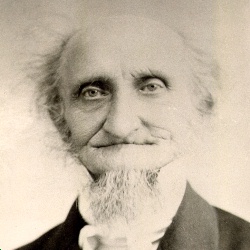
1885 Western District Essay
Obedience to Worldly and Secular Authorities
Doctrinal proceedings.
For twelve years, our district has discussed the following general topic at its annual synod meetings: “That only through the doctrine of the Lutheran Church is all glory given to God alone—irrefutable proof that its doctrine is the only true one.” After the first theses on this general theme had been presented as an introduction, showing why only that religion and, accordingly, only that church is true which gives all glory to God alone through all its doctrine, we then tested twelve main doctrines of our church and were delighted to see that our church also passed this test.
Those twelve main doctrines were as follows: 1) the Word of God, 2) the cause of sin, death, hell, and damnation, 3) Divine Providence, 4) The General Will of God, 5) The Atonement and Redemption of the Human Race, 6) The Justification of Sinners by Grace Alone Through Faith in Jesus Christ Without the Merit of Works, 7) The Necessity of Rebirth, Sanctification, and Good Works, 8) The Establishment, validity, power, and immutability of the means of grace, 9) of conversion, 10) of the election of grace, 11) of the invocation and worship of God, and finally 12) of obedience to men in matters of faith and conscience.
With the statement that even in this twelfth highly important doctrine, only the Lutheran Church gives all glory to God alone, we did not come to a conclusion at our last meeting (1883). We were initially only convinced that Lutheran doctrine decisively rejects all coercion of conscience exercised by human beings within the church. The last two theses concerning the doctrine of coercion of conscience, namely that no one should rule over faith and conscience even in the state and household governance, are before us this year.
Accordingly, our main topic today is once again the following:
That only through the doctrine of the Lutheran Church is all glory given to God alone, as is also evident from its doctrine of obedience to human beings in matters of faith and conscience.
Thesis VII.
The Lutheran Church further believes, teaches, and confesses according to God's Word that even secular authorities have neither the right nor the power to rule over the faith and conscience of their subjects.
(It should be noted in advance that each part of the following thesis refers to the passage in which people [respectively secular authorities] can demand obedience from us, in which we therefore have no freedom according to God's Word. On the one hand, this is intended to reject the abuse and misunderstanding that some associate with freedom of conscience, but on the other hand, it is also intended to show that the Lutheran Church is well aware of and respects the limits of this freedom set by God's Word, thus also giving glory to God in this matter.)
Thesis VII, 1.
The Lutheran Church believes, teaches, and confesses according to God's Word that a. subjects may not resist the secular authorities by force, even if they do them injustice, but that b. the secular authorities have no right to command their subjects to do what God has forbidden, or to forbid what God has commanded, or to compel them to do anything against their conscience.
According to Lutheran teaching, subjects must obey the secular authorities, whatever they may command, provided that they are not thereby compelled to act against their own conscience. The Lutheran Church declares the authorities to be God's servants. It is therefore not a matter of obedience to human beings as human beings, but to God's majesty itself, of which the authorities are a reflection. This also means, of course, that the authorities may not demand anything that violates the commandment of the one who is also their Lord. In such cases, obedience must be refused. In all other matters, however, their commandment is divinely binding.
We maintain that this doctrine of our church gives all honor to God. We cannot measure the honor that is due to God according to our reason or our feelings. We could easily be very mistaken in doing so. Calvin also believed that he was giving honor to God with his doctrine of absolute election and rejection, and yet with this doctrine he robbed God of the honor that is due to Him according to Scripture, the honor of His love and righteousness. The Word of God alone can judge this matter. Let us hear what it says about this.
Romans 13:1–7 is the basis for the doctrine of authority. First, it tells us who our authorities are. “Let every person be subject to the governing authorities, for there is no authority except from God.” Whether they came into office lawfully, whether they are pious, or whether they share our faith, cannot therefore be decisive here. Christianity allows secular orders to exist; it only wants to change the hearts of men. This is important for the spread of the Christian church. What godless prince would allow the Christian religion to enter his country if it condoned rebellion against those who came into office unlawfully or who abused their authority? It is also clear from this that anyone who emigrates to another country or travels through such a country is then again subject to the authorities under whose power he places himself. It should be noted here that at the very time when the Apostle Paul wrote this to the Romans, the bloodhound
Nero sat on the Roman imperial throne and used his power to cruelly torture Christians. But, says the Apostle, all that makes no difference; he has the “power”; thus he is the authority appointed by God. — We should be subject to the authorities that have power over us; otherwise, we sin not only against a human being, but against God Himself. "For there is no authority except from God, and those that exist have been instituted by God. Therefore whoever resists the authorities resists what God has appointed, and those who resist will incur judgment. “It is not merely a disturbance of the public peace when one resists the secular authorities, but actually a fight against the divine majesty. Therefore, we should”be subject for the sake of necessity,“but”not only for the sake of punishment, but for the sake of God and conscience." (v. 5.) We should also give Nero the honor he deserves (v. 7.), not only outwardly with gestures, but also in our hearts; for he has the power of the great God. That is why the apostle himself speaks in verses 3 and 4 of the works of the authorities in such a way that he completely disregards the state of the Roman authorities of his time and only considers the will of God in the establishment of the authorities. “Everyone” is required to be subject to the authorities, including preachers; it is antichristian when popes and priests exempt themselves from this general divine commandment.
In the Catholic and Reformed churches, conscience is not sharpened in this matter. History shows the consequences of this. While there has never been any talk of revolution among truly Lutheran citizens and in truly Lutheran countries, unless the Lutheran church had ceased to exist in them, even in times of the most terrible oppression of Lutherans, we read much in the pages of history about revolts against the authorities in Catholic and Reformed countries. The Lutheran Church can therefore sing with all its heart:
“What do you fear, enemy Herod,
That Christ, the Lord, is born to us?
He seeks no mortal kingdom,
He brings us the kingdom of heaven.” (Hymn No. 60, 1.)
1 Peter 2:13-17 is the second passage that belongs here. “Be subject to every human institution” (not as if the authorities were an institution made by men, but as a creation [κτίσις] of God among men) “for the Lord's sake.” And we owe obedience and honor not only “to the king, as the supreme authority,” but also “to the magistrates, as his messengers.” In our country, for example, it is not the president, Congress, etc., but the people who are
sovereign. But if we resist these officials appointed by the people, we resist the sovereignty of the people and thus God himself.
When the people of Israel, tired of their free constitution, demanded a king like the surrounding heathen nations had, Samuel had to proclaim to them, on God's command, “the rights of the king who would rule over them.” (1 Sam. 8: 9-20). They were not to resist his power, even if the exercise of that power involved flagrant injustice and arbitrariness. Yes, even if they cried out to the Lord about their king, they would not be heard, for whoever demands a real king should also know what his rights are.
Another passage is Matthew 26:51–52. One would think that if there ever was a time when a Christian could have resisted the authorities, it would have been at that moment when Peter saw the life of his Lord and Savior in danger. But Christ says, “Put your sword back in its place, for whoever takes up the sword will perish by the sword.” Christ declares that Peter's attempt to defend him against the servants of the Sanhedrin by using force is a robbery of the sword and therefore a sin worthy of death.
John 19:10-11 is an exceedingly wonderful passage. For there the Lord of glory Himself submits to the authority of Pilate and concedes to him that he has the power to crucify him. At the same time, however, He declares to him that he is committing a great sin if he uses the power given to him by God for this purpose.
Proverbs 24:21 warns everyone against associations that harbor rebellious plans.
All these passages tell us that we must not resist tyrannical authorities with violence. But the Lord gives us one permission in Matthew 10:23: “When they persecute you in one city, flee to another.” It is therefore not revolution when one withdraws from the power of the authorities without using violence. Thus, the Apostle Paul once fled from Damascus before the governor of King Aretas, who wanted to seize him. (2 Cor. 11:32-33)
We see that the Lutheran Church teaches this from its public confessions, as well as from the writings of its orthodox teachers:
This is stated in Article 16 of the Augsburg Confession: "The Gospel does not teach an outward, temporal, but an inward, eternal nature and righteousness of the heart, and does not reject worldly government, police, and marriage, but wants one to keep all these as a true order, and in such states to prove Christian love and truly good works, each according to his calling. Therefore, Christians are obliged to be subject to the authorities and to obey their
commands in everything that can be done without sin." (Article XVI. Müller's Book of Concord, p. 42 f.)
Apology of the Augsburg Confession: “The Gospel not only brings laws into the world order, but also commands and requires that we obey the laws and the authorities under which we live, whether they be pagans or Christians, and that we show our love in such obedience.” (Article XVI. Müller p. 215.)
Dannhauer makes it clear more than others what is to be understood by the “right” of a king. He writes regarding 1 Sam. 8:11: "That a king who is entitled to this right, even though he is a tyrant in practice, should not be attacked by force by his subjects, is easily proven: 1. from the divine description given in 1 Sam. 8: 'Now therefore obey their voice. But testify to them and proclaim to them the right of the king who will rule over them,‘vv. 9-18, where Samuel, in presenting the royal’right,' is undoubtedly not speaking of the just and lawful right; for Deut. 17:14-20 is far from consistent with this; nor does he speak of the mere fact (that the king will behave in this way), for there would be nothing special in this, since private individuals also do wrong to other private individuals; but rather of a fact with the effect of a legal obligation not to resist. Royal law is therefore such that it must not be resisted, but one may appeal only to God as the avenger of injustice. 2. From the apostolic admonition against resistance, Rom. 13:1, which had to be accepted no less by the tyrant Nero than by the milder lord Tiberius, who was more lenient toward Christians. 3. From the prohibition against encroaching on a foreign office, 1 Peter 4:15. For since the sword given according to Romans 13:4 is the business of the authorities, and the sword taken according to Matthew 26:52 is the business of the subjects, he who seizes it encroaches on a foreign office. 4. From the necessity of order and public peace, which cannot exist if everyone has the right of resistance, and degenerates into cyclopean existence." (Lib. conscient. I, 873)
(Calov and some other orthodox theologians even find the legal authority of a king described in 1 Sam. 8.)
Dannhauer also proves that one must also be subject to an authority that has come into office unlawfully, as follows: "This also includes the long-standing statute of limitations, which is recognized in Judg. 11:28; for if this did not apply, what rule would then be valid?
How many kings, if one goes back to their origins, have a legal claim to power?“”Otherwise, however,“Dannhauer adds,”the subject also retains for a short time the right that everyone has against a public enemy; but in such a way that, as long as the power to resist is lacking, the rule of the latter has binding force, not because it is right, but because it is probable that the one who has the right to rule would rather have what is commanded be valid in the meantime than have everything thrown into confusion by the abolition of laws and courts." (Lib. conscientiae, I, 872. sq.)
It is well known that the Romans acquired almost all their provinces through unlawful conquests; nevertheless, Christ submits to the Roman governor Pilate, and the apostles exhort all Christians of their time to be obedient to the Romans. For a time, as has been said, citizens have the right to oppose a conqueror and usurper who has invaded their country, as was the case, for example, in the time of Napoleon I. In such a case, every citizen is a soldier. But as soon as such a conqueror establishes himself, he becomes the authority that binds people to obedience, for he has the power that ultimately makes him the valid authority.
Spener expresses himself as follows on this subject: “It should be noted that the authority also has a divine calling, for it is” (according to God's word in Romans 13:4, 6) “God's servant, and yet such a calling is not always such that everything would have gone according to divine order, but rather it is a divine decree, and it proceeds in such a way that nothing divine can be found in it except the power itself.” (Theol. Bedenken. Hallische Ausgabe. IV, 523.)
Ad. Osiander: "The form of government is one thing, and power is another. Power, and indeed the highest power, denotes the rights of majesty, dominion, and sovereignty.... Aristocracy“(in which the nobles have power)”and democracy“(in which the people have power)”are accidental forms of government, which the Apostle in Romans 13:1 does not take into account, to which the subjects are not subject as such, but to the highest power, which is also found in aristocracy and democracy." (Colleg. th. VIII, 3.)
Luther: “I stand and will always stand with the party that suffers rebellion, as it always has unjust cause; and against the party that causes rebellion, however right it should always be.” (Faithful admonition to all Christians to guard against rebellion and revolt. From the year 1522. X, 413 [StL 10, 365; cf. AE 45:63])
Gerhard: “Augustine writes in his treatise on the City of God (6, 21): ‘He who gave imperial power to Constantine the Christian
also gave it to Julian the Apostate.’” (L. de magistr. § 79.)
Balth. Bidembach writes on the story of King Saul's attendants, who were ordered to kill the innocent priests of the Lord but did not carry out this order: “Although they did not kill the priests of the Lord, they did not take them from the king by force, but let it happen; for otherwise it would have looked like a revolt and rebellion against the king.” (Explanation of the 1st and 2nd Books of Samuel, p. 301.) —
According to modern constitutions in so-called constitutional monarchies, part of the sovereign power is reserved for a representation of the people, the estates, etc.
Dannhauer expresses his opinion on the extent to which the latter owe allegiance to the head of state in the following: "It is not right for a subject to take up the sword, which is in the full sense of the word and nothing more; however, if the king (only) has part of the supreme power, the other part being held by the people, the Senate, then the king, if he wants to seize the part that is not his, can rightly be opposed (also) by force, because he does not have sovereignty in this respect; which (as Hugo Grotius argues in his booklet on the right of peace and war) is also the case even if the power of war were in the hands of the king. For this is to be understood in terms of war against external enemies, since everyone who has a part of the supreme power must necessarily also have the right to defend and assert that part." (Lib. conscient. I, 871.)
The relationship between the German princes and the emperor in Luther's time was similar. Luther did not want to decide the question of whether the princes could resist the emperor by force if he exceeded his rights, but referred the decision to the lawyers; however, Luther ultimately relied on the same decision. When, during the Thirty Years' War, the emperor assumed rights and asserted them against the Lutherans, which did not belong to him according to the imperial constitution he had sworn to uphold, Lutheran theologians were prompted to distinguish between absolute and limited monarchy, as well as between pure subjects and those who share in sovereign rights, e.g., the estates of the empire. —
But what if the authorities demand that we do something that is sin? Then our church teaches that we must refuse to obey. God has not given us any such commandment that, by obeying it, we would have to transgress another of his commandments. For then we would be sinning, whether we chose to obey one or the other.
The second half of the first part of the thesis states:
The Lutheran Church believes, teaches, and confesses according to God's Word that the secular authorities b. have no right to command their subjects to do what God has forbidden, or to forbid what God has commanded, or to compel them to do anything against their conscience.
Note that our church does not teach that secular authorities have no right to permit anything, that is, to declare unpunishable what God has forbidden. They do indeed have this right. Even Moses, as a political legislator, permitted many things that the prophets condemn. The authorities do not have only Christians among them who are governed by God's Word; nor should they actually govern the state, which is not an institution for the salvation of souls but for the protection of body and property, according to God's Word, but according to reason. However, a prohibition by God does not lose its binding force through the permission of the authorities. If, for example, the authorities license sinful pleasures, divorces for trivial reasons, or the keeping of drinking establishments, a Christian cannot make use of this permission. The authorities must permit such things for the sake of the “hardness of heart” of their subjects, in order to avoid rebellion, murder, and manslaughter. Therefore, when the Pharisees once asked Christ the question in order to gloss over their false doctrine on divorce: “Why then did Moses command that a certificate of divorce be given and that she be divorced?” Christ answered, “Moses allowed you to divorce your wives because of the hardness of your hearts, but from the beginning it was not so.” Matthew 19:7-8.
However, the authorities have no right to command sin. If they do so nevertheless, God's commandment takes precedence over the commandment of the authorities. We see this clearly from the passages cited. When Christ adds the admonition “And give to God what is God's” to the words “Give to Caesar what is Caesar's” in Matthew 22:21, the latter is clearly a restriction of the former. Christ means to say: There is a King above all kings; therefore, His commandments are far above the commandments of all human kings. If the latter contradict the former, they are null and void; indeed, they must not be obeyed under any circumstances, lest one take away the glory from God.
This is how the Church of God has always acted. Acts 4:18-19 recounts the example of the apostles, who did not cease to proclaim the name of Christ on his command, even when the Sanhedrin forbade them to do so and punished them for it. They therefore establish the rule in Acts 5:29: “We must obey God rather than men.”
1 Samuel 22:17 recounts that Saul's guards did not carry out their king's command to kill the priests of the Lord, because they
knew that it was no crime for those priests to support David, who had already been anointed king by God's command. — Another example is that of Shadrach, Meshach, and Abednego, who refused to worship the golden image despite Nebuchadnezzar's command (Dan. 3:1-30), as well as the example of Daniel, who prayed publicly to the true God three times a day, even though Darius had issued a strict command that for thirty days no one except him should be asked for anything. (Dan. 6:5-10.) Finally, the story of the midwives in Egypt (Ex. 1:17-21) belongs here, who, out of fear of God, did not carry out Pharaoh's cruel command, but let the Hebrew boys live, for which God rewarded them with temporal blessings.
The Lutheran Church teaches this in complete accordance with Holy Scripture.
The Augsburg Confession states: “If the command of the authorities cannot be obeyed without sin, one must be more obedient to God than to men. Acts 5:29.” (AC XVI, 6-7)
What is the work of the Lutheran Reformation other than obedience to the words: “One must obey God rather than men”? Blind Pharisees see the Reformation as a rebellion against the authorities. It was not. Only in obedience to the commandment of God, the supreme Lord, did the purified church not submit to the commandment of the secular authorities, who wanted to force it into false worship.
In his 1523 treatise “On Secular Authority, How Far One Owed Obedience to It,” Luther says: "The secular government has laws that extend no further than body and property and what is outwardly on earth. For God can and will allow no one to rule over the soul except Himself alone. Therefore, where secular power fails to give law to the soul, God intervenes in its rule and only seduces and corrupts souls." (X, 452; [StL 10, 395; cf. AE 45:105])
Miesler also gives a very good reason for this when he writes: "Actually, directly, immediately, and in itself, conscience connects nothing except divine law. 1. Because conscience or the soul is actually subject only to God. 2. The rule of conscience is the law of God written in the heart. Rom. 2:15. Human (civil) laws, however, must be observed for the sake of conscience before God. Rom. 13:5: ‘Be subject, then, for the sake of necessity, not only because of punishment, but also for the sake of conscience’; because God's law has established this order and authority and commands that the same submission and obedience be rendered." (Opus novum quaest. practico-theol. fol. 543.)
The godly jurist Reinking says: "When a godless Saul commands his attendants to kill the Lord's priests and shed innocent blood (1 Sam. 22: 17), no honest servant should or must carry it out, unless it is commendably recorded by the Holy Spirit in Scripture that, on the command of their king, they do not want to lay their hands on the priests of the Lord to kill them, contrary to God's commandment and the love of their neighbor." (BiblischePolizei, Book II. Axiom 54.)
Luther wrote the following in 1524, when a man from Orlamund wanted to ask the Elector whether he could take a second wife to his first: “If he is otherwise uncertain, he cannot be sure through the consent of the prince, whose office it is not to decide anything in this matter, and since it is the office of the priests to answer God's Word, from whose mouth one must seek the law of the Lord, as Malachi (2:7) says.” (Letters, collected by de Wette II, 459.) Cf. Matthew 19:7–9.
But just as the permission of the authorities does not excuse an action that God has forbidden, neither does it justify before God that one allows oneself to be forced by the authorities to do something sinful. For example, a Christian soldier should rather give up his life than go to war at the behest of his king in an unjust war.
Balth. Bidembach writes on this subject: "Soldiers who serve a lord in unjust causes are also doing wrong; burning several miles of road, robbing, murdering innocent people, etc., and their supposed excuses are of no value, that they say: Well, I don't know whether the lord is right or wrong; I will let him answer for it. No, don't you know what St. Paul says: ‘Each one shall bear his own burden,’ and if you don't know whether he is right or wrong, why don't you stay at home? Who is forcing you? You are guilty of all the evil that is done there. *) And even if you are chosen and see that wrong is about to be done, you should still not help. Or you must not say: If I don't do it, someone else will. No, let Doeg do it, keep your hands clean. It would be good if no one did it; but if someone must do it, it is much better for you that someone else does it than you. God says, “Thou shalt not kill,” thou shalt not do it, let another do what he will, see to thyself. No one will go to heaven or hell for thee. Each one will bear his own burden, as has been said." (Explanation of 1 and 2 Samuel, p. 302.)
The following testimonies provide scriptural clarification on all kinds of difficult moral issues that belong here.
__________
*) At that time, soldiers were usually not conscripted, but recruited.
Luther: “What if a prince” (who goes to war) "is in the wrong, are his people still obliged to follow him? Answer: No, for no one ought to act against justice; rather, ‘one must obey God (who demands justice) rather than men’. Acts 5:29. — What if the subjects did not know whether he was right or not? Answer: Because they do not know, nor can they find out through diligent inquiry, they may follow him without danger to their souls. For in such a case, one must apply the law of Moses, Exodus 21:13, where he writes that a murderer who kills someone unwittingly and unwillingly shall be acquitted by fleeing to a free city and by the court. (On secular authority, to what extent one is obliged to obey it. X, 475; [StL 10, 413; cf. AE 45:125f.])
The same: “What if my lord is wrong to wage war? Answer: If you know for certain that he is wrong, you should fear God more and”obey God rather than men," Acts 5:29, 29, and you shall not fight nor serve; for you cannot have a good conscience before God. Yes (you say), my lord compels me, takes my fief, does not give me my money, wages, and pay, and on top of that I would be despised and reviled as a coward, yes, as a traitor before the world, who abandons his lord in times of need, etc. Answer: You must dare to do this and, for God's sake, let go of what is going on; he can well repay you a hundredfold, as he promises in the Gospel, Matthew 19:29: “Whoever leaves house, farm, wife, and possessions for my sake shall receive a hundredfold in return,” etc. One must also expect such danger in all other works, since the authorities compel one to do wrong. But since God also wants us to forsake our father and mother for his sake, we must of course also forsake our master for his sake, etc. But if you do not know, or cannot find out, whether your master is unjust, you should not weaken your uncertain obedience for the sake of uncertain justice, but rather do your best for your master in a loving manner. For “love believes all things and thinks no evil” (1 Cor. 13:7). In this way you will be safe and will conduct yourself well before God. “(Considerations on whether soldiers can also be in a blessed state. 1527. X, 614 f. [StL 10, 524 f.; cf. AE 46:130 f.])
The same: “But this is my faithful advice, that if the emperor were to raise an army and wage war against us for the sake of the pope's affairs or our doctrine, as the papists now boastfully and defiantly proclaim (but I do not yet consider myself the emperor), that in such a case no man should allow himself to be used for this purpose, nor be obedient to the emperor, but be certain that it is strictly forbidden by God to obey the emperor in such a case, and whoever obeys him should know that he is disobeying the dear Lord and will lose his body and soul for eternity. For the emperor then acts not only against God and divine law, but also against his own imperial rights, oaths,
duties, seals, and letters. *) [*) Therefore, passive disobedience is also permitted, indeed commanded, for private individuals.]... The first reason why you should not obey and fight for the emperor in such a case is this: that you (as well as the emperor himself) have sworn at Baptism to keep the Gospel of Christ and not to persecute or dispute it. Now you know that the emperor is being incited and deceived by the pope to fight against the Gospel of Christ, because our doctrine has been publicly declared at Augsburg to be the true Gospel and Holy Scripture. And you shall say to the summons of the emperor or your prince: Yes, dear emperor, dear prince, if you keep your oath and duty made at Baptism, you shall be my dear lord, and I will be obedient to you if you wish. But if you do not keep your baptismal duty and Christian covenant made with Christ, but persecute it, then let a rogue be obedient to you in my place, for I will not blaspheme my God and persecute His Word for your sake, and so boldly run and leap with you into the abyss of hell." (Warning to his dear Germans. 1531. XVI, 1985. 1991 f. [StL 16, 1641, 1647; cf. AE 47:30, 35])
The same tells a wonderful example of this from ancient church history. "The dear holy martyrs, St. Moritz and his companions, when the emperor ordered them to fight against the Christians, did not want to do so, threw away their weapons and said: if he wanted to fight against the Christians, he should not look for others, they themselves were there as Christians, ready to suffer whatever he wanted. So you too should serve the Turks in such a way that you do not strive against Christians or against God, but only help his house and his possessions for the best." (Army sermon against the Turks. From the year 1529. XX, 2739 f. [StL 20, 2193;]) **)
**) According to Kurz, the essence of this story told by Theodoret is that St. Mauritius, as tribunusmilitum (commander-in-chief), was executed on Maximian's orders (around 286) in Apomea in Syria with only 70 soldiers. Others claim that an entire legion (6600), the Legio Thebaica, was slaughtered.
When, in 1542, Duke Moritz (about whom Luther once said, when asked about Elector Johann Friedrich: “Take care, gracious lord, that you do not raise a young lion.” Wernicke's Weltgesch. Vol. III. Section 1. p. 113) wanted to force free passage through the electoral city of Wurzen by force of arms, Luther wrote the following to both parties (Elector Johann Friedrich and Duke Moritz): “And since God is for him (for me, yes, you, my dear Lord Jesus Christ, together with all who pray with me, will graciously protect him), that a prince or province” (= provincial estates) "should deny peace and justice and run counter to God and pursue vengeful wrath: in that case, which God graciously avert, I will side with the party, be it my most gracious lord, the elector and provincial estates, or
my gracious lord, Duke Moritz and provincial estates (for there is no hypocrisy here, I speak before God to my conscience), I say, in that case, I will side with that party that offers peace and justice, can suffer, and desires it. For even if the other side had the highest right and could justly use anger, it condemns itself by taking God into its own hands, wanting to be judge and avenger itself, and thereby forcing the opposite of self-defense and judging it with its actions and making it innocent, but destroying itself with the law, as has been said above. For it is said: “Quodjustum est, justeexequaris” (What is just, you must also execute justly). “Et mea est vindicta” (And vengeance is mine). And then that party that seeks justice and peace shall defend itself confidently and cheerfully, and praise only that I have commanded, advised, and admonished it in God's stead. For I will take upon myself the blood and damnation of that party, and must do so well. And if it should come to pass, God forbid, that you should go to war or otherwise come to attack, then bow your heads here toward Wittenberg to us and receive our hands, which I hereby also promise, for the forgiveness of sin, as those who defend themselves out of necessity and willingly " (judicial decision) "and thus also be righteous before God in this matter, and believe in our absolution. After that, be confident and fearless, let your spears and guns go to the children of strife, anger, and vengeance; God's will be done: whoever dies, dies blessed“(insofar as this matter is concerned),”in obedience and self-defense, to protect his prince and country. We must not fear death from a living devil, much less from mortal poor human beings. To the other vengeful, unpeaceful crowd, I hereby proclaim that they should know and have no excuse on the Last Day and Judgment Day that they have excommunicated themselves and given themselves up to God's vengeance and, if they perish in war, they must be eternally damned with body and soul. For they not only wage war without faith, but also bring evil consciences into battle in worldly law. And I also faithfully advise that whoever fights under such a quarrelsome prince should run as fast as he can from the battlefield, save his soul, and leave his vengeful, senseless prince alone to fight with those who want to go to hell with him. For no one is compelled, but rather forbidden, to obey princes and lords or to keep oaths to the damnation of his soul, that is, against God and justice. It is said: ‘Hoc possum, quod jure possum’ (I can do what I can do by right)." (Admonition to peace to Elector John Frederick and Duke Maurice of Saxony, concerning the sudden uprising that arose around Würzburg. Anno 1542, April 7. XVII, 1813 ff. [StL 17, 1444 ff.])
Six days later, Luther writes to Amsdorf: “We have committed these war disturbances to God the Father through faithful prayers and do not cease, being certain that everything is being directly instigated by Satan himself on the part of Duke Moritz, this furious and arrogant young man. The whole matter is supposed to be about Moritz's free passage through Würzburg.” (See Luther's letters from de Wette. Vol. V, p. 461 [StL 17, 1446])
When the emperor wanted to forbid the Protestant estates in Augsburg in 1530 from allowing their preachers to preach in Augsburg during the Imperial Diet, explaining that his conscience commanded him to demand the cessation of the sermons, Landgrave Philip of Hesse took the floor and said: “His Imperial Majesty's conscience is not lord and master over our conscience.” (See: Herzog's Real-Encyklopädie, 2nd edition. Vol. XI, p. 585.)
Thesis VII, 2.
The Lutheran Church further believes, teaches, and confesses according to God's Word that a. the secular authorities are indeed obliged to protect the church in its freedom against injustice and, insofar as they (the authorities) consist of persons who are members of the church, to serve it with their power, but that they b. have neither the right nor the power to usurp the government of the church and to compel it to adhere to the true faith, or what they consider to be the true faith.
a. We so-called Missourians are suspected of wanting to deny the authorities any influence over the church and of viewing those princes, who once did so much for the Lutheran church and suffered so much for it, with blind fanaticism and shameful ingratitude toward men who, by encroaching on a foreign office, have godlessly assumed dominion over the church and thus laid the foundation for the present disastrous enslavement of the church under state authority. But this is an injustice to us. Rather, we remember the old Lutheran princes with deep reverence and the most heartfelt gratitude for the many benefits they bestowed upon the church at the cost of the greatest sacrifices, endangering their bodies and lives and enduring the reproach of Christ. For although, according to God's Word, the authorities should not rule in the Church, they nevertheless have the general duty to take care of the Church as a society within the state. Without claiming special privileges for our church from the authorities, we nevertheless demand that they respect our freedoms and
rights the same protection that all other societies within the state enjoy. We are convinced that just as the authorities, when they neglect some of their subjects in favor of others, neglect their duty to exercise justice, namely to give each his due (suum cuique), so too they act contrary to their duty as authorities when they protect other communities within their territory in their freedom but deny this protection to the church. We therefore highly praise our local authorities for not only refraining from interfering in the government of the church themselves, but also for not tolerating others interfering in it. However, we are convinced that those in authority have a double obligation to do so if they themselves are members of the church, because every Christian should put his gifts at the service of Christ and his kingdom.
Thus we find the authorities described in the prophecies of Isaiah 49:23 and 60:16, where the Lord says to Zion: “The kings shall be your guardians, and their princesses your nursing mothers.” — "The kings' breasts shall nurse you; that you may know that I, the Lord, am your Savior, and I, the Mighty One of Jacob, am your Redeemer." In Germany, people believe that they are living in fulfillment of these words. But the opposite is true. The authorities oppress and persecute pure doctrine and fill the pulpits and chairs with those who undermine the foundations of the house of God.
Acts 23:10-31 and 21:30-40 tell how the Roman captain protected the apostle Paul in the exercise of his office from the hostilities of the Jews. The judge Gallio in Corinth, on the other hand, violated his official duty by allowing Sosthenes to be beaten before his judgment seat for the sake of religion (Acts 18:17).
1 Tim. 2:1-2. Christians are exhorted to pray for the authorities, “that we may lead a quiet and peaceable life in all godliness and honesty”; thus indicating in the most glorious way the duty of the authorities toward the church, not only when the authorities are also members of the church, but especially then.
We therefore wholeheartedly profess the following passage from the Smalcald Articles: "Especially, kings and princes, as the most distinguished members of the church, should help and see to it that all kinds of error are removed and that consciences are rightly instructed, as God especially exhorts kings and princes to do in Psalm 2:10: ‘O ye kings, be wise; ye judges of the earth, be just.’ For this should be the foremost concern of kings and great lords, that they diligently promote the glory of God. Therefore, it would be unjust if they were to use their power and authority
to preserve such abominable idolatry and countless other vices and to allow pious Christians to be so miserably murdered... But since the judgments are those of the councils of the Church, and not those of the Pope, it is incumbent upon kings and princes not to allow the Pope such license, but to ensure that the Church's power to judge is not taken away, and that everything is judged according to the Holy Scriptures and the Word of God." (Treatise On the Power and Primacy of the Pope, § 54, 56.)
Admittedly, this passage is often cited as proof that, according to Lutheran doctrine, the state must govern the church. But the word “especially” already indicates that this refers to a general Christian duty, which Christian princes are better able to exercise in their high position. That is why they are not referred to here insofar as they are princes, but insofar as they are members of the church.
The following, among other things, serves as proof that Luther really meant it this way. He writes: “The calling and election of orthodox ministers is not actually and originally a matter for the authorities, but for the church. But if the authorities are faithful and members of the church, then they call them, not because they are authorities, but because they are members of the church.” (UnschuldigeNachrichten. Year 1715. p. 383)
The same: "Our secular rulers must now be emergency bishops and protect us pastors and preachers (since the Pope and his gang do not do so, but rather oppose it), and help us so that we can preach and serve churches and schools; as Isaiah says (chap. 49:23):,Reges nutricii tui', kings shall nourish you and queens shall suckle you; as they did in former times, almost too abundantly, and where the Gospel has made them pious, still do." (Example of consecrating a true Christian bishop, from the year 1542. XVII, 154 [StL 17, 113])
The same: “If they (the authorities) prevent the churches from censuring and punishing and do not allow or permit the excommunication, as Christ himself instituted and commanded, they thus promote, foster, and contribute to offenses, and will be transformed from servants of God into serfs of the accursed devil in hell.” (Explanation of the Prophet Joel. 1545. VI, 2406.)
The pious Duke Albrecht of Prussia himself also expressed this view. In 1530, he wrote: “We are compelled to take on a foreign office, namely that of bishop.” (Real-Encyklop. XXI, 127.)
In the opinion of the Wittenberg theologians to the imperial estates from 1530, we read: “For the order that bishops are set over priests as superintendents has undoubtedly had many honest causes. For priests must have superintendents. Thus, the secular princes will not wait continue much longer to serve in the role of church government.” (Corpus Ref. II, 284.)
Far from considering the so-called ecclesial acts of the princes to be princely official acts, they were rather seen as burdens that the princes bore only provisionally and would soon shake off.
How important were the services rendered to the church by the Lutheran princes of the Reformation period! What would have happened if the Elector of Saxony had not prevented Luther from having to follow the Pope's summons to Rome? In any case, he would not have returned to Germany alive. What would have happened if the same Elector had not brought Luther, who was under anathema and imperial ban, to safety at Wartburg Castle? Consider also the efforts of the pious Elector Augustus to bring about the Formula of Concord. At his own expense, he held 15 meetings, to which theologians from foreign countries were also invited. It is reported that this alone cost him nearly a ton of gold. — b. On the other hand, however, we find in God's Word that even a pagan, the governor Gallio, brother of the philosopher Seneca, once recognized that the authorities had neither the right nor the power to usurp the government of the church and to compel people to embrace the true faith, or what they considered to be the true faith. For we read in Acts 18:12-16: "But while Gallio was proconsul in Achaia, the Jews made a united attack on Paul and brought him before the tribunal, saying, 'This man is persuading people to serve God contrary to the law. But when Paul was about to open his mouth, Gallio said to the Jews, “If it were a matter of crime or wickedness, dear Jews, I would listen to you, but since it is a question of doctrine and words and the law among you, see to it yourselves; I do not intend to be a judge over you.” And he drove them from the judgment seat. The Holy Spirit undoubtedly had this story recorded, among other things, so that people would know in matters of doctrine, the secular authorities as such have no right to pass judgment. The dogmatists of the 17th century deviated here from Scripture and confession in favor of the state churches and call it Gallionism when one denies the secular authorities as such the right to judge right and false doctrine by virtue of their office.
This is taught just as clearly in John 18:36-37. According to this, Christ, the King of Truth, does not have a kingdom of this world and therefore does not want his kingdom to be defended with secular weapons. That is why Christ also says to his disciples James and John, who wanted to call down fire on the Samaritans who did not want to receive Christ: “Do you not know what kind of spirit you are of?” (Luke 9:52-56).
It is therefore contrary to Christ's kingdom and spirit to try to force people to the true faith by external force. God therefore cannot be pleased with a war waged for the spread of religion. Only to protect the persons of the professed followers of a religion against the persecutors of that religion can a religious war be pleasing to God under certain circumstances. God does not want subjects who are subjugated to him with worldly weapons. He is pleased only with those who “willingly sacrifice to him in holy adornment.” (Ps. 110:3) God had also ordained religious freedom for the Jews. According to Exodus 12:45, 48, they were not to force anyone to convert to their religion. Nor did they do so when they subjugated their neighboring peoples.
Does our church now give God the glory in this as well? Yes, praise God! In this as well. Far from subjecting matters of religion and the church to the decisive official authority and physical coercive power of the secular authorities, it rather teaches and professes that the secular authorities as such have nothing to do with spiritual and soul matters, that is, with matters of religion and the church.
Thus, for example, we read in the Augsburg Confession: “The secular government deals with many other things besides the Gospel; its power protects not souls, but bodies and property against external violence with the sword and corporal punishment. Therefore, the two governments, the spiritual and the secular, should not be mixed and conflated.” (Art. 28, 11-12) Furthermore, in the
Apology of the Augsburg Confession: "This whole doctrine of the difference between the kingdom of Christ and the civil kingdom has been usefully explained in the writings of our people, namely, that the kingdom of Christ is a spiritual one, that is, one in which the knowledge of God, the fear of God and faith, eternal justice and eternal life, but meanwhile, outside of it, allows us to use the lawful civil orders of whatever peoples among whom we live, just as it allows us to use medicine, or architecture, or food, drink, and air." (Müller p. 215, § 54.)
Brenz therefore writes explicitly: "When Christ says, ‘Tell it to the congregation’ (Matthew 18:17), this is not to be understood as a large assembly or congregation (Acts 19:32), in which the secular authorities are present and, in accordance with their profession, uphold the public honorability of life; Rather, it is to be understood as a small assembly (Matthew 18:17), of which the secular authorities are not members and in which the authorities either have no business or are regarded as private individuals, such as the assembly that followed Christ." (In scripturas Matth. commentar. 1566. fol. 602.).
When, in 1530 in Augsburg, the papists pressed Melanchthon with the argument that the bishops were also secular princes and that one must therefore obey them for that reason if one did not want to be guilty of the sin of rebellion, Luther replied to the question put to him by Melanchthon on this subject with the following, among other things: "A bishop as bishop has no power to impose any statutes or ceremonies on his church without the consent of the church in clear words or by tacit agreement. Because the church is free and the mistress of the house, and the bishops do not rule over the faith of the church, nor may they burden and harass it against its will. For they are only servants and stewards... The bishop as prince can the church even less impose anything; for that would mean mixing the two authorities, and then he would truly be an allotrioepiscopus or a bishop who meddles in foreign affairs; and if we allowed him to do so, we would be guilty of the same ecclesiastical robbery. Here one must rather give up one's life than allow such godlessness and injustice. I speak of the church as something special from the police. The bishop as a prince can impose and command whatever he wants on his subjects as subjects, as long as it is pious and right; and the subjects must obey. For they do not obey as a church, but as citizens. For the same person leads a double life. So when Conrad von Tüngen commands his Franconians as Duke of Franconia to fast or do something else that is permitted, he compels those who recognize the duke to obey, but not those who recognize the bishop, namely those who are under the authority of other princes, even though they belong to the Church of Würzburg. Just as Pomeranus compels his servant to obey his house rules, but not the church in Wittenberg. So when the emperor commands everyone to fast, those who are in the church also obey, because the church is under the emperor according to the flesh, but not as a church." (Answer to the Questions Sent about Human Statutes. 1530. XVI, 1207 f. [StL 16, 1014 ff.])
We Lutherans also celebrate the so-called National Day of Thanksgiving every year, which our governors and presidents recommend that we celebrate; but we would not do so if they ordered it by virtue of their office.
Now it is declared in Germany to be a characteristic peculiarity of the Lutheran Church that it places the government of the church in the hands of the secular authorities, or rather the respective sovereign. In this connection, reference is often made to the fact that in 1527 Luther persuaded the electors to conduct a church visitation in Saxony. Furthermore, he later worked for the establishment of a consistory, which, in the name and authority of the prince, was to arrange everything in the churches, appoint and dismiss pastors,
decide on emerging heresies, and make all kinds of church laws. Luther thus gave preference to the so-called episcopal system among all forms of church government, according to which the sovereign is also a kind of bishop of the church of his country. Luther thus rejected not only the territorial system, according to which the sovereign has full power over the religion of his subjects, but also the collegial system, according to which the church governs itself.
However, history teaches us otherwise. It was only the great need that moved the warm heart of the elector, on the advice of Luther and other theologians, to take charge of the visitation and later to appoint the consistory. For it was easy to see that if, after the abolition of the government of the papal bishops, no other external connection was created by any supervisory authority for the many isolated individual congregations, which, moreover, often remained in the deepest ignorance together with their preachers, the church would soon have to fragment and crumble, unity in faith would become impossible, and an obvious Babel would arise. However, the Elector did not act in his official capacity, but out of a duty of love as the man best suited to the task. Incidentally, the consistory originally had no jurisdiction at all; it was only an advisory body. Only later did it acquire more and more legislative power, until finally it came to the point where enemies of Christ ruled over the church in the consistory and the church could no longer rid itself of them. That this was completely contrary to Luther's intention and opinion can be seen, among other things, from the preface to the “Instruction for Visitors,” where Luther writes: "Now that the Gospel has mercifully returned to us through the abundant, inexpressible grace of God, or rather, has first dawned upon us, through which we have seen how miserably Christianity is confused, scattered, and torn apart, we would have gladly seen the same rightful episcopal and visitation office restored, as it is most necessary; but since none of us had been called to do so or had received any specific command, and since St. Peter does not want anything to be done in Christendom unless it is certain that it is God's work (1 Pet. 4: 11), none of us dared to undertake it before the others. So we wanted to act according to our conscience and, out of love (which is common and commanded to all Christians), we humbly and diligently petitioned His Serene Highness, the noble Prince and Lord, Lord John, Duke of Saxony,... as the prince of the land and our certain worldly authority, ordained by God: that His Electoral Grace, out of Christian love (for they are not bound to do so by secular authority) and for God's sake, for the good of the Gospel and for the benefit and salvation of the miserable Christians in His Electoral Grace's lands, graciously
wished to call and appoint certain capable persons to such office. Which His Electoral Grace has graciously done and accomplished through God's good pleasure... And although we cannot issue this as a strict commandment, lest we raise new papal decrees, but rather as a history or story, and as a testimony and confession of our faith: we nevertheless hope that all pious, peaceful pastors who take the Gospel seriously and desire to do so will agree with us, as St. Paul teaches in Phil. 2: 2, that we should do, will not despise the diligence of our sovereign and most gracious lord, nor our love and good intentions, with ingratitude and pride, but willingly, without compulsion, submit to such visitation in a loving manner, and live peacefully with us, until God the Holy Spirit brings about something better through them or through us." (Instruction of the Visitors, from the years 1528 and 1538. X, 1905 f. 1909.)
Therefore, Luther fought earnestly against the consistories as soon as he saw that they wanted to become “spiritual authorities.” After the Wittenberg consistory was established in 1539 without any jurisdiction, Duke Moritz established consistories with state-church authority in 1543 by decision of the estates. Luther therefore wrote about this on October 22, 1543, to Daniel Greser, superintendent in Dresden: "I can hope for nothing good, dear Daniel, from the kind of investigation that has been undertaken at your court. For if the courts want to govern the church as they please, God will give poor blessings and the latter will be worse than the former; because what does not come from faith is sin; but what happens without vocation happens, without question, without faith and passes away. Accordingly, they may either act as pastors themselves, preach, baptize, visit the sick, administer the Lord's Supper, and take on all priestly duties—or they may cease to mix their calling; rather, they may take care of their court and leave the church to those who are called to it and who will also give account to God for it; for it is not at all tolerable that others should concern themselves with that for which we are to give account. The offices in the church and at court must be distinct, otherwise we burden both. Satan remains the adversary: under the pope, he mixed the church with the secular government; in our time, he wants to mix the secular government with the church. But with God's help, we resist and strive with all our might to keep the professions separate." (XXI, 1325 f.)
The same: "The Pope has brought the oral sword [or spiritual authority] into secular government; thus the Word of God is lost. Now the tide is turning.
For they are turning the office of the fist into a verbal office, and the secular lords want to rule the spiritual government and govern the pulpit and the church, so that I should preach what the prince likes to hear... Now that the law” (the Old Testament) “has been abolished, the iron sword has been handed over to the secular emperors, kings, and princes, but the verbal sword has been given to the apostles and us preachers. So it shall remain; let those who can help themselves do so. For if the princes want to mix these things together, as they are doing now, may God graciously help us that we do not live long, so that we do not see such misfortune; for then everything in the Christian religion must fall to ruins. As happened under the papacy, when the bishops became worldly princes. And if now the worldly lords become popes and bishops, so that they are preached to and told what they like to hear, then the wretched devil will preach at that time; he will preach too." (Excerpt from the 1st and 2nd chapters of John from the year 1537. 1538. VII, 1744 f. [StL 7, 1791 f.; cf. AE 22:227 f.])
Therefore, Luther finally declared: “We must tear apart the consistory, for we want, in short, to have neither the lawyers nor the pope” (papal law, jus canonicum, according to which the lawyers began to decide in the consistories) “inside. The lawyers do not belong in ecclesiam” (in the church) “with their lawsuits.” (Table Talk. XXII, 22, 10.)
Even Emperor Constantine the Great, with whom, according to some, the heyday of the Christian Church is said to have begun, while in reality the decline of the Church began with him, declared to the bishops: “You are bishops of the internal affairs of the Church, but I believe that I am appointed by God as bishop of foreign affairs.” 'Υμείς των εισω της εχχλησίας, εγώ δέ των έχτός υπό ϑεοΰ χαϑεσταμενος επίσχοπος αν ειην (Eusebius, vitaConstant.. IV, 23–24.)
While the early Lutheran Church, according to the writings of its theologians and its public confessions, adhered to the doctrine that the authorities had neither the right nor the power to seize control of the church, it was precisely Calvin who established and implemented the principle that the secular authorities as such had a duty to govern the church, albeit with the advice of theologians. *)
*) Ranke also writes of Zwingli: “He believed that the congregation was adequately represented in the Grand Council, both ecclesiastically and politically.... The latter exercises power.” (p. German History at the Time of the Reformation. III, 74.
But unfortunately, later Lutheran dogmatists have deviated far from the doctrine of our church in this matter.
Baier writes: "The power and office of the authorities extends to everything on which the welfare of the state depends, and therefore equally to civil and sacred matters, but in different ways.
... For civil matters are subject to the authority of the government, so that it can impose any laws and establish any institutions it sees fit, provided they do not conflict with natural and divine law.... But as far as sacred matters are concerned, the doctrines of faith are not subject to the authority of the government; moreover, the government is obliged to observe and practice those acts which God has commanded and which are common to all Christians, but it must leave those which are peculiar to the ministers of the church to them and may not claim them for itself. However, since everything else that belongs to the service of God and serves either to preserve the true religion or to restore it when it has fallen into decline is usually counted among sacred matters, it must be recognized that this belongs in its own way to the authority of the government.... In particular, as far as the care of religion and worship (sacrorumcuram) is concerned, it is the responsibility of the authorities to appoint competent church servants, to build and maintain schools and church buildings, to ensure the decent maintenance of church servants, to establish visitations and councils, to enact and enforce ecclesiastical laws (tueri), to administer church property, to maintain church discipline, to conduct investigations against heretical and godless church and school ministers as well as against any similar persons, and to compel them to appear in court, to punish those who are accused of heresy or crimes, to abolish manifest heresies and idolatrous worship condemned by the church, and to ensure that the church is cleansed of them, etc." (Compend. th. pos. P. III. cap. 15. § 4. 5. 6. 8.) Regarding § 4, a note states as proof that the power of the secular authorities also extends to holy things: “This was known even to the pagans. In the Old Testament, however, the guardianship of the entire law concerning both tablets of the Ten Commandments was entrusted to the princes. See Deut. 17:18-19; Josh. 1:7; 2 Kings 11:12; 2 Chron. 23:11.” — In § 10, the examples of David (1 Chron. 24 and the following chapters) and Jehoshaphat (2 Chron. 19:8 and 20:3) are cited as proof that the authorities have the right to enact ecclesiastical laws. — Furthermore, as proof that the secular authorities must use their power against heretics, it is stated: "See the examples of Solomon, who removed Abiathar from his priesthood, 1 Kings 2:26, 27; King Asa, who drove the harlots out of the land and abolished the uncleanness of idols, 1 Kings 15:12; of Jehoshaphat, who abolished the high places, 2 Chron. 17:6; of Hezekiah, who, after abolishing corruption and abominations, restored the service of the sanctuary
almost completely, 2 Kings 18:4 and 2 Chron. 29:5 ff.; of Josiah, who did something similar, 2 Kings 23:5 ff. 2 Chron. 34:3 ff."
It is hardly possible to confuse and mix the worldly and ecclesiastical government with the clear testimony of our church in its fundamental confession, as our dear Baier does here. What applies only to the church of the Old Testament, which according to God's will was to be united with the state until Christ came, in order to form a theocracy, is here transferred to the church of the New Testament, and what befell David, Josiah, etc., is readily attributed to all princes and supreme secular authorities, thus establishing an obvious princely papacy (Caesaropapism)! God have mercy on us!
It is equally far from the true Lutheran Church to call upon the help of secular authorities to compel those outside to embrace its faith. Unbelievers seek to justify their rejection of the Christian religion by pointing to the blood (allegedly) shed by the church. And they say with good reason: a church that resorts to such measures for its expansion or preservation cannot possibly be the true church. But we Lutherans can confidently reply: Show us even one case where the truly Lutheran church has incurred such blood guilt or even approved of it! On the contrary, our church teaches that no one should be forced to believe, indeed, that this is not even possible, because external force cannot change the soul. Luther says, for example, in the preface to the Small Catechism: “Although no one can or should be forced to believe, one should nevertheless keep the flock together and drive them so that they know what is right and wrong among those with whom they live, feed, and want to live.” (Preface. Triglotta p. 535) Further down, Luther writes: “We should not force anyone to believe or to receive the sacrament, nor should we impose any law, time, or place, but preach in such a way that they urge themselves without our law and (as it were) force us pastors to administer the sacrament.” (Ibid. p. 538)
The false church, the Reformed and especially the Catholic church, has stained itself with the blood of those who did not want to accept its faith. One thinks of the so-called Paris Blood Wedding [or “St. Bartholomew's Day massacre”] of 1572, celebrated by the Papists, that most gruesome of all events reported in world history, which the “most holy father” in Rome sanctioned with cannon salutes from the Castel Sant'Angelo, the minting of a jubilee coin, a solemn Te Deum, and the proclamation of a jubilee year! Without doubt, it is with reference to this that the princes of the Augsburg Confession wrote a few years later in the
Preface to the Book of Concord: "Wherefore we hereby testify before Almighty God and all Christendom
that it is not our intention or opinion to cause any hardship or persecution to the poor, oppressed Christians through this Christian reconciliation. For as we have a special compassion for them out of Christian love, so we have an abhorrence and heartfelt displeasure at the fury of the persecutors, and we do not want to be complicit in this bloodshed, which will undoubtedly be demanded from the persecutors' hands on the great day of the Lord before the serious and severe judgment seat of God, and for which they will have to give a heavy account." (Preface, p. 12.)
Nicolaus Selnecker, one of the authors of the Formula of Concord, writes in a thoroughly Lutheran spirit: "It is true that in the persecutions that arose in France, the Netherlands, and elsewhere, many innocent people were miserably slaughtered for the sake of religion, and many martyrs were also found among the Sacramentarians, with whom even a heart of stone must sympathize. But, dear God! All of these were not killed because of the doctrine of Holy Communion, but because they did not want to worship the papal abomination, as Lutherans. Therefore, God graciously stood by them in their distress and joyfully and confidently called them to Himself, and covered over their weakness and delusion, in which they were led astray because of their error on Holy Communion, and thus bore with patience, as the pious God always turns to good the faults and shortcomings of his believers that are not defended wilfully, deliberately or stubbornly." (Response to the blasphemy and sacramental libel Danäi. 1581.)
When the Formula of Concord of 1577 was to be introduced, the crypto-Calvinists raised a great outcry, as if a storm of persecution were now about to break out against them. Admittedly, those who had held Lutheran preaching offices under false pretences were now dismissed from their posts, but no further action was taken. No one was physically punished for false teaching. Chancellor Nic. Crell and Funk, who were executed, were convicted of high treason, while others were imprisoned for political crimes.
Jacob Andreae was therefore able to testify at the Herzberg Assembly in 1578: “I can truly say that no man has been forced to sign the Formula of Concord, nor has any been expelled for that reason, as surely as the Son of God redeemed me with his blood; for otherwise I would not share in the blood of Jesus Christ.” (Der Concordienformel Kern und Stern. St. Louis, Mo. 1877. I, 72)
The famous historian Johannes von Müller says of Luther: “He may have condemned his opponents, but he did not allow himself to persecute them.” (Allgem. Geschichte. Tübingen 1811. Vol. III, 12 f.)
Luther therefore writes: "Thus, each person is responsible for his own belief and must see to it that he believes correctly. For just as no one else can go to hell or heaven for me, so too no one else can believe or not believe for me, and just as no one else can open or close heaven or hell for me, so too no one else can drive me to belief or unbelief. Because it is up to each person's conscience how he believes or does not believe, and so that no harm comes to the secular authorities, they should also be satisfied and attend to their own business and believe as they can and will, and no one should be forced by violence. For faith is a free work, and no one can be compelled to it. Yes, it is a divine work in the spirit, so be silent, that external power should compel and create it. Hence the common saying, which Augustine also has: ‘No one can or should be forced to believe.’ To this end, the blind, miserable people do not see how futile and impossible their undertaking is. For no matter how harshly they command and how fiercely they rage, they can never compel people to do more than follow them with their mouths and hands; they cannot compel their hearts, even if they tear themselves apart. For the saying is true: “Thoughts are free.” What, then, is it that they want to compel people to believe in their hearts, seeing that it is impossible? Do they drive weak consciences by force to lie, to deny, and to say otherwise than they hold in their hearts, and thus burden themselves with horrible foreign sins? For all the lies and false confessions that such weak consciences make go upon the one who compels them. It would be much easier, even if their subjects were mistaken, to let them err badly than to urge them to lie and say something other than what they have in their hearts; nor is it right to fight evil with evil.... You say: But Paul said in Romans 13:1, “Let every soul be subject to the powers that be.” And Peter says in 1 Peter 2:13, “We ought to be subject to every human institution.” Answer: You are right, for these sayings apply to me. St. Paul speaks of the authorities and powers. Now you have heard that no one can have power over the soul except God. So St. Paul cannot speak of obedience, for there can be no power. It follows that he is not speaking of faith, that worldly power should not command faith, but of external goods, to order and govern them on earth. This is also made clear and explicit in his words, since he sets the goal for both authority and obedience and says in Romans 13:7: “Render therefore to all their dues: to whom tribute is due, tribute; to whom customs, customs; to whom fear, fear; to whom honor, honor.” Behold, worldly obedience and authority extend only to tribute, customs, honor, and fear externally....
Christ himself also distinguished and summarized all this finely when he said in Matthew 22:21: “Render unto Caesar the things that are Caesar's, and unto God the things that are God's.” If imperial power extended into God's kingdom and power, and were not a separate entity, he would not have distinguished it in this way. For, as has been said, the soul is not under the power of the emperor; he can neither teach nor guide it, neither kill nor give life to it, neither bind nor loose it, neither judge nor condemn it, neither hold nor let it go, which would have to be the case if he had power to command it and lay down laws for it, but he does have such power over the body, property, and honor, for these are under his power.... If your prince or worldly lord commands you to agree with the pope, to believe this or that, or commands you to do away with your books, you should say: 'It is not fitting for Lucifer to sit beside God; dear lord, I am obliged to obey you with my body and possessions; command me according to your power on earth, and I will follow. But if you command me to believe and to do away with my books, I will not obey, for then you are a tyrant and overstep your bounds, commanding where you have neither right nor power, etc.' If he takes your possessions and punishes such disobedience, you are blessed and should thank God that you are worthy to suffer for the sake of the divine word. Let him rage, the fool, he will find his judge. For I tell you, if you do not contradict him and give him room to take away your faith or your books, you have truly denied God. Let me give you an example: In Meissen, Bavaria, and in the Mark and other places, the tyrants have issued a command that the New Testaments should be handed over to the authorities. Here, their subjects should do as follows: they should not hand over a single leaf, not a single letter, at the risk of losing their salvation. For whoever does so hands Christ over to Herod, for they act as Christ's murderers like Herod. *) [*) Traditors under Diocletian (d. 305) were excommunicated.] Instead, they should suffer if they are told to run through their houses and take by force, whether books or goods. One should not resist wickedness, but suffer it; but one should not approve of it, nor serve it, nor follow it, nor obey it with a foot or a finger.... But you say again: Yes, worldly power does not compel belief, but only resists outwardly, so that people are not led astray by false teaching; how else could one resist heretics? Answer: That is the task of the bishops; such a duty is entrusted to them, not to the princes. For heresy can never be resisted by force; it requires a different approach, and here there is a different struggle and battle than that fought with the sword. God's word should fight here; if that does not work, then it will remain unresolved by worldly
force, even if it fills the world with blood. Heresy is a spiritual thing that cannot be cut with iron, burned with fire, or drowned with water. But it is God's word alone that does this, as Paul says in 2 Cor. 10:4-5: “Our weapons are not carnal, but mighty through God to the pulling down of strongholds, casting down imaginations, and every high thing that exalteth itself against the knowledge of God, and bringing into captivity every thought to the obedience of Christ.” (On secular authority, to what extent one owes obedience to it. 1523. X, 455 f. 457 f. 458. 459 f. 461 f. [StL 10, 398, 399, 400, 401, 403; cf. AE 45:108-14])
The same: "What are you doing, princes and lords, driving people to God against their will and without their thanks? It is not your office or power to do so. You should drive them to outward piety. Let vows be vows, let commandments be commandments, yet he does not want it, unless it is kept willingly and with pleasure: and should we all become mad and foolish, He will not change His mind because of our driving and coercing. He says, “No one comes to me unless my Father draws him” (John 6:44). Is that not clear enough, dear Lord God? The Father must draw; so a man wants to drive. What God does not presume to do, the poor worm wants to presume to do, and to do it through another unwilling person, which he himself cannot do. If you do not want to be forced to accept our gospel, why do you force us to accept yours?“(A story of how God helped an honorable convent nun, etc. From the year 1524. XIX, 2097 f. [StL 19, 1677 f.; cf. AE 43:87])
The same:”You see what [Ulrich von] Hutten is doing. I did not want people to fight for the Gospel with violence and murder. I have written this to people. The world is overcome by the Word, the Church is preserved by the Word, and it will also be rebuilt by the Word. Even the Antichrist, who began without a hand, will also be "wiped out without a hand by the Word. “(XV, Appendix p. 128.)
Gotthold:”Question: Can and should the secular authorities force their subjects to accept a religion? Answer: Not at all. For who can impose on me the necessity of either believing what I do not want to believe or not believing what I want to believe? Nothing is so much a matter of the will as religion; for if the spirit of man is opposed to it, it is already abolished, already nothing. Religion is to be defended not by killing, but by dying; not by rage, but by patience; not by wickedness, but by faith, as Lactantius writes. Therefore, Stephen Bathori, King of Poland, used to say that God had reserved three things for himself: to make something out of nothing, to know the future, and to rule over consciences. And Emperor Maximilian declared: There is no tyranny more unbearable than wanting to rule over consciences. However, it is not permissible for those who are subjects to resist by force an authority that forces them to
follow a false religion. Instead, they should either beg their authorities humbly and imploringly to allow them to practice their pure religion, or they should emigrate, following Christ's advice in Matthew 10:23. 10:23, emigrate; or finally, and this is the last resort, they should be prepared, following the example of the holy martyrs, to lay down their lives and shed their blood for the truth of the Gospel. See Matthew 5:10, Proverbs 24:21." (Manualecasuisticum. Prefaced by J. Fr. Buddeus. p. 400 f.)
Tertullian wrote in 211: "It is a matter of human rights and natural freedom for everyone to worship what he believes in, and the religion of one person does not harm or benefit another, but it is also against the nature of religion to compel religion. “(Ad Scap. 2) *)
*) ”Humani juris et naturalispotestatis est unicuique, quodputaverit, colere, nec alii obestautprodestalterius religio, sed nec religionis est, cogerereligionem."
Thesis VII, 3.
The Lutheran Church believes, teaches, and confesses according to God's Word that a. the secular authorities have the right to neutralize and take action against those heretics who establish or follow principles that are dangerous to the state, but that, b. outside of this case, the secular authorities have neither the right nor the power to use coercive force against false beliefs and false worship, or what they consider to be such.
Christ was accused by the Jews before Pilate not for his alleged blasphemy and new teaching, but as a rebel, as a man who sought the crown of a king of the Jews, Luke 23:2-4. Pilate, however, immediately realized that Christ claimed to be a king of Israel in a completely different sense than the Jews wanted him to believe. In any case, this story teaches that if a teacher incites the people against the authorities with his teaching, the authorities have a right, indeed a duty, to judge him.
2 Peter 2:10 names as the worst heretics those who “despise authority, are violent, self-willed, and do not tremble at the majesty of God.” It is obvious that this refers mainly to the Antichrist, as the Apostle Paul clearly prophesies about him
2 Thess. 2:4, “that he sits in the temple of God, as a god, and pretends to be God.” Truly, the secular authorities would therefore have sufficient reason to take action against the Pope as a heretic with principles dangerous to the state; but because they fear him, they bow down before him.
About such heretics who also teach doctrines dangerous to the state, such as a group of Anabaptists in the 16th century, our Confession says: “The Anabaptists are divided among themselves into many groups, some disputing many errors, others few” (defendunt = defend); “but in general they teach doctrines that are neither to be tolerated nor suffered in the Church, nor in the political and secular government, nor in the household.” (FC Ep XII 2)
Luther: "Some heretics are rebellious, who publicly teach that one should not suffer any authority; again, that no Christian may hold a position of authority; again, that one should have no property of one's own, but should leave one's wife and children, house and farm, or hold and have all things in common: these are to be punished immediately and without any doubt by the authorities, as those who publicly strive against secular rights and authority, Rom. 13. For they are not only wicked heretics; but as rebels they attack the authorities and their rule and order, just as a thief attacks another's property, a murderer another's body, and an adulterer another's spouse; all of which is intolerable." (Interpretation of Psalm 82, from I. 1530. V, 1055 [StL 5, 718; cf. AE 13:61])
Therefore, it was right that the Jesuits were expelled from Catholic countries in the last century (not for religious reasons, for they were the most loyal papists), and their order was solemnly abolished by Pope Clement XIV in 1773 at the insistence of Catholic powers. In America, this category includes the Mormons, who were expelled from Missouri and Illinois because of their thievery and settled in Utah, but must also expect expulsion there if they do not renounce their immoral practice of polygamy.
With regard to the adherents of [Thomas] Münzer, Luther further wrote: “Where they want to do more than fight with the word; where they also want to break and strike with their fists, there Your Royal Highnesses should intervene, whether it be us or them, and immediately banish them from the country, saying: We are willing to suffer and watch you fight with the word, that the true doctrine may be proven.” (the test shall stand); “but keep your fists still, for that is our (the princes') office; or remove yourselves from the country.” (To the princes of Saxony, on the rebellious spirit. From Aug. 25, 1524. XVI, 20 [StL 16, 14; cf. AE 40:57])
As certain as this is, it is also certain on the other hand that b. the secular authorities have neither the right nor the power, except in this case, to use their coercive power against false beliefs and false worship, or what they consider to be such. “He shall be broken without hand,” it says in Dan. 8:25. Without external force, through the Word alone, the “deception” of the Antichrist should therefore be destroyed. This is also taught in the parable of the weeds among the wheat, where the master forbids his servants to pull up the weeds. (Matthew 13:27-30.)
Regarding this parable, Luther says in the Church Postil: "This parable does not speak of false Christians who are only outwardly living, but of those who are unchristian in their doctrine and faith under the name of Christians, who are beautiful on the outside but harmful.... On the other hand“(this parable teaches)”how we should behave toward these heretics and false teachers. We should not exterminate or destroy them. He says publicly here that we should let them grow together. We should act here with God's word alone, for it is so in this matter that whoever errs today may come to his senses tomorrow. Who knows when the Word of God will touch his heart? But if he is burned or otherwise killed, he is prevented from coming to his senses; and if he is thus removed from the Word of God, he must be lost who otherwise might have been saved." That is a powerful reason. Consider what unspeakable damage it would have been to the church if it had burned Augustine when he was still a heretic. Therefore, Luther continues: "Then it happens, as the Lord says here, that the wheat is also uprooted when the weeds are weeded out. That is a terrible thing before God and can never be justified. From this, note what raving people we have been for so long, wanting to force the Turks to believe with the sword, the heretics with fire, the Jews with death, and to eradicate the weeds with our own power; as if we were the people who could rule over hearts and minds and we could make them pious and righteous, which only God's Word can do. But we separate people from the Word with murder, so that it cannot work on them, and thus bring two murders upon ourselves at once, as far as we are concerned, namely that we murder the body temporarily and the soul eternally at the same time, and then say that we have done God a service and want to earn something special in heaven. Therefore, this saying should rightly frighten the heretical masters and murderers of people, if they did not have iron foreheads. But now they burn the true saints and are themselves heretics. What else can this mean but that they pull up the
wheat and pretend to weed out the tares, like senseless people." (Ev. Kirchenpost. XI, 693 f.)
In the bull of excommunication sent to Luther by Pope Leo X, he was accused of 41 alleged heresies, the thirty-third of which reads as follows: “To burn heretics is against the will of the Holy Spirit.” (See Walch's Works of Luther XV, 1706 [StL 15, 1438])
From this we can see both Luther's position and how the Pope wanted to treat heretics. Luther, on the other hand, published a defense in 1520 entitled “Writing Against the Bull of the Antichrist,” in which he writes, among other things:
"His papists excuse their oil-idol thus: The Pope does not argue, nor does he burn anyone, but sits in his holy chair in Rome and prays (perhaps Complines); rather, he commands the worldly sword to wage war and burn. This is the same as what the Jews did when they handed Christ over to Pilate and the heathens to be crucified, but they, like the great saints, did not want to go into Pilate's house, Matthew 27:2, John 18:28, even though St. Stephen calls them Christ-murderers in Acts 7:52 and died for it. So, when I call the Pope the greatest murderer the earth has ever borne, who murders body and soul, I am, praise God, a heretic in the eyes of his Holiness and his papists. (XV, 1855 [StL 15, 1556])
The same: “Authorities should not prevent anyone from teaching and believing what they want, be it the Gospel or lies; it is enough that they prevent the teaching of rebellion and discord.” (Exhortation to Peace on the Twelve Articles of the Peasantry in Swabia. 1525. XVI, 64 [StL 16, 50; cf. AE 46:22])
The same: "Now let this be the sum, most gracious lords, that your princely graces should not prevent the ministry of the Word. Let them preach confidently and freely what they can and against whom they will, for, as I have said, ‘there must be sects’ (1 Cor. 11:19), and the Word of God must go forth and fight; that is why the evangelists are called ‘armies’ (Ps. 68:12) and Christ is called a king of armies in the prophets. If their spirit is right, it will not fear us and will remain well. If ours is right, it will not fear them or anyone else. Let the spirits clash and meet. If some are led astray, well and good! That is the way of war: where there is strife and battle, some must fall and be wounded; but those who are honest will be crowned." (To the princes of Saxony on the rebellious spirit, *) dated August 21, 1524. XVI, 20 [StL 16, 13 f.; AE 40:57])
*) Against the Münzer gang in Allstadt in Saxony-Weimar.
The same: "But it is not right, and I am truly sorry that such miserable people are so pitifully murdered, burned, and horribly killed; everyone should be allowed to believe what he wants. If he believes wrongly, he has enough punishment in the eternal fire of hell. Why should they be tortured in this life as well, provided that they are only mistaken in their beliefs and do not also rebel or otherwise resist the authorities? Dear God, how quickly it happens that someone goes astray and falls into the devil's snare! They should be resisted and opposed with Scripture and God's word; fire will accomplish little." (Letter on Rebaptism. 1528. XVII, 2644 f.)
Adam Osiander: “The holy and powerful kings David and Solomon did not force the peoples they conquered and subjugated, the Philistines, Ammonites, and Syrians, to adopt their religion, and were satisfied with civil obedience. It is God alone who rules over consciences. Therefore, several religions can be tolerated in one state.” (Colleg. theol. VIII, 34.)
That is why Luther declares that one should not wage war against the Turks for the sake of religion. He writes: "The emperor is not the head of Christendom, nor the protector of the Gospel or the faith. The Church and the faith must have another protector, for the emperor and kings are commonly the worst enemies of Christianity and the faith, as Psalm 2:2 says and the church everywhere complains. … Even if the emperor were to destroy the unbelievers and non-Christians, he would have to start with the pope, bishops, and clergy, and perhaps not spare us or himself; for there is enough terrible idolatry in his empire that there is no need to fight the Turks for that reason. There are too many Turks, Jews, pagans, and non-Christians among us, both with public false doctrine and with annoying, shameful lives. Let the Turks believe and live as they will, just as one lets the papacy and other false Christians live. The emperor's sword has nothing to do with faith; it belongs to physical, worldly matters, lest God be angry with us if we reverse and confuse his order." (Writings on the War against the Turks. From the year 1529. XX, 2665 [StL 20, 2134; AE 46, 185 f.])
History tells of many bloody atrocities committed by Roman Catholic authorities at the instigation of their spiritual advisors in order to destroy what they considered to be false faith and false worship. Reference has already been made to the Paris Blood Wedding [p. 37], where the blood of the Huguenots was shed in torrents. A second example of deliberate cruelty, also perpetrated by the French government against the Huguenots a hundred years later,
is the infamous Dragonnades. [See this blog post for more details.] During the reign of King Louis XIV of France (1660–1715), there were over a million Reformed Christians, known as Huguenots, in his kingdom. The king's religion consisted of nothing more than strict outward observance of the religious practices prescribed by the Roman Church. The Duchess of Orleans, his sister-in-law, writes: “One cannot be more simple-minded in religion than the king (Louis XIV) was. He believed what the priests said as if it had been spoken by God, for he had never read a word in the Bible and knew nothing except what his confessors told him.” Thus, with the help of his confessor, [François de] la Chaise, it was easy for the clergy and the Jesuits to inspire him with the plan to eradicate the Reformed Church in France and thus transform his entire country into a purely papal one. They presented to the king the grace that could be obtained from God through so many sinners brought back to the true, sole church of salvation. They reminded him how he could make amends for his indescribably licentious life. So they began by imposing all kinds of severe oppressions on the Huguenots in order to first make their religion distasteful to them and then persuade them to convert to the Roman Church. They were accused of all kinds of completely unproven offenses in order to be able to sentence them to harsh punishments, declared them unfit for many offices and positions of honor, took away their trade rights, did not allow their children to attend higher schools; reformed teachers were only allowed to teach reading, arithmetic, and writing; there could only be one school and one teacher in each place; they were forbidden from performing any ecclesiastical duties; they were also not allowed to be doctors, lawyers, printers, or booksellers. They were forbidden from emigrating, and to prevent this from happening, guards were stationed in port and border towns. They were also prohibited from having their children educated abroad; if they attempted to do so, their children were taken away from them to be educated in the papist faith. Those who allowed themselves to be converted by the priests did not have to pay their debts to their Reformed creditors, while those who did not want to convert were condemned to pay the debts of those who had become Catholic. The king allocated large sums of money to establish special missionary institutions for the conversion of his heretical subjects. Although all this led to whole crowds converting to the Roman Church, the plan was to either drive the Huguenots to the last man into the Papal Church or to exterminate them. Finally, in 1681, on the advice of the notorious Minister of War Louvois, even harsher measures of force were taken, the infamous so-called Dragonnades, namely, priests and dragoons were sent to all provinces
to complete the alleged work of conversion. When the priest arrived with his dragoons at the house of a Huguenot, he announced to the inhabitants that it was the king's will that all should become Catholic and that those who resisted should be forced to do so by force. If they now declared that they were ready to give their lives for the king, but that they could not accept the Roman Catholic faith against their conscience, then the dragoons moved in; up to a hundred men in some distinguished houses; they occupied all the entrances and shouted with their swords in their fists: “Die or become Catholic!” And now these inhuman beings behaved in the worst, almost indescribable manner, considering and treating not only the goods, but also the women in the house as their property and committing the most unspeakable atrocities without hesitation. This was called, as already mentioned, the Dragonnades, or alleged conversions by dragoons. All Reformed worship was then banned, their schools closed, and their children handed over to Catholic parents for education. Emigration was prohibited on pain of galley slavery and confiscation of property. Reformed preachers who immediately converted to Catholicism received an annual salary that exceeded their previous income by a third; on the other hand, those preachers who did not convert were either executed or ordered to leave the country within fourteen days. The prisons filled with prisoners. Anyone who refused to receive the Catholic so-called last rites on their deathbed lost their property and was sent to the galleys if they recovered; if they died, their property was also confiscated and their bodies handed over to the executioner. Women who sang Protestant hymns and psalms had their hair cut off; old men were dragged to the altars by soldiers amid curses and threats to receive communion under one form; However, those who had renounced their faith out of fear and then returned to the Reformed church, or were even caught making a non-Catholic statement, had to atone for their “blasphemy,” as it was called, either in the harshest prisons or on the scaffold. The Jesuits took over the Reformed preacher seminaries and assigned Catholic priests as preachers to the Reformed congregations. Finally, all religious gatherings and the practice of Reformed worship in the castles of the nobility were prohibited on pain of confiscation of their property and persons. From then on, all their children were baptized and raised in the Catholic religion. Every Reformed person who emigrated, and every preacher who did not emigrate within 14 days, was condemned to the galleys. The Edict of Nantes, issued by King Henry IV in 1598, which had previously granted them protection, was now repealed on October 25, 1685. Sixteen hundred
Reformed churches were torn down during this period, thousands of their members were put to work on the galleys, and countless others were tortured, hanged, broken on the wheel, and burned. (See Wernicke's and Becker's World History.)
Luther therefore says quite rightly in the Hauspostille: “Truly, if anyone did not otherwise want to fall away from the Pope, he should nevertheless fall away from him for the sake of the blood, so that he may burden himself and his own and God may take hold of him in his judgment and sentence.” (XIII, 462.) Yes, in the papacy the words of Revelation have been fulfilled: “I saw the woman drunk with the blood of the saints and with the blood of the witnesses of Jesus.” (XVII, 6.)
Unfortunately, however, the Reformed not only experienced such persecution from their papist opponents, but also practiced it to a certain extent against the opponents of their faith wherever they had the power to do so. Calvin forced the Council of Geneva in 1553 to burn Servetus, who denied the Trinity. Valentin Gentilis was beheaded in Bern in 1566. Zwingli expressed the principle: “Qui mergit, mergatur” (whoever drowns, shall be drowned), and so multitudes of Anabaptists in Switzerland were drowned, including those who were not rebellious, but only adhered to their error.
Even Tholuck, a man who was always more inclined towards the Reformed than the Lutherans, writes: "In Kassel, Lutherans were not allowed to hold public worship services until 1724. The Lutheran nobility scattered throughout the country were only allowed to have communion at home without the presence of strangers. It was not until 1782 that Lutheran worship attained general religious freedom.... As late as 1678, Count Moritz (of Nassau-Siegen) renewed the ban on Lutherans settling in the Siegen region; in Wied, the children of Lutherans had to be raised in the Reformed faith; circumventing the ban by receiving a Lutheran education abroad was punishable by expulsion from the country (even after the church ordinance of 1708)." (See: Das kirchliche Leben des 17. Jahrhunderts [Church Life in the 17th Century]. II, 228. 238.)
Even the Reformed Max Göbel must admit: "The relationship between the Reformed religion and the Lutheran religion was, on the whole, just as hostile and harsh as that with the Catholic religion. However, it was clear that the Reformed, although not in doctrine and in controversial sermons, were far more the persecutors than the persecuted in preventing Lutherans from worshiping and forming congregations, and, just as they suffered many injustices at the hands of the Catholic sovereign and his counselors and theologians, so too did they commit many injustices with the help of their Reformed state government and
embittered the Lutherans who zealously opposed them in word and writing with such violent measures." (History of Christian Life in the Rhineland and Westphalia. II, 62 f. 65.)
In other countries, too, it became apparent that the spirit of persecution animated the Reformed Church. In the 16th century, Lutheran congregations sprang up everywhere in Holland. At that time, the King of Spain was the ruler of the Netherlands, and under his iron scepter the Lutherans had to suffer greatly. But when, over time, Zwingli's doctrine gained the upper hand, the yoke of Spanish rule was shaken off, and the Reformed became masters of the country. Under them, however, the Lutherans fared no better than under Spanish rule. Their Lutheran schools were closed down and they were even forbidden to send their children abroad to receive a Lutheran education. Public worship services were not permitted; worship gatherings in homes were broken up. Finally, the persecuted Lutheran groups gathered in fishing boats on the Zuiderzee and held their worship services there. Many similar examples could be cited.
We Lutherans in America cannot therefore thank God enough that the federal constitution makes it impossible for our authorities to give preference to one religion over another. The Constitution, signed on September 17, 1787, states: “No religious test shall ever be required as a qualification to any office or public trust under the United States.” And in the amendment adopted by the first Congress two years later, it is added: “Congress shall make no law respecting an establishment of religion, or prohibiting the free exercise thereof.” While in Germany there are fears that the church will disintegrate into sects if it is no longer held together by the coercive power of the authorities, here, to the shame of those fears, religious freedom has proven to be the highest and richest blessing for both the state and the church.
Incidentally, Germany has also had a prophet in recent times who fearlessly testified to the freedom of the church from the coercive power of the state, the blessed Rudelbach, superintendent and consistorial councilor in Glauchau in the Kingdom of Saxony. But his voice was not heard. So when his testimony did not gain acceptance in Germany, he resigned his offices in the state church and returned to his native Denmark. In 1843, 42 years ago, he wrote in the eighteenth of his “49 Theses on Religious Freedom”: "It must be shown that the time is ripe for this, that everything in the church and in the state is pushing for it, that without it no blessed cooperation, not even a tolerable human coexistence, is possible anymore. But what is easier to demonstrate?
It is, after all, the loud cry of the birthing times.“*) Rudelbach therefore calls out to those theologians who work not for but against the proclamation and introduction of religious freedom: “Those who despise the power of the idea that dominates a time have deprived themselves of their historical inheritance.” *) In his last thesis, Rudelbach writes: “The time is ripe for religious freedom, in its pains and struggles on the one hand, and in its waiting and confidence on the other, insofar as it stands on God's Word. May we not lack the wise guiding hand, the sure and clear eye, when we have recognized God's hour from His guidance of the church!” (Journal for the Entire Lutheran Theology and Church. Fourth Volume, 1843. Third Quarterly Issue. p. 115 f. 134.)
*) Rudelbach himself had these words highlighted in bold type.
With thanks to God for the freedom enjoyed by the Church in this country, the synod concluded its doctrinal deliberations after also acknowledging the last thesis and its implementation. It was decided to deal with Thesis VIII next year, and the esteemed speaker, Dr. Walther, was asked to serve the synod again.