
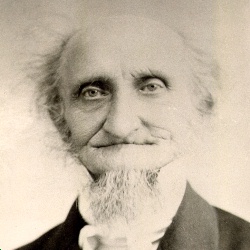
Editorial Note
Source note and document background
This text follows the Google Doc source and keeps the document's source note in a cleaner reading layout.
C. F. W. Walther is identified in the source note as the essayist at the 1867 Northern District convention, with references to Franz Pieper's Christian Dogmatics, I, 348 n. 154 and Christliche Dogmatik, I, 420 n. 1148.
The same note explains that the page references point to original German pages on Internet Archive, that quotations from the Book of Concord and Luther are linked back to their sources, and that several quotations also appear in Walther's True Visible Church and its CPH edition.
Quick Reference
Jump to a section
Use the original section numbers to move through the document on desktop or mobile.
§ 1
Because one should not follow just any spirit, but test the spirits also with regard to the interpretation of Scripture, the Lutheran Church has collected certain rules of Scriptural interpretation from Holy Scripture, according to which every interpretation of Scripture should be made and by which it should be tested.
§ 2
These rules, because they are taken from Holy Scripture itself, are to be distinguished from those which are made apart from Scripture and without it (as, for example, by the Papists) and to which Scripture must therefore be subordinate.
Luther: "I do not like rules or measures (leges interpretandi) for interpreting Scripture, because the Word of God, which teaches all freedom, should not nor must be bound." Letter to Pope Leo. Vol. 53, 49. [StL 15, 792; not in Am. Ed.]
Chemnitz: "In the Church there is no dictatorial or papal power of interpretation, but there are certain rules according to which it is to be done and according to which it is to be examined. For the Church has the right and freedom to judge. But the papists assume such a right of interpretation that they relieve themselves at one stroke of the burden of proof and deprive the Church of her freedom of judgment.
§ 3
Although some of them are already known from the light of nature, we do not follow them, both because they are known from the light of nature and because we find them applied and confirmed in Scripture itself.
§ 4
Among such rules of interpretation arising from the light of nature are all those which must be followed in the interpretation of any writing.
The following comments were made on these introductory statements:
The rules of scriptural interpretation, which are known from the light of nature, are those by which one interprets every author. — There are certain laws of reason which are innate in man, and which cannot be transgressed without being unreasonable, e.g. two times two is four; something cannot be and not be at the same time; every effect has its sufficient cause. Such are also the laws of interpretation, which are known from the light of nature, e.g: Every writing must be understood according to the use of language; in interpreting a writing one must be guided by its purpose and context. Such rules are confirmed by Holy Scripture. — But one must be careful not to speak of them as if one were giving too much credit to reason. Only such rules of interpretation have value as are taken from Scripture itself. That such do not contradict the light of nature can only be dear to us. He who understands Scripture only according to the principles known from the light of nature does not yet have a saving understanding of it. Everyone must have divine certainty from Holy Scripture itself, not standing on the light of nature, but on the light of the Holy Spirit. The rules of scriptural interpretation must be gleaned from the Scriptures themselves. If we observe the prophets as they interpreted Moses, if we observe the Lord Christ and the apostles as they interpreted Moses and the prophets, we find that they follow certain generally recognized principles. For example, the Apostle Paul, when he wants to prove justification, goes back to the place of this doctrine in the Old Testament: "In thy seed shall all the nations of the earth be blessed" (Gen. 22:18); and here he follows a generally recognized grammatical rule by pointing out that the good Lord does not say: "Through the seeds, as through many, but as through one, through thy seed" (Gal. 3:16). Thus we must be able to prove in individual cases that the prophets, Christ and the apostles themselves acted according to such principles in the interpretation of Scripture. But even if such principles
are known from the light of nature, we do not stand on the light of nature, but on that of the Holy Spirit. — The objection that someone could claim hereafter: Thus the Word of God in the article of the Holy Trinity teaches something contrary to the light of nature or reason, for: Three are not one and one is not three, is a nullity. Holy Scripture does not say that three times one is one and vice versa, but it teaches that there is one essence and in this essence there are three persons. — Nature [Wesen] and Person are not one and the same, even according to the light of nature. Just as there can be one essence and one person, there can also be one essence and three persons. — The light of nature is that which is innate to man from God, as far as the use of spiritual powers is concerned, insofar as it is not corrupted and darkened by sin. — The meaning of a merely human writer is not always revealed by observing these rules; but the Holy Spirit has placed the words in such a way that the meaning intended by him can be recognized from them. — It is on such certainty of the Holy Spirit that a Christian bases his consolation in mortal distress.
§ 5
Since the Holy Spirit speaks through Scripture, the meaning of the Holy Spirit cannot be separated from the words of Scripture.
Smalcald Articles: "In these matters concerning the external oral word, it is to be firmly maintained that God gives no one his Spirit or grace without through or with the preceding external Word. That we may guard ourselves against enthusiasts, that is, spirits who boast of having the Spirit without and before the Word, and who judge, interpret, and stretch the Scriptures or the Word to their liking, as Münzer did, and still do much today, who want to be sharp judges between the Spirit and the letter, and know not what they say or state. For the papacy is also a vain enthusiasm, in which the pope boasts that all rights are in the shrine of his heart, and what he judges and calls with his church is supposed to be spirit and right, even if it is above and against Scripture or the oral word. This is all the old devil and old serpent, who also made Adam and Eve enthusiasts, who leads from the outward word of God to spiritualism and self-conceit, and yet does so also through other outward words! Therefore we should and must insist that God does not want to deal with us humans except through his external Word and Sacrament, but everything that is praised by the Spirit without such Word and Sacrament is the devil." (Th. 3, Art. 8.)
The following comments apply:
The papists claim that Scripture is a skeleton that must be animated by the Holy Spirit, but not by the Holy Spirit who speaks through Scripture, but who speaks through the Church apart from Scripture. But this is not true. — Just as the hearers of the prophets took the meaning from their orally preached words, so we too can and should take the meaning from the written
words. — The enthusiasts falsely refer to the passage: "The letter killeth, but the spirit giveth life." (2 Cor. 3:6) — The sense of the Holy Spirit is obtained through words, letters, syllables, as in preaching through sounds. — No one comes with the meaning of the Holy Spirit unless he gets it from the words. — Let a Christian say with confidence: “Thus it is written”. —
§ 6
Therefore it is not for any man to put any meaning into it first; we are only to take the meaning of the Holy Spirit from His Words, and let the Scriptures interpret themselves, since the Holy Spirit himself is the only sure and true interpreter of the Scriptures.
2 Pet 1:20: "Knowing this first, that no prophecy of the scripture is of any private interpretation."
Luther: "That is why the Scriptures are such a book, which requires not only reading, but also the right interpreter and revealer, namely the Holy Spirit. Where he does not open the Scriptures, they remain incomprehensible, even if they are read." (House Postils, 2nd Easter. Vol. 3, 334)
Formula of Concord: "Now there is none so faithful and certain an interpreter of the words of Jesus Christ as the Lord Christ Himself, who best understands His word and His heart and mind, and is wisest and most able to explain them." (FC SD VII, 50)
Kromayer: "Scripture interprets itself, either directly or indirectly (vel actu, vel polentia). Directly, when it immediately adds the explanation. When, for example, Christ says in John 2:19, 'Destroy this temple, and on the third day I will raise it up,' then verse 21 is added: 'But he spoke of the temple of his body'. Furthermore, when the Savior says John 12:32: 'I, if I be lifted up from the earth, will draw them all unto me,' the explanation of these words is immediately added in v. 33: 'But this he said, to interpret what death he would die.’ Thus Revelation 5:8 explains the incense in the golden bowls as the prayers of the saints. Indirectly, when it gives us the means of interpretation, which are the original language, the preceding and following, the purpose, the parallel passages, the analogy of faith, the general purpose of the whole Scriptures, which are found in the Scriptures, although the use of them is added from without. … The Holy Spirit is the best interpreter of his words". (Theol. positivo-polem. II, 15.)
Gerhard: "Since the Scriptures 1. are perfect, i.e. contain everything that belongs to faith, morals, worship, and thus to the attainment of salvation, so that it is not necessary to attach foreign doctrines to them; 2. since they are clear, i.e, clear and bright words in the exposition of the articles of faith, so that it needs no light from without, since the rest receives light from the brighter; 3. finally, since the rule of faith, the comparison of passages, the consideration
of what precedes and follows, the examination of sources, etc., are not external to Scripture: therefore the rightful interpretation of Scripture is that which is done from it and through it." (Loc. de interpr. p. p. § 126.)
Luther: "Jerome reports, among other things, in addition to this Psalm, that in the Psalms this is a constant custom, that ten successive Psalms are always due to the author whose name is expressed in the preceding Psalm. He may have taken this from the rabbinical tradition. But I have no doubt that this (90th) Psalm is to be attributed to Moses and not the following ones, which have no title. For the Heb. 4:7 speaks openly of the 8th verse of the 95th Psalm: 'Today, when ye shall hear his voice' etc., that God spoke this through David; therefore we must take it for granted that Jerome followed the poems of the Jews in this." (Interpretation of the 90th Psalm of 1534, V, 1086)
Brenz: "If Paul interprets this (18th) Psalm of Christ, no other interpretation is to be recognized, not even that of an angel. (Ad Ps.. 18.)
The same: "Since we have apostolic testimonies, which are the foundation of the Church, that this (2nd) Psalm is to be understood of Christ, the Son of God, even an angel, let alone a godless rabbi, who teaches otherwise, is not to be heard." (Ad Ps. 2. Tom. 3, f. 199.)
J. J. Rambach: An interpreter of Scripture must be careful to choose skillful guides whose footsteps he can follow safely and confidently. But he will not find more skillful ones than Christ himself and his infallible apostles, who, by interpreting in the New Testament very many passages of the Old Testament, which speak of Christ himself according to the intention of the Holy Spirit, provide the key to the right understanding of countless others." (Institutes. hermen. Lib. II. c. 4. § 6. p. 154. sq.)
The following comments apply:
The papists admit that no one is allowed to interpret the meaning, but they say that the meaning is so hidden in it that the official gift is necessary to recognize and explain it; because the bishops and priests have this official gift and are exclusively appointed by Christ to interpret Scripture, a layman must believe them and accept their interpretation, whereby he can be completely confident. — Scripture must interpret itself. — Only this interpretation demands faith if one can prove that Scripture itself interprets it in this way. No man has the right to interpret Scripture, but only the Holy Spirit. We do not need anyone to tell us first, because the Holy Spirit has already told us. An authentic interpretation can only be given by the one who has spoken or written the words himself. Since the Holy Spirit has inspired the Scriptures, he alone can provide an authentic interpretation of them. — Luther is best able to prove that his interpretation is the right one, because he convinces consciences of the right meaning by the way he presents it, and thus compels them to accept it. —
§ 7
Correct interpreters are therefore only instruments for interpreting and explaining the meaning of the Holy Spirit, but not dictators whose interpretation we should regard as infallible and binding for the sake of their office.
The following comments apply:
When someone swears by the symbolic books, he swears by the doctrinal content, namely, that all the interpretations contained therein are analogous to the faith; but not that the first and last meaning of Holy Scripture is always taken in all passages. — To the question: How is the fact that Scripture interprets itself to be applied to the prophetic passages of the New Testament? was answered: Not only what is clearly and explicitly stated in Scripture is to be accepted for God's Word, but also what is obtained from it by correct inference. For example, it is not expressly stated in Scripture that the Roman pope is the Antichrist, but it is to be inferred from it. The marks of Antichrist are given in Scripture; now we must look around to see in whom these marks are to be found. Since we find them in the Pope of Rome, we must also regard him as the Antichrist, even though he himself does not want to be regarded as such. When a prophecy is fulfilled, Scripture interprets itself through such fulfillment. — The Lutheran Church has confessed that the Pope of Rome is the Antichrist. Anyone who does not believe this is not a Lutheran. How can he be, since the whole work of the Reformation is based on it? Luther would then have been the worst deceiver in the world! If the Pope is not the Antichrist, then we can confidently put the symbolic books and Luther's works in the oven. What kind of church would the Lutheran Church be if it were a lie that the Pope is the Antichrist, since it has confessed this for three hundred years and separated from the Roman Church for its own sake? — The belief that the Pope is the Antichrist has nothing at all to do with the production and preservation of the saving faith, but it is a question of whether he is a Lutheran preacher and confessor who does not believe this. A true Lutheran thanks God day and night that he has revealed to him the mystery of wickedness. — The Iowans have now finally admitted that the symbolic books say that the Pope is ex professo the Antichrist. But how they deal with those of Dorpat, who say the opposite in their opinion, they may see for themselves. — When some of our ancients say that the question of who is the Antichrist can be disputed in utramque partem, [both sides] they do not say this with regard to the doctrines by which the saving faith is worked, but with regard to the articles by which the saving faith is not produced and maintained. — If one proves something from Scripture, one must believe it, whether it is fundamental or not. — One cannot know for certain whether the interpretation of a prophetic passage is correct until it is fulfilled. — But every interpretation of a prophetic passage must be analogous to faith. If someone claims that it is certain that the thousand years have not yet passed, this is obviously false teaching; but not if it is said that it is possible that they are yet to be fulfilled. — How
the Holy Scripture interprets itself can be seen quite clearly from 2 Thess. 2:8. First it says: "whom the Lord will consume by the spirit of his mouth"; and then: "and will put an end to him by the appearance of his coming." From this it is clear that the Holy Spirit does not mean by "putting to death" such a thing as making an end of him or destroying him; that is, not a physical, but rather a spiritual putting to death or killing. To kill or slay means to bring about the sensation of death, just as the devil has been killed and overcome by Christ, but still continues to exist. — Through the historical fact that the papacy has arisen, it is not Scripture that is first interpreted, but Scripture interprets the papacy, namely, so that one can recognize it for the kingdom of the Antichrist. — Luther, Brenz and Rambach, for example, refer to the interpretation of Old Testament passages by the apostles in the New Testament, and consider such an interpretation to be the only correct and certain one. On the other hand, the newer theologians claim that if, for example, Paul interprets a passage of the Old Testament, this is not the only correct and true interpretation. Such an assertion, however, is blasphemy, which is why we rightly say that anyone who interprets a passage differently from the way the apostles interpret it is accursed.
§ 8
[cf. True Visible Church, Thesis XIX]
The Church accepts it in faith, having come to understand it in whatever way she wants, and in this it is certain of its faith. John 8:31: "If ye continue in my word, then are ye my disciples indeed."
Luther: "The holy Christian church ... is not a reed nor a penny. No, it does not waver or give way, like the devil's harlot, the papal church..., but, says Paul 1 Tim. 3:15, it is a pillar and foundation of the truth. It stands firm, he says, is a foundation and firm ground, and not a false or lying foundation, but a foundation of truth, not deceiving, not deceiving, not dealing in lies. But what wavers and doubts cannot be truth. And what use or need would a church of God have in the world if it wanted to waver and be uncertain in its words or to set something new every day, now giving this, now taking that? Indeed, what use would such a God be if he wanted to teach us to waver and doubt? As the papists' theology teaches that we must doubt grace; otherwise enough is written about this. For where otherwise the papists would have won in all things, they are lost in this main point, since they teach that one must doubt God's grace, … the doctrine ... does not belong in the Lord's Prayer, since we say: Forgive us our trespasses, for they are not our own doing, but God's own word, who cannot sin nor do wrong. For a preacher must not pray the Lord's Prayer, nor seek forgiveness of sins, when he has preached (if he is a true preacher), but must say with Jeremiah and praise in Jer. 17:16: "Lord, thou knowest that which is gone out of my mouth,
that it is right and pleasing to thee", yes, with St. Paul, all the apostles and prophets, say in spite of themselves: Haec dixit Dominus, that God himself has said. Et iterum (and again): I have been an apostle and prophet of Jesus Christ in this sermon. Here it is not necessary, indeed it is not good, to ask forgiveness of sin as if it were wrongly taught; for it is God's Word and not mine, which God neither should nor can forgive me, but confirm, praise, crown and say: You have taught rightly, for I have spoken this through you and the word is mine. He who cannot boast about his preaching is guilty of preaching, for he is certainly teaching and blaspheming God. If the word should be sin or unrighteousness, what would or could life be judged by? Surely one blind man would lead another, and both would fall into the pit, Matt. 15:14 If the sounding line or square should be wrong or crooked, what would or could the master work by it? One bend would make another without end or measure. So here, too, life may well be sinful and wrong, indeed, it is unfortunately all too wrong: but the teaching must be straight and certain, without all sin. Therefore nothing must be preached in the church except the certain, pure, single word of God. If this is lacking, then it is no longer the church, but the devil's school. Now all this is to say that the church must teach God's word alone and be certain of it, by which it is called the foundation and pillar of truth and built on the rock, holy and incorruptible, that is, as it is rightly and well said: the church cannot err; for God's word, which it teaches, cannot err. But what is taught otherwise, or is doubtful whether it is God's Word, cannot be the teaching of the church." (Against Hans Wurst. From 1541. XVII, 1680-86 [StL 17, 1340 ff.; AE 41, 212 ff., 216])
The same: "We learn here (Acts 15) that every man must take heed to himself that he is sure and certain of the righteous doctrine, and do not place it on other men's ears and inferences; if not, the Holy Ghost shall soon make thee see a stumblingblock. If you are to be saved, you must be so sure of the word of grace for yourself that if all men spoke differently, even all angels said no, you could still stand alone and say: I still know that this word is right; and this because: for those who are against us have no stronger evidence to throw up than that they say: Yes, should God keep the world in error for so long with so many learned, pious, holy people? Therefore they think that where most of the multitude falls, there one should go; on this they insist and cry out: There are so many and such great people on our side, and such a long time and habit, therefore we cannot err. You hold your nose at them and say, "Let the greatest, the most eminent and the most learned conclude and say, why is it written here that the very best Christians, with the exception of three persons who stand alone in chivalry, fall away over the main matter of the Christian faith? Therefore I have said that every Christian must be so sure of the matter that he feels in his heart what is right and what is not
right, as Christ says in John 10:3, 5: 'My sheep hear my voice and know me; the voice of strangers they know and do not hear. The sheep must be sure of the voice, close its eyes and ears and not want to hear anything, as great, many, wise, pious people are. If it does not do this, if it lets go of its certainty and only wants to hear what is finally concluded, then it has already been deceived by the shepherd. God has indicated this to us in this first council. He allows it to happen that you strengthen your faith through the coincidence of pious people who hold it with you; so far that you do not trust in it, as if you could not lack it. Accept it, but do not rely on it. The Holy Spirit has not promised to be in the churches, but in the hearts of Christians whom He knows. ... Therefore it is ever clear that the councils are uncertain and are by no means to be relied upon. For never has one been so pure, it has added to and detracted from the faith; and the newer, the worse, until at last they burned the holy men John Hus and Jerome of Prague at Constance." (Two sermons on 1 as 15. and 16. chap. of the Acts of 1526. VIII, 1032-34 [StL 8, 1003 ff. ; not in Am. Ed.]])
The same: "It is not enough to say that such a saying may give them understanding, but they must prove that it enforces and penetrates such understanding. One must certainly proceed in these matters that concern the conscience, and not stand on them and say: it may be understood thus. May and must are not one; you must prove that it must be understood thus and not otherwise. As long as you do not prove such "must", your saying and understanding will be of no avail." (On the Adoration of the Sacrament to the Brethren in Bohemia, etc. From the year 1523. XIX., 1604. f. [StL XIX, 1317; AE 36, 284])
The same: "You (Erasmus) say: 'You are not at all pleased with the certainty and obstinacy with which we treat this matter (which you call obstinacy), and you would rather be like the skeptics, who are not certain of anything, if the holy Scriptures and the unbreakable commandments of the Church did, to which (as you say) you would gladly submit and subjugate your mind and your opinion, whether you understand and obey their commandments and decisions or not,' you say that this is your way, that you like this way.... (But) it is not Christian to want to do such things and then say: I do not want to conclude or have decided anything certain. For a Christian should be quite sure of his doctrine and his cause, so that he knows how to establish his doctrine quite firmly and to conclude it with certainty, or he is not a Christian.… Therefore, always keep away from philosophers, be they skeptics or academics, who do not want to affirm anything with certainty. We Christians must be absolutely certain of our doctrine and know thoroughly and without any wavering how to say yes or no and stick to it. … For the Holy Spirit is given to Christians from heaven to sanctify the hearts of believers, to make them steadfast and certain in confessing Christ, and to stand firm and die to it. Does this not mean that if I remain so firm in my yes, I will die on it? … What a fine Christian teacher that would be to me, who taught and punished other people, and was not himself certain of his teaching, whether it were divine or ungodly! he
would have to be furious and mad. But it is a pity that I should have to give time and word to this article, namely that a Christian must be certain, which is clearer than the sun. What Christian can suffer or hear Erasmus or others say that he does not want to be certain of anything in this matter on which a Christian's salvation depends? For what is it but to conclude nothing certain in these matters, but to deny all Christianity and the faith? ... What is more similar to unhappiness and damnation than uncertainty, and what is more blessed than certainty? … Further, what shall I say to these words of yours, since you say: 'that you submit your mind and opinion to the Scriptures and the churches, you understand the same, or reach the same conclusions, or not? What is that said, Erasmus, or what? Is it not enough that you submit to the Scriptures, must you also submit to the Church? Tell me, what more can the Church decide or set about that which is decided in Scripture? And where is the freedom to judge and pass judgment on all decisions and statutes made by the church or concilia, of which Paul writes in 1 Cor. 14:29, where he says: 'judging others'? Why should we not judge the decisions of the church, which Paul not only gives freely, but also gives? … Furthermore, how can it be proper for a theologian and Christian thus to cast Scripture and the church and its decisions to the winds, saying: He submits himself to Scripture and the church, he understands it, or not, what is the opinion of Scripture, he obtains it or not? Does it mean to submit to the Scriptures if I do not ask whether I understand the opinion of the Scriptures or not? Dear Erasmus, I think nothing at all of submission, and so I say: Let him be banished and accursed who boasts of being a Christian, and is not sure of his cause, that he understands, or attains with his understanding, what the Scripture wants or does not want. … Your words are just as if you did not care much about it, as if everyone believes what he wants, if only physical peace, rest and comfort remain in the world. Yes, they are just as if we only want to preserve goods, honor, rumor, human favor, peace, as the guest of pleasure or parasite does in Terence, who says: he needs art: if they say yes, he also says yes; if they say no, he also says no. It is as if you did not hold Christian doctrine in much higher esteem than philosophy and other human teachings, and consider them great fools who fight and hold so hard over such things, since nothing but discord and division and manifold divisions of physical peace arise from them. But (since God is for) if your heart were thus set, it would follow that you would also say with that philosopher: What is that which is above us to us? … Henceforth thou mayest be moderate in thy prudent speech and measured words. For thou art doing nothing else by it than letting thyself know what sort of Lucian or Epicurean lies behind it, who does not think much of there being any God, and secretly laughs into the fist of those who hold or believe it. Let us
fight and hold hard about our doctrine, because God has given it to us and has called us in Christ; and if you ever like it so, you may hold it with your uncertain, fickle skepticism and academics until Christ also calls you. The Holy Spirit is not a skeptic; he has not written an uncertain delusion in our hearts, but a strong, great certainty, which will not let us waver, and (God willing) will not let us waver, but (praise God) makes us as certain as we are that we now and naturally live, or that two and three are five." (That the free will is nothing, to Erasmus of Rotterdam, dated 1525. XVIIl., 2058- 66. [StL XVIII, 1675 ff.])
The following comments apply:
This is directed against such talk: the church has not yet decided. — The Church has nothing more to do than to agree with the interpretation of the Holy Spirit. It is a terrible trick of the evil enemy to say that the Church has not yet decided; we must wait until learned men come and interpret it. This means: do not believe what God's Word teaches, but what the Church believes. — The Church has already professed everything in full faith; it accepts the whole Word of God and professes it. — It is frightening that there is now so much talk of open questions. — Everyone should note what the Apology says about this: "Good consciences cry out for truth and right instruction from the Word of God, and for them death is not so bitter as it is bitter to them when they doubt about something." (Ap VI, 31 Of Confession and Satisfaction.)
§ 9
Since the Holy Spirit alone speaks through Scripture, tradition, which is asserted alongside Scripture as the word of the Holy Spirit, and the reputation of the Church Fathers cannot be a standard of interpretation.
Luther: "The goat (Emser), as much more learned than St. Paul, wants to turn this around; he argues that we should not follow the mere text, but the interpretation of the Fathers, and makes the Fathers the judges and provers of God and the divine Word. So that he proves how true it is that no foolishness is alone. Such jugglery has never yet been heard among the ancient Fathers; it is a new discovery of the pope and his sects, the high schools, that one does not merely want to see the Scriptures, but according to the interpretation of the Fathers, so that they may escape the sword." (On the Book of Bock's Emser at Leipzig Answer. vol. 27. 246 [StL 18, 1294])
The following comments apply:
We have been accused of not going back to the Scriptures but to the Fathers. But show us where we have somehow accepted the interpretation of a passage because Luther, for example, gave it, and not because Scripture gives no other, or because it is analogous to the faith. — A Lutheran must accept the lessons which the symbols have drawn from Scripture. — God has never directed us to tradition, but
to the Scriptures alone, as the Scriptures themselves testify (Deut. 4:2): "Ye shall not add unto that which I command you, neither shall ye add unto it, that ye may keep the commandments of the Lord your God which I command you."
§ 10
This is why reason cannot be considered the norm.
2 Cor. 10:5.
Luther: "The Bible and Scripture is not such a book that flows from reason or from human wisdom. The arts of lawyers and poets come from reason, and may in turn be understood and grasped by reason. But the teachings of Moses and the prophets do not come from reason and human wisdom. Therefore, anyone who presumes to understand Moses and the prophets with reason and to measure and calculate the Scriptures as it rhymes with reason will get away with it. For even all heretics, from the beginning, have arisen because they thought that what they read in Scripture they would interpret as reason teaches. St. Paul in 1 Cor. 1:23-24 says: 'We preach Christ crucified, a reproach to the Jews and foolishness to the Greeks. But to those who are called, both Jews and Greeks, we preach Christ, divine power and divine wisdom. To the Jews, he says, we preach vanity, which causes them to stumble and become mad and foolish; they can neither hear nor see it. To the wise Gentiles we preach foolishness, which makes them fools, because it is contrary to their reason, which cannot endure it; but they are simple sheep, both Jews and Gentiles, who say: God has spoken it, therefore I believe it; they can grasp it and understand it. And Christ himself, Matt. 11:25, gives thanks to his heavenly Father with a cheerful heart, who has hidden these things from the wise and understanding and revealed them to babes and foolish fools and children. I praise our Lord God that he is allowed to do so. If he had not done it, I would ask him that he would still do it. For it is impossible to instruct wise men and high reason in divine things, of baptism, of Christ, of faith, of salvation and eternal life." (House Postils, Easter Monday, vol. 3, 335. 336 [StL 13b, 1899])
The same author: "St. Augustine complains that he first went into the Scriptures with free reason and studied them for nine whole years, wanting to understand the Scriptures with reason; but the more he studied them, the less he understood them, until he finally learned to his detriment that one must put out the eyes of reason and say: What the Scriptures say, I leave unexamined with reason, but believe it with a simple heart." (House Postils, Easter Monday, StL 13b, 1909)
The following comments apply: *)
One must have reason in order to understand Scripture. It has a twofold task: 1. to hear what Scripture says. It is the lantern
————
*) Dannhauer (Prodrom. antichristosoph. p. 57.) See Lehre und Wehre. April, 1867. p. 108.
in which the light is placed, but not the light itself. It is called reason because it hears. 2. to understand what is written about natural things. But as far as spiritual things are concerned, it is blind. — Although its eyes must be gouged out, it must not be thrown away, since it is, as it were, the soil on which the Holy Spirit sows heavenly thoughts. — Enlightened reason has nothing to say in spiritual matters. — How can it give light to the Word, since it is only enlightened by it! —
§ 11
The same is true of the so-called inner light of the spirit, of which the enthusiasts speak. Smalcald Articles SA 3, 8.
Remarks:
There is no working of the Holy Spirit without through the Word. — No one can have the Holy Spirit apart from the Word. — The inner light of which the enthusiasts, especially the Quakers, boast is the devil's light.
§ 12
An interpreter must therefore prove his interpretation to be correct solely from the Scriptures themselves.
Luther: "When they (the Fathers) interpret a passage of Scripture, they do not do so with their own sense or word (for where they do so, as often happens, they commonly err), but bring in another place which is clearer, and thus illuminate and interpret Scripture with Scripture." (On the book of Bock's Emser at Leipzig Answer. Vol. 27, 244 [StL 18, 1293])
The same: "And all the books of the fathers must be read with modesty, not to believe them, but to see whether they also contain clear Scripture and transfigure Scripture with light." (Ibid. p. 248 [StL 18, 1295])
Remarks:
It is extremely important that an interpreter must prove his interpretation from Scripture. — True interpretation is Scripture itself. —
§ 13
We must also accept as an interpretation of Scripture with Scripture those sayings from which the evidence can and must be inferred.
Remarks:
Here occurs the use of reason according to which it is to draw conclusions. An example is the passage Matt. 22:29 ff. In this passage reference is made to the doctrine of the resurrection of the dead, namely, how it must be inferred from it by necessary conclusions. Christ does this himself by first saying: "You do not understand the Scriptures," but then does not cite the Scriptures themselves, but makes a very subtle conclusion and thus proves the doctrine of the resurrection of the dead. God is only the God of those who put their trust in Him; because He now calls Himself the God of Abraham, Isaac and Jacob, then Abraham, Isaac and Jacob,
although they died in the flesh, must nevertheless live, so there is a resurrection of the dead. "You do not understand the Scriptures," says Christ to the Jews, because they did not make and recognize this conclusion. — If one says of an object: every part of this object is of iron; everyone draws the correct conclusion from this: therefore the whole is of iron. — What follows from the Scriptures is what it says. The Bible does not contain the word "triune", nor does it say "three persons", and yet Christians believe and confess it because it necessarily follows from Scripture. — Almost all doctrines of Christianity are the result of such conclusions. — What is written in the Formula of Concord is nothing more than a careful reading of what is revealed in Holy Scripture.
§ 14
Every interpretation must be similar to faith. Romans 12:7: "If anyone has prophecy, let it be analogous to faith."
2 Timothy 1:13: "Hold fast the example of the words of salvation which you have heard from me, about faith and love in Christ Jesus."
Apology: "The wise and learned know well that all examples should be interpreted or introduced according to the rule, that is, according to clear Scripture, and not contrary to the rule or Scripture." (Art. 27.)
Formula of Concord: "As the apostle testifies (Rom. 15:4): All things that are written are written for our learning, that we through patience and comfort of the Scriptures might have hope: but since by the Scriptures such comfort and hope are weakened and even taken away from us, it is certain that they are understood and interpreted contrary to the will and mind of the Holy Spirit." (Repetition. Art. 11.)
Gerhard: "Every interpretation of Scripture must be analogous to the faith. This rule is set forth in Romans 12:6, the meaning of which is that the interpretation of Scripture should be so arranged and finely constituted that it agrees with the constant opinion which is presented in Scripture of every chief part of heavenly doctrine. For since all Scripture comes from the direct impulse of the Holy Spirit and is inspired by God, everything in it is therefore also true and agrees with one another in the best possible way, so that there is nothing in it that is contrary or contradictory or inconsistent among themselves. The articles of faith, which the apostle understands by "faith" in this passage, the knowledge of which is necessary to all for salvation, are taught with clear and distinct words in Scripture, and a sum of them is briefly repeated in the Apostles’ Creed, which the Fathers often call the rule of faith. Against this rule of faith nothing may be brought forward in the interpretation of Scripture, and therefore, although we cannot always attain the true meaning intended by the Holy Spirit in every passage, we must be careful not to bring forward anything against the analogy of faith." (Exeges. Loc. de S. S. § 531.)
John Musaeus: "The first characteristic of the points of doctrine belonging to growth, or so-called permissible innovations, is that they are according to the analogy of faith, as Paul says in Romans 12:6, or, as Luther puts it, similar to faith, and do not violate or overthrow, either directly or indirectly and by implication, any article of faith revealed in Holy Scripture and accepted by the universal Christian Church.... From this it follows that, if one wishes to judge correctly of the growth in the knowledge of faith and its difference from other reprehensible innovations in the doctrine of faith, one must first and foremost have the analogy of faith in mind, and consider whether the newly introduced explanation of a difficult question or interpretation of a difficult biblical saying is in accordance with the analogy of faith and does not contradict, weaken or overthrow any article of faith." (Concerns about the disputes of the Wittenbergers with the Helmstadters. S. Calovii Historia syncretismi. S. 1028.)
Pfeiffer: "The analogy of faith, or the model of salutary words, is the whole series or sum of the heavenly doctrine of what is to be believed, or of the articles of faith, which is taken from such passages of Scripture, where the Holy Ghost deals with them intentionally, or at least according to all admission, and that in words round, simple, clear, and elevated above all inferences. The apostle Romans 12:6 clearly indicates that this analogy of faith is to be taken into account in the explanation of Scripture, especially when he demands that prophecy be analogous to faith, and in 2 Timothy 1:13 he recommends to Timothy the 'example of wholesome words'. Furthermore, common sense itself advises the same, namely that the particular and obscure passages are to be interpreted according to the general and unquestionable passages. For example, a passage that is beyond all doubt and objection is that God does not will sin and that he is therefore not the cause of it, according to Ps. 5:4 [KJV]. Since this saying leaves no room for doubt, no explanation of any passage of Scripture that would overturn it may be admitted. … But since all, even the unbelievers, allege the analogy of faith and cite it for themselves, … the question is, from what can it undoubtedly be evident what is the analogy of faith to be observed in the interpretation of Scripture? I answer: The analogy of faith is to be judged from Scripture, and especially from the original and proper place of the articles in Scripture, since there is no article necessary for salvation that is not presented somewhere intentionally in clear and round words. For example, Holy Communion is intentionally treated in its proper place in the words of institution. If, therefore,
any doubt or dispute arises about this article, it is absolutely necessary to go back to it and not to doubtful passages, e.g. to the story of the journey to Emmaus, Luke 24, or to John 6, for there is no trace of Holy Communion; here, however, the eating of the body and drinking of the blood of Christ is dealt with, but not the sacramental part, which takes place in Holy Communion. Thus even the opponents, even the most impudent, do not dare to deny that Romans 3 deals with justification intentionally. Thus, according to the contents of this chapter, all scriptural passages are to be explained where this matter is dealt with accidentally and by application.... The analogy of faith is understood to be the agreement and harmony of the main parts or articles of the Christian religion. For faith in its connection is one and like a golden chain, which, as Luther says, is completely broken by the one who breaks one link. It is therefore necessary to hold one place in such a way that it does not oppose several. ... That the analogy of faith is to be judged from the proper seat of each article, Christ teaches Matt. 19:3 ff. in deciding the question of arbitrary divorce. The Jews referred to a passage which was not the main passage, Deut. 24:1; but Christ pointed them to the proper seat of the doctrine of marriage, Gen. 2:24." (Thesaurus hermen., cap. XII., § 1 — 4., p. 355. sqq.)
Baier: "Since the highest and most exact harmony is undoubtedly inherent in the Scriptures which have sprung from God, and since it is also certain that God has expressed the main points of faith and morals, which are necessary to know, in clear and distinct words, one must endeavor to go through the whole of Scripture and immediately summarize it, to go through the whole of Scripture, and from it at once to comprehend the summa of the heavenly doctrine, and, when this and all the individual parts of it are well understood, to proceed thereafter in the interpretation of all other statements of Scripture in such a way that no statement is given a meaning which does not accord well with those principal parts of Scripture and with the whole sum." (Compend. th. exeget. p. 38.)
Pfeiffer: "Whatever interpretation of Scripture is not analogous to faith is false and erroneous, for this is what Paul intends when he says: 'If anyone has prophecy, let it be analogous to faith,' q. d. (as if to say): otherwise it is of no use, and is not worthy to be heard. Now chiliastic prophecy or interpretation is by no means analogous to faith. Hence it is false and erroneous. … If only one article of faith is touched, then the interpretation is already not analogous to faith. However, for this time I will demonstrate and prove with irrefutable reasons that the chiliastic fanatics overthrow three highly important articles of our faith, namely 1. of the kingdom of Christ, 2. of the future of Christ in judgment, 3. of the resurrection of the dead, although not directly and immediately, but indirectly and dangerously, according to necessary characteristics and circumstances established in Holy Scripture, and gives them a violent blow." (Antichiliasm. 2nd ed. Lübeck, 1729. p. 138. f.)
The following comments apply:
The Iowans invoke Musaeus by saying that the Missourians are the resurrected Wittenbergs, but they are the Jenensians. The latter were the moderates and the latter the fanatics. Musaeus claimed that the church must always continue to develop; Calov, however, said that it was already finished. — Neither of them said that. Musaeus admits growth, but not the kind that the newer ones want. — The newer ones say that the church is like a person who is growing and becoming more and more knowledgeable. Dr. Kurtz, for example, says: "We are the fathers, the old are the children." — But the Church is to be compared to the moon. Just as the moon is sometimes waxing, sometimes waning; just as it is new moon and completely dark, so it is with the church. When God bestows great grace on a fine church, it also receives great light. But where it is not recognized with proper gratitude and faithfulness, it gradually becomes dark again. At the time of the Reformation, God gave his church a great light; soon after Luther's death, however, it became dark again. At the time of the Concordian formula, this light flickered a little again and shone throughout the seventeenth century, but in the eighteenth century it became completely dark again. Now, in the present time, that light has flickered a little again. It is therefore folly to talk of progress. — The church is like the sun that is obscured by a cloud: when the cloud goes away, the old sun shines again. — When Musaeus speaks of an innovation, he means a new answer to a difficult question, but the answer must be similar to the faith. — A very difficult question, for example, is this: How is the soul of man propagated? Scripture gives no answer to this question, and theologians have almost racked their brains over it. Even now they are still not in agreement. — Musaeus therefore only wants no one to condemn anyone because he answers such a question differently, only that such a new answer is analogous to faith. — In the passage Romans 12:7, "prophecy" is to be understood as the interpretation of Scripture, because in this passage the apostle gives a standard by which Scripture is to be interpreted. The proclamation of future things cannot therefore be meant by this, because the apostle would have prescribed a norm for the Holy Spirit! Nor subjective opinion, since the Word must precede it. Nor faith, since faith is sometimes strong and sometimes weak. — Scripture speaks of faith in two ways: 1. in relation to what is believed, and 2. in relation to what is believed with; which of the two is meant must be determined by the context. — There are no contradictions in Scripture. For example, when Scripture says: Christ is God and man, this is not a contradiction; but if it were said that Christ is God and Christ is not God, it would be. — In the passage Ephes. 4:5, "faith" is to be understood in the same way as Romans 12:7. — Every Christian must know that the Scriptures are plain and clear, and therefore everything necessary for salvation must be revealed in them. The sum of all this, however, is what Scripture calls "faith." — If a teacher does not preach what a Christian either already knows from God's Word or what
is analogous to faith, he is not an expositor but a peddler. — The passage 1 John 2:27 must be explained according to Romans 12:7. Every pretended "anointing" must be analogous to faith. A Christian must therefore say: prove your anointing from the Scriptures. Therefore 1 John 4 says that one should test the spirits, because there are many false spirits.
§ 15
The Old Testament must be explained from the New.
Luther: "We Christians have the sense and understanding of the Bible, because we have the New Testament, that is, Jesus Christ, who is promised in the Old Testament and came afterward, bringing with him the light and understanding of Scripture, as he says in John 5:46: Moses wrote of me. If you believed Moses, you would believe me; again, Luke 24:44-45: What is written of me in the Law, the Prophets and the Psalms must be fulfilled. And open their minds that they may understand the Scriptures. — In sum, if we do not turn our diligence to drawing the Hebrew Biblia, wherever it will suffer, to the understanding of the New Testament, contrary to the understanding of the rabbis, it would be better to remain with the old interpretation" etc. (Of the Last Words of David. Vol. 37, 3. 5 [StL 3, 1882])
The following comments apply:
The Old Testament itself forces us to understand what the New Testament reveals about the Old Testament in this way and no other. — Where the New Testament says: What is written here or there in the Old Testament is fulfilled, then it is fulfilled in fact and nothing else, and we must not speak of any example. — A Christian must already come to the certainty through the Old Testament that the Holy Spirit alone points to Christ through it, even if there were nothing about it in the New Testament. — All the teachings of the New Testament are already contained in the Old Testament, brightly and clearly, even the doctrine of the divinity of Christ, of the Holy Trinity. After all, the apostles proved and had to prove everything they taught from the Old Testament, because otherwise they would not have been God's messengers. — This paragraph is also directed against the chiliasts because they interpret the New Testament from the Old Testament. The Old Testament speaks of the "last days". The New Testament shows that this is to be understood as the time of the New Testament. After the fall, the Savior had to come; but after his coming, the drama of humanity was, so to speak, over. It is God's great mercy that the world is still standing. But chiliasts and enthusiasts are still waiting for great things, even though everything is ready to go.
§ 16
The darker passages of Holy Scripture should be judged according to the lighter ones, not the other way around.
Luther: "The holy teachers have the way of interpreting Scripture, that they take bright, clear sayings and make dark, wavering passages clear; it is also the way of the Holy Spirit to illuminate darkness with light. But
our enthusiasts do contrary to sense, they take from a text a dark, wavering word that pleases their conceit, leave what is written next to it, listen to it and want to make a bright, clear text dark and wavering with it, and then say that it is the pure truth. This is the way of the devil, who is a master of darkness and wants to make the light dark with darkness." (That these words of Christ: "This is my body etc." still stand firm. Vol. 30:113 [StL 20, 856])
The same: "So we say that the Scriptures are to be the judge to test all the spirits in the church, 1 Thess. 5:14; for all Christians must above all things hold this to be true and know that the Holy Scriptures are a spiritual light, much brighter than the sun, Ps. 119:105, 2 Pet. 1:19, especially in those things which are necessary for a Christian to know and useful for salvation. But because people are persuaded by the above-mentioned diabolical doctrines of the pope and the papists of another, namely, that Scripture is dark and has many kinds of reason: so we must first prove this as our main reason, in Latin primum principium, by which we will prove everything else, which the philosophers would consider quite clumsy and impossible." (Reply to Erasmus that free will is nothing, dated 1525. XVIII, 2157. [StL 18, 1742])
The same: "The sophists have said that the Scriptures are dark; they have said that God's word is so dark and speaks so strangely. But they do not see that all defect lies in the languages; otherwise nothing easier would ever be spoken than God's Word, where we understand the languages. A Turk must speak darkly to me, which a Turkish child of seven years old can hear, because I do not know the language." (Writing to the councillors of all German cities that they should establish and maintain Christian schools, dated 1524. X, 551. f. [StL 10, 473])
The same: "But if any of them should challenge you, saying, 'We must have the interpretation of the Fathers, that the Scriptures are dark,' you should answer that it is not true. There is no clearer book written on earth than the Holy Scriptures, which are to all other books as the sun is to all lights. They speak such things only to lead us out of the Scriptures and exalt themselves as masters over us, that we should believe their dream sermons. It is a terrible great dishonor and vice against Holy Scripture and all Christendom to say that Holy Scripture is dark and not so clear that anyone can understand it to teach and prove his faith. And remember this: Should it not be a great shame if I or you were called a Christian and did not know what I believe? But if I know what I believe, then I know what the Scriptures say, because the Scriptures contain nothing more than Christ and the Christian faith. Therefore, if faith only hears the Scriptures, they are so clear and light to it that it says without all the glosses of fathers and teachers: "This is right; I believe it too. ... It is true, some passages of Scripture are dark, but in them there is nothing different from what is in other
places in the clear open sayings. And this is where heretics come from, that they take the dark passages according to their own understanding and fight with them against the clear sayings and the foundation of faith. So the Fathers fought against them with the clear sayings, illuminating the dark sayings and proving that what is said in darkness is said in light. ... Only be sure, without doubt, that there is nothing brighter than the sun, that is, the Scriptures; but if a cloud has replaced it, there is nothing behind it but the same bright sun. Therefore, if there is a dark saying in Scripture, do not doubt; there is certainly the same truth behind it that is clear in the other place, and if anyone cannot understand the darkness, let him stay with the light." (Interpretation of the 37th Ps. of 1521. V. 456. ff. [StL 5, 334 f.])
The same: "If there is any obscurity in Scripture, it is in some places because of the words and language, and that I call it Latin-Greek because of the grammar, and it is generally such an obscurity that nothing hinders us from recognizing the most important number and the whole main point of Scripture. For what greater, higher or deeper mystery can there be than Christ? Now that the seals have been opened, Rev. 6:1, and the stone rolled away from the tomb, Matt. 28:2, and the supreme mystery has been revealed, that Christ, the eternal Son of God, is man, Heb. 2:14, 16, that there is one eternal God in three persons, 1 John 5:7, that Christ died for our sins, Rom. 4:24, and reigns eternally in heaven, Mark 16:19; how then this is preached publicly throughout the whole world, so that even children may hear and know: what greater hidden thing or mystery can there be than Christ is? And if Christ is taken out of the Scriptures, what mystery remains? Therefore this is very foolish and unchristian: since it is ever true that the principal things and all that a Christian needs to know are revealed in the clear light of day by the dry word of Scripture, that for the sake of some passages you want to say, "There are still great hidden things behind," when there can be nothing greater than the knowledge of Christ. Although in some places in Scripture the passages are obscure, in other places in Scripture they are clear. And the one main thing or matter, namely faith and Christ, which is presented to the whole world in Scripture, is presented here with bright clear words, there with hidden dark words. What is the matter, then, if the chief part of the whole Scripture is in plain, dry words, as in the epistle to the Romans, if some of the words which speak of the same thing are still dark? … But that there are some, as the sophists and others, to whom also the main things of Scripture and of God's Word are hidden, is not the fault of the darkness of Scripture, but rather of their blindness, that they are so hardened that they do not recognize or desire to recognize the public truth, as St. Paul says of the Jews 2 Cor. 3:15: 'For this
day the veil is hanged before them; and when he says Chap. 4, 3: 'If our gospel is hid, it is hid to those who are perishing! Yes, in the same way, if the Scriptures should be dark to me, so that I would not understand many things, I would also say that the sun would be dark if I wanted to cover my eyes or go out of the light into darkness. But what do poor blind men condemn the Scriptures and the holy, pure Word of God for, that they should be called dark because of their blindness? ... So also the examples rhyme with nothing at all, so that you secretly want to have engraved, I know not what, of the three persons of the Godhead, 1 John 5:7, of the union of the humanity and Godhead of Christ, John 1:14, of sin in the Holy Spirit, Match. 12:13; which articles you say are also still obscure and unreported. For if thou meanest by this the vain contention of the sophists, which they have brought up in these things, what has the Word of God and the pure Scriptures done to thee, that thou shouldest blame the wicked sophists for their abuses? The Scriptures speak plainly enough, and say that three persons are one God, 1 John 5:7, that Christ is true God and man, Gal. 4:4, Heb. 2:14, that there is a sin against the Holy Spirit which will not be forgiven, Matt. 12:31; Mark 3:28-29. There is nothing dark or obscure. But how all this happens is not expressed in Scripture, nor is it necessary to know. The sophists have brought their dreams after their own heads; you may reproach them, but the Scriptures are certainly innocent. But if by your words you mean these articles to be dark, you have again not to reproach the Scriptures, but rather the Arians and the like, to whom the bright gospel has been obscured, because they have not seen the clear sayings of the Trinity, of the humanity and divinity of Christ, through the blindness of the devil. And that I speak briefly of this: There are two kinds of clarity and two kinds of darkness in Scripture: one is external to Scripture itself, as it lies there, and there is nothing dark or doubtful there, but everything is clearly given to the light of the whole world through the bright words of Scripture, what the main points of all Scripture contain; the other is internal to the heart, so that one may know and understand the spiritual things and things that Scripture holds forth, 1 Cor. 2:14 And if thou speakest of the same, there is not a man upon earth that understandeth or seeth the least tittle of the scriptures, save they which have the Spirit of God. For all men are blind by nature and kind and have a darkened heart, so that even though they read or speak much of the Scriptures, they do not perceive, see or recognize anything, nor do they sincerely or truly believe that there is a God or that they have body and life from God or that they were created; as the 14th Psalm, v. 1, says of inherent blindness: 'The wicked said in his heart, God is nothing, there is no God.' For of course no one on earth will recognize or understand the Scriptures or even the least thing in the Scriptures without the Holy Spirit. (Reply to Erasmus that free will is nothing, dated 1525. XVIII, 2068-2072 [StL XVIII, 1681-1684])
The same: "This is the characteristic of the whole of Holy Scripture, that it interprets itself through passages and words held together everywhere, and wants to be understood through its rule of faith alone. And this is above all the surest way to investigate the meaning of Scripture, if you make an effort to come to an understanding by comparing and perceiving many passages." (On Deut. 1, 19-26. III, 2042 [StL 3, 1386])
The same: "When they say that the Fathers, Augustine, Ambrose, Jerome, and others have illuminated the Scriptures, they are lying; for they have not illuminated them, but have made the Scriptures clear with their own light, holding one saying to another, that one has made the other finely bright and clear. Thus the Scriptures are their own light. This is how it is when Scripture interprets itself. Therefore do not believe the lies of the pope, and do not regard as dark that which is not proved by the clear passages of the Bible. Thus we must first put this error out of the way, for it is almost deeply entrenched, that the Scriptures are dark and must be illuminated by the teaching of men. This is a splendid error and a blasphemy, and is actually called leading the Holy Spirit to school or teaching him first. But the fact that the Scriptures seem dark to us ... makes us want to interpret them according to our own minds, which will not rhyme in any way." (Church Postil, Gospel Part, on the Day of Jacob. XI, 3108. f. [StL 11, 2335-2336])
Quenstedt: "Darker passages which need explanation can and should be explained by other brighter passages of Scripture, and thus Scripture itself provides the interpretation of the darker passages when they are compared with the brighter ones (where a doctrine has its home, as it were, as Dannhauer says in his Hermen. sacra p. 77), so that Scripture is explained by Scripture. For there are indeed certain biblical statements which are as it were suns in relation to the others, and by which these are illuminated like stars. The blessed Dannhauer says in the place indicated p. 87: Scripture is like a sky in which a sun always appears, from which the darker stars draw their light. (Theol. didactico-pol. Th. 1, Cap. 41, Sect. 2, Fr. 14, col. 199.)
The following comments apply:
If the newer theologians want to bring us new things, we should plug our ears. — There are still closed passages of Holy Scripture, but there is nothing in them other than what is written in our catechism. A Christian rejoices every time he finds in a dark passage what he already knows from the clear ones. — Luke 14:26, for example, is an obscure passage, because we are commanded in the holy ten commandments: To love father, mother, etc. But here it says: whoever does not hate them cannot be a disciple of Christ. How do we resolve this passage? Through the parallel passage Match. 10, 37: So when Christ says that we should hate our father and mother, he means that whoever loves them more than Christ cannot be his disciple, because we should love our
parents less than Christ. He uses the word "hate" because it looks like hatred and is often taken for that by the world when one loves one's parents less than Christ. — Romans 9:13 is also to be understood in this way. — Christ also says that he casts out devils by the finger of God [Luke 11:20]. Who would know what this means if Christ himself had not interpreted it? The parallel passage [Matt. 12:28] shows us that the Holy Spirit is meant by it; therefore neither an angel nor a man may interpret it differently.
§ 17
Those passages of Holy Scripture in which a doctrine is only touched upon are to be judged according to those passages in which, as in their seat (sedes doctrinae), the doctrine is treated deliberately and in detail before others — not the other way round.
Luther: "This is our reason for believing that where Holy Scripture establishes something, we should not depart from the words as they are written, nor from the order in which they are written, unless an expressed article of faith compels us to interpret or order the words differently. Otherwise, what will the Bible become?" (Against the Heavenly Prophets, of 1524. XX, 285. f. [StL 20, 213-214])
Gerhard: "Every article of faith has, as it were, its certain and proper place somewhere in Scripture, but elsewhere it is only touched upon. Every article of faith must therefore be judged from its proper place; but those passages in which it is dealt with only in passing, casually and accidentally, are not to be emphasized against the treatment given to it in its proper place. Thus the doctrine of justification is treated deliberately (ex professo) and as if in its own place Rom. 3 and 4, Ephes. 2, Gal. 2 and 3; the other passages dealing with justification are therefore to be weighed according to the same. The proper place of the article on the Lord's Supper is Matt. 26, Mark. 14. Luke 22. 1 Cor. 10. and 11.; from these passages, therefore, the doctrine of the Lord's Supper is to be drawn, not from extraneous passages." (Loc. de interpret. S. S. § 212.)
The following comments apply:
When a secular writer deliberately wants to speak of a matter, he applies all diligence to the position of the words. This applies much more to the Holy Spirit. — If a secular writer speaks somewhat indistinctly, one goes back to where he speaks at length about the matter. The same must be done with the Holy Scriptures. The Savior did it himself. In the question about marriage he goes back to the place where the institution of marriage is dealt with, or where this doctrine has its proper seat. — If someone wants to speak improperly, he may only do so on a known and clear matter. — Since Christ instituted Holy Communion, he was only allowed to speak of it actually and without any image, because neither angels nor men knew anything about it beforehand. — If the apostle Paul wants to establish the doctrine of justification, he takes passages that explicitly deal with it, such as
"All generations shall be blessed." "Abraham's faith was counted for righteousness." This is not done by the newer theologians, who, for example, have invented a completely new doctrine of the Lord's Supper, which they base on John 6, but which does not speak of the Lord's Supper, but of spiritual enjoyment.
§ 18
The interpretation must be based on purpose and context.
Luther: "And take for me the saying of St. Hilarii de Trinitate: ex causis dicendi sumenda est intelligentia dictorum, i.e. whoever wants to understand a speech must see why or from what causes it was spoken. Sic ex causis agendi cognoscuntur acta. Natural reason also teaches this; but it wants to indicate it in a crude way. When one peasant accuses another: dear judge, this man calls me a rogue or a knave. These words and letters merely give the impression that the plaintiff is greatly wronged and are false and vain lies; but if the defendant comes and gives cause for such letters and says: dear judge, he is a knave and a rogue, for he is from the town of N. for the sake of his mischievousness and has been begged by pious people not to be hanged, and will hand me over here in my house, here the judge will understand the letters differently than before, as experience in the government teaches us daily. For before one learns the reason and cause of the speeches, they are letters or the cries of choir students and the singing of nuns. Thus Chri st says to Peter: What you bind on earth shall be bound in heaven, and what you loose shall be loosed (Matt. 16:19): the pope takes these letters and takes them to the land of Cockaigne and interprets them thus: What I do in heaven and on earth is right; I have the keys to bind and loose, everything and anything. Yes, if we had eaten turnips, etc. But if you look at the causes, Christ is speaking about the binding and loosing of sins, because they are keys to the kingdom of heaven, to which no one comes except through the forgiveness of sins, and no one is excluded from it unless they are bound for the sake of his unrepentant life. So that the word does not concern St. Peter's power, but the need of miserable sinners or proud sinners. But the pope turns such keys into two lock picks for all kings' crowns and chests, for all the world's bags, bodies, honor and goods. For he looks at the letters like a fool and pays no attention to the causes. Thus there are many sayings in Scripture which are contrary to the letter, but where the causes are indicated, all is right. (On the Councils and Church. Vol. 25, 262. 263 [StL 16, 2184 f.; AE 41, 53-54])
Apology: "Loci integri prolati plerumque secum afferunt interpretationem" (i.e. if the passages are taken entirely in their context, they generally bring the right interpretation with them). (Ap 3, 159 Of Love and Fulfillinstg of the Law)
Gerhard: "The interpretation of every passage must agree with the purpose, with the circumstances of the members and with the order of the same. As the jurists say: it is unworthy of a citizen to attempt to judge certain words of a law without first having considered the whole law, so
the true interpretation of a statement cannot be judged unless regard is had to the purpose, circumstances, and order of the text." (Exeges. artic. Loc. de S. S. § 535.)
Pfeiffer: "If a doubt arises as to the meaning of a word, a figure of speech or a phrase in the text, one must go back to the preceding and following verses, and even, according to circumstances, to earlier chapters of the book, and see which meaning of the word or figure of speech in question fits those circumstances and agrees with the intention of the writer. This requires, first, the natural method of interpretation, which teaches that every man is the best interpreter of his own words, and that no meaning may be assumed in the text which cancels out what precedes and follows, and causes the writer to contradict himself (provided that there is no doubt as to the writer's lack of error). This requires the second rule of interpretation: sacred Scripture must be explained from sacred Scripture. ... For example, are the children of God in Genesis 6:2 to be understood as angels or men? Answer: The latter is clear from the context. For here we are not dealing with angels, but with the multiplication of the human race. Since men are also elsewhere called the children of God, how is it necessary to understand angels and not rather men according to the present subject? Was he who was presented by the soothsayer at Endor, 1 Sam. 28:12 ff., the true or revived Samuel, or was he a ghost under his form? Answer: The latter is clear from the context, since what is said in verses 6, 19 ff. does not correspond to the true Samuel." (Thesaur. hermen. cap. X. § 2. 5. p. 324. 326.)
The following comments apply:
We find apparent contradictions in Scripture. For example, Christ says to that Pharisee: "Do this and you will live." But to Nicodemus he says: "So God loved the world, etc." To resolve this apparent contradiction, we must look at the purpose and the cause. He points the self-righteous Pharisee to the law so that he might thereby come to the knowledge of his sins; Nicodemus, however, was a sinner who was eager for salvation, so he points him to Christ. — Paul circumcised Timothy for the sake of the weak, but not Titus in order to preserve Christian freedom against the false brethren. — Dr. Kurtz understands by the "children of God" Gen. 6:2. the angels, to which he comes through the false doctrine of the angels, according to which the angels are supposed to have an ethereal body, so that they could also commit fornication with men. Christ's answer to the question of his disciples is very important: whether he will re-establish the kingdom of Israel at this time. He says to them: "It is not for you to know the time or the hour which the Father has reserved for his power." Now the chiliasts say: the apostles also believed in such a kingdom as we do; therefore it cannot be wrong to believe in a millennial kingdom. From the whole context, however, we see that Christ did not want to go into this matter at all, but
pointed his disciples to the near outpouring of the Holy Spirit. It is true that Christ came into the world to establish a kingdom and that his disciples did not think clearly about it; but that is why Christ answered them that at Pentecost they would also receive the right understanding in these matters through the Holy Spirit, as experience has shown in the disciples. — Emperor Julian, the apostate, declared that Christianity could not be the true religion of the world, because Christ said: "You shall not resist evil" [Matt. 5:39], for this would abolish all authority. In that passage, however, Christ is not talking about how a person should behave in the world in general, but about how a Christian should behave as a Christian and how things will be in Christ's kingdom.
§ 19
Because the Holy Spirit inspired the Scriptures in Hebrew and Greek, we must go back to this basic text when interpreting them.
Luther: "If I could obtain it from you, I would ask that you not despise languages in this way, but because you could well do so, let your preachers and skillful boys all learn Latin, Greek and Hebrew well. I also know for a fact that whoever is to preach and expound the Scriptures and "has no help from Latin, Greek and Hebrew, and should do it from his mother tongue alone, will make many a beautiful mistake. For I experience how languages help beyond measure to the clear understanding of divine Scripture. St. Augustine also felt this and meant that in the churches there should be those who also know Greek and Hebrew, who should first handle the Word; for the Holy Spirit has written the Old and New Testaments in these two languages." (Vom Anbeten des Sacram. vol. 28, 419 [StL 19, 1336-1337])
The same: "As dear as the gospel is to us, let us be as strict about the languages. For it is not in vain that God has caused his Scriptures to be written in the two languages alone, the Old Testament in the Hebrew, the New Testament in the Greek. ... And let it be said to us that we will not receive the gospel without the languages. The languages are the sheath in which this knife of the Spirit is sheathed. They are the shrine in which this jewel is carried. They are the vessel in which this potion is held. They are the vessel in which this food lies. And as the Gospel itself shows, they are the baskets in which these loaves and fishes and fragments are kept. ... For this reason the apostles themselves considered it necessary to write the New Testament in Greek and to set it on fire; no doubt to keep it safe and secure for us there, as in a sacred ark. ... Therefore it is certain that where the languages do not remain, the gospel must ultimately perish. Yes, you say, many fathers have been saved and have also taught without languages. That is true. But where do you put the fact that they were often mistaken in the Scriptures? How often did St. Augustine err in the
Psalter and other interpretations, as well as Hilarius, yes, also all those who undertook to interpret the Scriptures without languages? And even though they may have spoken correctly, they were not sure whether the same thing was right in the place where they interpreted it. … That St. Augustine himself must confess, as he writes in de doctrina christiana, that a Christian teacher who is to interpret the Scriptures needs not only the Latin, but also the Greek and Hebrew languages; otherwise it is impossible for him not to come up against all kinds of difficulties, indeed, there is still need and work to be done to find out whether one can speak the languages well. Therefore, it is quite another thing to be a bad preacher of the faith and an interpreter of Scripture or, as St. Paul calls it a prophet. A bad preacher, it is true, has so many bright sayings and texts through interpretation that he can understand Christ, teach and live a holy life and preach to others. But he is too weak to interpret the Scriptures and to argue against the false interpreters of the Scriptures; this cannot be done without languages. Now there must ever be such prophets in Christendom who can interpret and expound the Scriptures and are also able to argue, and it is not enough to live holy lives and teach rightly. Therefore tongues are strictly and certainly necessary in Christendom, as well as prophets and expositors; although it is not necessary, nor must it be, that every Christian or preacher be such a prophet, as St. Paul says 1 Cor. 12:8-9, Eph. 4:11. ... As the sun is against the shadow, so is language against the glosses of all the fathers. .... Nor should we be deceived that some boast of the Spirit and hold the Scriptures in low esteem; some also, like the Waldenses, do not regard languages as useful. But, dear friend, spirit or no spirit, I have also been in the Spirit, and have also seen the Spirit (if it is ever to be said that I boast of my own flesh), perhaps more than these same ones will see in the year to come, however nearly they boast. My spirit has also proved something, even though their spirit is completely silent in the corner, and does not do much more than throw out its glory. But I know well how almost everything is done by the spirit alone. I would have been too far from all the bushes if the languages had not helped me and made me sure and certain of the Scriptures. I could well have been pious and preached rightly in silence, but I would have let the pope and the sophists with the whole government of the Antichrist be what they are. The devil does not respect my spirit as much as my language and pen in the Scriptures. For my spirit takes nothing from him but me alone; but the holy Scriptures and languages make the world too narrow for him and do him harm in his kingdom." (Writing to the councilors of all German cities that they should establish Christian schools and halls, dated 1524. X, 547. ff. [StL 10, 470 ff.])
Pfeiffer: "The meaning of the words of Holy Scripture is to be judged according to the basic text; that is, an interpreter must not leave his care
to have the meaning of the words in the translations, but of those in the basic text; or for the investigation and development of the true meaning the sources must be consulted; for it is the basic text with which the art of interpretation has to do. The latter is as it were the source, the better translations as it were the brooks, other ponds and marshes; the former as it were the sun, the translations as it were the clocks; the former the norm, the translations, however good they may be, only the norm of their kind. ... This is to be noted against the Papists, who make their Latin translation, called Vulgate, canonical." (Thesaur. herm. cap. 6. can. 27. pag. 243.).
The following comments apply:
Even those who do not know the basic languages can be divinely certain that their German Bible is the Word of God, because they receive the testimony of the Holy Spirit through it. — Nor do scholars have more, for they too must receive such testimony from the Holy Spirit. — A knowledge of languages is not necessary for the knowledge of the truths that lead to salvation, nor for being a good preacher, but such a person will not be able to reveal the truth to heretics and reject false opinions. — The basic text contains many things that are not so prominent in the German Bible, but which are immediately obvious to those who know the basic languages. However, this does not provide more truths. — The truths that lead to salvation are expressed so clearly in Scripture that a preacher, even if he does not speak the basic languages, can see these truths immediately. — There is a difference between the translations. The Lutheran is the best. It can be compared to a brook, whereas the others are ponds and swamps. — How necessary it is to know the basic languages is shown, for example, by the Vulgate translation of Genesis 3:15. It translates: "She shall bruise your head" etc. From this the papists want to prove that it means Mary. In the same way the Anabaptists want to prove from the German translation of the passage Matt. 28:19, that those who are to be baptized must first be instructed. But the basic text says: "Go and make disciples by baptizing them" etc. The rationalists refer to the passage 2 Timothy 3:16, wanting to prove from the German translation of it that only the Scriptures which are inspired by God are to be accepted, and that therefore there is much written in the Bible which is not inspired by God; but the basic text says: "All Scripture is inspired by God and is useful for doctrine" etc.
§ 20
Because the Holy Spirit has given His Word in human language, the use of language must be retained in the interpretation of Scripture.
Apology: "The adversaries make black and white out of Scripture, if and how they will, against all natural kind of clear words in the place: Cognosce vultum pecoris ('Take heed to your sheep,'
Proverbs 27:23). There cognoscere must mean hear confession, cattle or sheep must be called men; stabulum (stable), we note, is also called a school, since such doctores and oratores are in it. But it serves them right who thus despise the Scriptures and all the good arts, that they are so grossly lacking in grammar." (Ap 12b (VI), 9 Of confession and reparation.).
The same: "Where do the poor people think? Do they think that the Scriptures speak so often with clear words without cause? Do they think that the Holy Spirit does not set his word with certainty and deliberation, or that he does not know what he is saying?" The Latin text reads: "Num arbitrantur, excidisse Spiritui sancto non animadvertent has voces?" i.e.: "Do they think that they escape the Holy Spirit because he did not pay attention to these words out of haste, out of an oversight?" (Ap 4, 107 Of justification.).
Luther: "One should always remain with the simple, dry words of Scripture and their natural way and meaning, which the letter or grammar (grammatica et usus loquendi = grammar and the use of language) and the natural way of speaking, as God has created the language among men." (That free will is nothing, against Erasmus, of 1525. XVIII, 2271. f. [StL 18, 1820]). [See True Visible Church p. 82]
C. G. Hofmann: "Ph. Melanchthon once rightly reminded us that Scripture is not understood theologically if it is not first understood grammatically. Martin Chemnitz teaches with the utmost seriousness that the church may only be grammatical, that is, that it may not invent anything new or create new doctrines, but must learn what has been handed down by the Holy Spirit from the true grammatical meaning of the words; for if the true grammar has been lost, the light of pure doctrine is also immediately extinguished, just as, when true grammar was restored in Luther's time, the purity of doctrine was also brought back again." (Institut. th. exeget. Witeb. 1754, p. 298. sq.)
The following comments apply:
The scriptural proof for this paragraph is Deut. 30:11-14, in which Moses answers those who want to say: You demand obedience to the word of the LORD, but if it is a heavenly word, who knows whether we can grasp it? No, Moses wants to say, "the word is close to you," you do not need to go to heaven or to the depths to find out the meaning, for the Lord speaks to you in your language, which you use in your house and on your gaff. — This is also directed against the Swedenborgians, who claim that the Scriptures are full of parables that God must first open up. — God uses the words that are spoken daily, therefore the interpretation is the right one, which is based on the fact that God spoke in human words. If the prophets and apostles had received the revelations in unspeakable words, what good would it do us? If God had not bound himself to the rules of language and thus spoken to us, we would not be able to understand it. — He who is lacking in grammar is a wretched theologian. — The Reformed theologian Beza shows us how necessary
it is to observe the rules of grammar. In the words of the institution of Holy Communion, he refers the words "shed" not to "cup," but, contrary to the rules of grammar, to "blood," because he did not believe that Christ's blood was present in Holy Communion. For when it says: the cup is poured out, the blood must necessarily be in it. — There are no linguistic errors in Holy Scripture, but if there were, no one could know for certain what the true meaning of the Holy Spirit would be. — Only by means of the rules of language can one communicate his thoughts intelligibly. The apostle Paul proves from the promise that God made to Abraham that Jesus is the only Savior of sinners. God does not say: through many, but through your seed, so that through one seed all nations may be blessed.
§ 21
Every passage of Scripture has only one meaning intended by the Holy Spirit, the literal meaning.
Luther: "Such four parts (prophecy, revelation, doctrine, exhortation) I will this time have taken from this little psalm (117), and regarding this, it is the right useful way to handle the Holy Scriptures, as Paul 1 Cor. 14:6. Paul also praises these four things which he wants to do in the Scriptures, when he says: "Brethren, if I come to you and speak with tongues, what good would I be to you if I do not speak to you by revelation, or by knowledge, or by prophecy, or by doctrine? He speaks here of speaking in tongues, which is nothing other than reading the Scriptures orally; and yet he wants to deal with such tongues or simple Scriptures in a fourfold way. Not that he wants to make a variety of meanings out of it, as Origen and Jerome, together with their like, do with their allegories, but wants to give much in a simple sense, as I (hope) have now also done here." (The 117th Ps. vol. 40, 323, 324. [StL 5, 1169; AE 14, p. 36]])
The same: "The Holy Spirit is the most simple writer and speaker who is in heaven and on earth; therefore his words can have no more than the simplest meaning, which we call the written or spelled sense of tongues. But because the things signified by his simple words are simple, something further and other things, and thus one thing signifies another, the words are finished and the tongues cease. So do all other things that are not mentioned in Scripture, since all God's works and creatures are living signs and words of God, as Augustine and all teachers say. But therefore it should not be said that Scripture or the Word of God have more than one meaning. That a painted image signifies a living man without Word and Scripture should not therefore make you say that the word 'image' has two senses, a written (literal) one signifying the image, a spiritual one signifying the living man. Therefore, although the things described in Scripture signify something else, it is not for this reason that Scripture should have two meanings, but should retain the one
to which the words refer, and then give leave to the spirits to hunt and search out from the words the various interpretations of the things indicated; but that they watch and do not drive themselves away or stumble, as happened to the gemmists, as also happened to Origen. It is much safer and more secure to stick to the words and the simple mind; there is the right pasture and dwelling place of all spirits." (Answer to the supra-Christian book of Emser. XVIIl, 1602. f. [StL 18, 1307-1308])
The same: "To interpret the Scriptures in more ways and understandings, I not only consider dangerous and useless to teach, but it also diminishes and weakens the name and reputation of the Scriptures, which should remain on one certain understanding and opinion always." (Great Excerpt from Genesis 1. To Gen. 15:7. I,1434 [StL 1, 950])
The same: "The prophet proclaims Ps. 22:19 two weaknesses of the Holy Scriptures, namely the division and the redemption. First, let us say of the division. This mystery of wickedness began to stir and work many hundreds of years ago, so that the simple mind of the simple Scriptures was divided into many opinions; which evil we may well ascribe and thank Origen and afterwards his successor Jerome, these two holy and chosen men, as I deem myself. For soon at the same time the elect also began to be deceived into error, that they might apply this saying of St. Paul 2 Cor. 3:6: 'The letter kills, but the Spirit gives life,' so that they drew and pressed on it, calling the letter the mind of history and the Spirit the secret mind. … [1304] Since, therefore, not the mystery of wickedness, but wickedness itself was at work, and the abomination now stood openly in the holy place, as Christ was now blotted out with the faith, the apostles of the pope, beginning with Thomas and Lyra, began to spread abroad the fourfold mind of the Scriptures, as: the written (i.e. literal), the spiritual, the spiritual, the spiritual, the spiritual, and the spiritual. (i.e. literal), the figurative-moral (tropological), the spiritual (allegorical) and the secret (anagogical) mind, and thus divided this garment of Christ into four parts. … [1305]] By what they have done they have succeeded in retaining the words of Scripture, but have so divided and torn them that they have left us no enduring understanding at all, so that we should clothe our souls. For Thomas, with all his theologians and all the scholastic theologians, never had or taught the right, natural, and true understanding, neither in St. Paul, nor in the Gospels, nor in any book of Holy Scripture, as experience makes certain enough. Where are they who would have treated St. Paul or the Gospel rightly according to its dignities and natural understanding? But they may still make great boast of it and say preachingly: The written sense teaches you what has happened, the spiritual sense what you should believe, the moral sense what you should do, the secret sense where you should think or hope; which they have thus spoken in Latin:
Littera gesta docet; quid credas, allegoria;
Moralis, quid agas: quo tendas, anagogia.
But is it not an ungodly trade to divide and divide the Scriptures in such a way that you attribute neither faith, nor morals, nor hope to the letter or the written (literal) sense, but that history alone is useless? ... Just as St. Paul said to Timothy 2 Tim. 3:16, 17: 'All Scripture inspired by God is profitable for teaching, for reproof, for correction, for correction in righteousness, that a man of God may be perfect, thoroughly trained for every good work. ... [1306] Thus we see that the Scriptures have remained in the papacy, but have been torn to pieces and, with their manifold fragments, have been brought and transformed into evil, useless, torn, uncertain rags, so that they no longer serve either for the teaching of faith, or for the teaching of hope, or for the teaching of morals, so that finally such coarseness and ignorance have taken over and broken in that they have not even understood the words and the grammar properly. And when they found some obscure speech, they made of it a spiritual understanding, that is, such an understanding that one did not know what they meant. And if the Spirit had not announced and prophesied beforehand that this rendition of Scripture should stand between the stakes and in the number of these four senses, truly they would have set up as many and various senses as the Scripture figures, that is, ornamented speeches and fanciful words; for they would not have had so much brain, wit, and understanding that they could have taken the spiritual, secret, and moral sense for one. For the spiritual, moral, and secret mind is one thing, which the apostle St. Paul does not call a mind or sense of Scripture (for Scripture has no more than a single and simple mind), but calls it secret and hidden speech, as he says in 1 Cor. 14:2: "He who speaks with the tongue does not speak to men but to God; for no one listens to him, but in the Spirit he speaks the mysteries! For this work stands and goes outside the Scriptures in the freedom of the Spirit and serves nothing for the action of the Scriptures, but it is a special and individual way of practicing, so that the Scriptures remain the simple teaching of all faith, hope, love and all good works." (Interpretation of the 22 first Psalms. Translated by Greif. From the year 1519. IV, 1758-1763 [StL 4, 1303-1306; not in Am. Ed.]]).
The same: "This saying: 'I will be his father and he will be my son' (Heb. 1:5), they have also made it weak, as if they were teachers only in order to weaken the Scriptures, and say that this saying has two meanings, one to be understood of Solomon as a figure of Christ, the other of Christ. But if this is admitted, that the Scripture does not insist on one simple meaning, then it is no longer in dispute. ... Therefore this saying from 2 Sam. 7, not from 1 Chron. 23, is to be understood only from Christ,
so that it is strongly reproved and proved." (Church Post. Epistle part. Other interpretation of the Ep. on Christ's day. XII, 228, 230 [StL 12, 169, 171])
Gerhard: "The proper and original sense of every passage is the one which the Holy Spirit has intended, and which is deduced from the original meaning of the words themselves; and from this literal sense alone are powerful proofs drawn. Allegories, tropologies, and anagogies are not different senses, but different inferences from that one sense, or different applications of that one sense and the thing which the letter expresses. One and the same story may be applied in different ways, so that it may be treated either allegorically, or tropologically, or anagogically, ... but the one sense of the words with which the story is described remains the proper and literal one." (Loc. de interpret. p. p. § 133.)
Pfeiffer: "The literal meaning of each passage is only one, i.e., through the words of Scripture, whether they are to be taken literally or falsely, not a twofold or multiple, but only a single meaning is initially and directly intended by the Holy Spirit. … If there were several literal senses of a passage, the Scriptures would be altogether obscure, for not to mean merely one thing is to mean nothing certain; what is spoken in a multiple sense is ambiguous; but to say this of the Scriptures is false. Ps. 19:8-9; 119:105; 2 Pet. 1:19." (Thesaur. hermen, cap. III, § 4. can. 7. p. 140.)
The same: "The secret (mystical) sense tends to be divided by the preachers into the allegorical, tropological and anagogical. … Thus the Sabbath means to them literally the celebration of the seventh day, allegorically the rest of Christ in the tomb, tropologically the rest of the soul and the cessation of sins, anagogically Sabbathism and the eternal rest of the blessed inhabitants of heaven. ... But allegory, tropology and anagogy, taken in the sense of the Papists, is not a threefold interpretation of Scripture, but a threefold use of the interpreted Scripture (the didactic for teaching, the pedagogical for discipline and the paraclete for consolation) or a threefold application and accommodation of the one literal sense of Scripture to articles of faith, morals and eternal life ... As to the allegorical sense in particular, that in the examples usually given for it is not a different sense, opposed to the literal, and indicated by the present words no less than that in one and the same place, but an accommodation and application of the thing presented to other and indeed more important objects, made by the Holy Spirit Himself. For example, when it says in Deut. 25:4: 'Thou shalt not muzzle the ox that thresheth,' the threshing ox is not understood to be the working teacher, but the animal which, according to the usage of the ancient Hebrews, kicked the grain out of the ears with its claws and horseshoes, and indicates that it is not to be led through the grain with a muzzle and kept from picking up grain
while walking. In that place this is the literal and indeed the only sense. Therefore, when Paul 1 Cor. 9:9. that the servants of the church are not to be denied sustenance, he is not expressing the meaning of the Mosaic commandment represented by the words themselves, but is applying that commandment to what he wishes to present, by drawing the conclusion from the lesser to the greater, namely, that much more is to be granted to the laboring servants of the church, and at the same time implies that God gave this commandment, according to its ultimate purpose, not for the sake of the oxen, but for the sake of men, so that they might deduce from it, or deduce by means of a good inference, the moral precept that the laborer is not to be cheated out of his wages. But here a distinction must be made between the reason for the commandment, or the ultimate end in view of which God gave the commandment, and that he gave it on that account, as revealed in another passage of Scripture, and between the meaning of the commandment itself, which is therefore not twofold, but one." (Ibid. Chap. III, § 8, 11., p. 116, 119. f.)
Baier: "The literal sense of one and the same passage is only one. For in every language and in every kind of speech it is the usage that the author, by one and the same words, when they are once placed in one and the same context, intends to indicate only one meaning, if he (the author) does not speak in order to deceive, but to teach and instruct others. Now because God speaks in Scripture after a human manner, and with words which have their meaning by agreement, or are taken from the common use of language to teach men, it is rightly believed that the literal sense of a statement in Scripture is one, not several." (Compend. th. posit. Proleg. II. § 43.)
The following comments apply:
Scripture must 1. not have a multiple meaning, otherwise it is ambiguous. "We have a firm prophetic word, etc." 2. it must be clear according to the saying: "Your word is the lamp of my feet, etc." It should 3. instruct to salvation, therefore it must not be ambiguous, because otherwise the whole Scripture would be made uncertain. A signpost must show so clearly that only one way can be understood. The newer theologians claim that the Scriptures have a multiple meaning, especially as far as the Old Testament is concerned, so that they conveniently bring all the prophecies of the New Testament out of the Old Testament. Only an impostor attributes a multiple meaning to the Holy Scriptures. The Word of God has only one meaning, even though things can mean a thousand different things. The Reformed claim that the words "eat" and "drink" in the words of institution have a double meaning. On the one hand they mean: to partake only of bread and wine, and then: to partake of Christ's body and blood in a spiritual way. The papists have invented a fourfold meaning, and the newer theologians say: the Scriptures have a lot of meaning. But no Christian can comfort himself with this, because he must be continually in fear as to what is the
meaning intended by the Holy Spirit. — If Scripture has a multiple meaning, it does not "argue", that is, it cannot be used to prove the doctrine of faith, nor to convict the opponents.
§ 22
The so-called spiritual sense [allegorical *), parabolic †) and typical ‡)] is not a second sense alongside the literal one, but a sense of the things which the letter expresses, opened up by the Holy Spirit himself, and which thus becomes a literal sense.
Luther: "Whoever hears the speech or tongues that Abraham had two sons by two wives (Gal. 4:21), remains in the same mind, thinks no further than the tongue or speech gives, until the Spirit goes further and opens the hidden mind of Christ and the two testaments and people. This is called mysteria, as Paul calls Ephesians 5:32 mysterium, Christ and the church in one flesh; as the Scripture and the letter say of man and woman, Genesis 2:24. But here it is necessary that not every man should invent mysteria of himself, as some have done and still do; the Spirit must do it himself, or it must be proved from Scripture, as I have written in the little book on the papacy." (On the book of Goat Emser at Leipzig Answer. vol. 27, 262 [StL 18, 1310])
The following comments apply:
There is no second sense of the word in Scripture, only of things. — What is told of Hagar in the Old Testament has only a historical sense there. But when the apostle quotes this story in the New Testament, it has only an allegorical meaning there, which is none other than the literal one. This is evident from the basic text, where the words which Luther translated as: "The words mean something," read differently in the literal translation, so that it is clear from this how these words have been given a spiritual meaning by Paul. — Even if Luther almost always gives a secret interpretation of the Gospel in his Church Postils, he was too fond of the weakness of his time, and no one is entitled to follow him in this. The listeners demanded it; but since Luther spoke of nothing more than faith and love in these secret interpretations, the listeners themselves finally grew tired of it, which is why we find nothing more of the secret interpretations in the House Postils, which was written later. — As far as the interpretation of the parables that are not opened up by the Holy Spirit is concerned, there is only a certain teaching in them to the extent that the Lord Himself excludes it. For example, in the parable of the tares among the wheat almost everything is interpreted, only the words: "While the people slept," the Lord gives us no information; if a preacher interprets these words, this interpretation must be analogous to faith, but no one can build the doctrine on it. — All interpretation that cannot be proved as Scripture is of no value at all, indeed, it is even to be rejected as interpretation, but not as God's Word,
————
*) Ex 12:46. cf. Joh 19:36. †) Gen 21:10. cf. Gal 4:21-31.
‡) Matt. 13:3. ff.
§ 23
The spiritual interpretations made by the Holy Spirit Himself in Scripture are to be distinguished from those made by interpreters; the latter cannot be recognized with certainty for the meaning intended by the Holy Spirit, and are therefore not conclusive (although they may be analogous to faith).
Luther: "Further, here also is to be seen what the door in the side" (of Noah's ark), "the window above the door, and the two-layered and three-layered chambers at the bottom of the box mean. Now I have often said that one should for all things remain with the Scriptures, in the simple understanding which the letters give, pure and simple; when this is done, one may then play with figures and interpretations; as we first dealt with these histories according to the simple words. Nor should such interpretations be taken as certain and sure, unless it can be proved from Scripture that they are to be interpreted in this way. Where this is not the case, you may well suggest it, but no one should rely on it. It is not to be resisted that one should play according to his spirit; but that which is to teach faith must be so well-founded and certain that life may be left over it. Thus we have established above from St. Peter's saying that the flood of sin signifies baptism, but of this we have no saying that the door on the side signifies the wounds in the left side of Christ (as it has hitherto been interpreted): or also that the ark signifies the body of Christ; therefore it is not to be built upon. It is true in itself that the interpretation is indicated by it, but whether the interpretation is right and rhymes with it cannot be taken for an article of faith. But if you interpret it in such a way that the box is the Christian church, but the door indicates the Word, through which one enters the Christian community; just as St. Paul also used to call the sermon, as to the Corinthians: the door is opened to me and there are many adversaries; likewise also Christ in John says that he is the door through which one enters and leaves the sheepfold: I accept this as not being contrary to Scripture. But if anyone does not want to accept it, let us let his mind prevail; for we must stick to the main understanding that the letter gives; we may decorate and cross out the rest as we can." (Sermons on Genesis 1, vol. 33, 178, 179 [StL 3, 152; not in Am. Ed.]])
The following comments apply:
Only the interpretation which the Holy Spirit himself gives is a conclusive one. — The Holy Spirit himself interprets the flood of sin as referring to the baptism; but the other interpretations: of the ark, the door into it, etc., are indeed analogous to faith, but therefore not yet conclusive. — The sacrifice of Isaac is narrated in Holy Scripture in such a way that it must be interpreted as a model for Christ. — When the papists read in Holy Scripture that sacrifice is to be made in the New Testament, and that sacrifice will cease at the time of the Antichrist, they interpret this as referring to the sacrifice of the Mass. The Socinians compare Christ's redemption with the redemption of Israel from Egypt, and emphasize that this happened without a ransom.
§ 24
The literal meaning is not always to be found in the actual meaning of the words, but often also in the non-literal figurative meaning.
The following comments apply:
In Holy Scripture, for example, it is said of God that he has one arm, that he sits and so on. What distasteful things follow from this if we take these words in their proper sense! If one wanted to understand the words of the Lord's Prayer: "Thou who art in heaven," it would follow that God is enclosed in heaven. — The sects reproach us: You Lutherans want to stick to the letter and yet deviate from it! When Christ says: "I am the vine"; when he is called the Lamb of God, etc., you do not take this in the proper sense either: therefore we also rightly depart from the letter. But this reproach is quite wrong. The sense of the letter is certainly not always the sense intended by the Holy Spirit, but nevertheless the sense must be extracted from the letter. — The literal meaning is that which necessarily follows from the words in the Bible. — When Christ is called "the vine", these words cannot actually be understood. Christ is not a natural vine rooted in the earth; and yet it is the literal sense when we understand these words in a non-literal way, because otherwise there would be no sense at all, but only nonsense. — Christ says: "By their fruits you shall know them." Everyone can see that "fruits" here does not mean apples and pears, but pure doctrine. — When Christ calls Herod a fox, he uses the word in a non-figurative sense. He wants to say: Herod is a cunning, sly man. And that is the literal meaning, because Christ is not talking about an animal, but about a person who has the characteristics of a fox. — In the doctrine of Holy Communion, however, everything must be taken in its proper meaning, because in it Christ describes his body and blood. — A lot of figurative expressions have been introduced into the language of common life. Thus the phrase "Christian walk" is obviously not to be taken in its proper meaning. — It is blasphemous to interpret the words: "And the tempter came to him" in the story of Christ's temptation as if these were the evil thoughts that had arisen in Jesus, since he had no evil thoughts at all, but sin could only approach him from the outside.
§ 25
To decide whether a passage is to be understood properly or improperly is not at anyone's discretion.
§ 26
We must not depart from the actual meaning of a word or phrase, unless Scripture itself compels us to do so.
§ 27
Such necessary reasons are: the circumstances of the text, parallel passages and the analogy of faith.
Luther: "Dear, the natural language is Madam Empress, it goes beyond all subtle, pointed, sophistical poetry: one must not depart from it, unless compelled by a manifest article of faith; otherwise there would remain no letter in Scripture by the spiritual deceivers." (Against the Heavenly Prophets. Vol. 29, 258. [StL 20, 249])
The same: "For I have often said that whoever wants to study the Holy Scriptures should always make sure that he dwells on the simple words as much as he can, and never depart from them, unless some article of faith compels him to understand them differently from what the words say. For we must be sure of this, that no simple speech has come on earth except what God has spoken. … For you should deal with the Scriptures in such a way that you think as God himself speaks. But since it is God who speaks, it is not for you to direct his word out of iniquity wherever you want, unless necessity compels you to understand a text differently from what the words say, namely, if faith does not suffer such understanding as the words give." (Sermons on the First Book of Moses, vol. 33, 24, 25 [StL 3, 20-21])
The same: "Here, then, the Diatribe has found a new art to escape the dry, clear, bright sayings that are contrary to free will, namely, that she wants to make a faded word (a trope) out of dry, simple words. ... But we ought to hold it justly, that we ought neither to allow a consequence nor a trope in certain passages of Scripture, where this is not compelled by a clear circumstance of the words, or by a manifest inconsistency of the matter which is contrary to an article of faith; but we ought everywhere to adhere to the simple and pure and natural meaning of the words, which grammar and the use of language bring with them, as God has created language among men. For if everyone should have power to step out of the pure, simple words, and to invent consequences and tropes in Scripture at his will, what would Scripture be but a reed which the wind beats and weaves, or a Vertumnus [change his form at will]. If everyone should have power to do this, nothing certain could be concluded or proved in any article of faith which could not be controverted in this way (that I say, it is a hasty trope and not to be understood simply). I say, however, that one should avoid every trope and flee like poison and stick to the plain, clear words, unless Scripture itself compels one to understand some sayings as a faded word. Just see how Origen has fared, who has made tropes everywhere in his interpretation of Scripture; how good cause he gives Porphyrio to dispute everything, so that even Jerome, who nevertheless protects Origen, says that it is of little consequence! Again, how did the Arians fare with that trope according to which they
made Christ a nominal god? Again, what has happened in our time to the new prophets with the words of Christ Matt. 26:26.: 'This is my body'? Since one assumed a trope in the little word 'this', the other in the little word 'is', the third in the word 'body'? I have had particular regard to the fact that all heresies and errors in Scripture have not come from the simple words of Scripture or the Bible (although throughout the world the sophists have raised the proverb that the Bible is a heretical book), but all error has come from the fact that people have abandoned the clear words and have invented peculiar interpretations by means of consequences and tropes from their own brains. ... [1822] We have not enough of it if you say: There can be a trope in the passage or is a faded word, but one asks whether it is also such a saying, which cannot be understood otherwise than in a tropical way, nor should it be (as I have said above), whether it is such a saying, since the simple mind does not want to rhyme at all. Indeed, if you do not show clearly and distinctly that there must be a trope and that the simple mind cannot take its place, then you are doing nothing." (Reply to Erasmus that free will is nothing, dated 1525. XVIII, 2270-75 [StL 18, 1819-1822])
The same: "That Matt. 16:18, that Christ is called a rock is no good for me to make Christ out of it, where I find a rock in Scripture. Again, since Moses struck a rock in the wilderness, it is not fitting that I should make Matt. 16 be a physical rock. How then should one do this? Let every word be left in its natural sense, and not be forsaken except by faith. As the word rock in Matt. 16, I should leave it in its natural interpretation, that it means a physical rock, but faith does not suffer and compels me from such a natural interpretation, and forces me to understand a spiritual rock. For faith does not suffer me to build Christianity on a physical rock. Therefore, when I say here that Christ is the rock, the little word cannot mean so much as that Christ is the rock, but that he is truly the rock himself. Again, if I speak of the rock of Moses in the wilderness, and say: Christ is the physical rock in the wilderness, then faith compels me to understand the word 'is' as 'signifies'; thus: Christ is signified by the physical rock Moses; for faith does not suffer Christ, who is a man, to be a natural stone." (On the Adoration of the Sacrament to the Brethren in Bohemia. From 1523. XIX, 1601 [StL 19, 1314 f.])
The same: "It is not so sacrilegious to God's words that someone, without an expressed clear Scripture, wants to give a word a different interpretation than its natural meaning; as these do, who freely force the little word 'is' to mean as much as the little word 'means' without the reason of Scripture; and make this saying of Christ such a nose, 'this is my body', should count as much as 'means my body' etc. But
we will and should remain simple in Christ's words, who will not deceive us, and will beat back such error with no other sword than that Christ does not say: this means my body, but: This is my body. For if one were to allow such an offense in one place, that one would say without Scriptural reason: The little word 'is' means as much as the little word 'means', one could not defend it in any other place and would destroy the whole Scripture, since there would be no reason why such an offense would be valid in one place and not in all places. Let it be said, then, that Mary is a virgin and the mother of God, that is, Mary is a virgin and the mother of God; again, Christ is God and man, that is, Christ is God and man; again, Rom. 1:16: The gospel is the power of God, that is, the gospel is the power of God. Behold, what a hideous creature will this become? Therefore, if such an outrage is not to be suffered in any other place, neither is it to be suffered here, that Christ's body is signified by bread, because the words are bright, dry and clear: 'This is my body', unless certain bright passages are brought forward, that here the little word 'is' should mean 'is'." (Ibid. p. 1598 f. [StL 19, 1312 f.])
The same: "To teach you further, as our own, you should know that it is a pure poem who says that this little word 'is' means as much as 'interprets'. No man can ever prove it in any place of Scripture; yea, I will say further, if the enthusiasts in all the languages that are on earth bring forth a saying wherein 'is' is as much as 'signifies,' they shall have won. But let them leave it alone; it is the fault of high minds that they do not properly regard the art of oratory, grammar or, as they call it, tropus, which is taught in children's schools. This art teaches how a boy should make two or three words out of one, or how he should give one word a new meaning and more interpretations. So that I prove with several examples: The word 'flower': according to its first and old interpretation it means a rose, lily, violet and the like, which grows and blooms from the earth; to whom: I would now praise Christ with a fine praise, and see how he comes from the Virgin Mary, such a beautiful child — I may take the word 'flower' and make a trope or give a new interpretation and custom and say: Christ is a flower. Here all the grammarians or masters of speech say that flower has become a new word and has a new meaning and is no longer called the flower of the field, but the child Jesus, and that the word 'is' does not have to become an interpretation here; for Christ does not mean a flower, but he is a flower, but a different flower than the natural one. For thus says the poet Horatius: Dixeris egregie, notura si callida verbum reddiderit junctura novum, i.e., it is finely spoken if you can use a common word well. ... Now when Christ says, 'John is Elias,' no one can prove that John means Elias; for it would also be ridiculous that John should mean Elias, as much more cheaply Elias means John. And according to Zwingel's art, Christ would have to turn it around and say: Elijah is John, i.e., he means John. But Christ wants to say
what John is, not what he means, but what his nature or office is, and says: He is Elijah. Here Elijah has become a new word, and does not mean the old Elijah, but the new Elijah, as we Germans say: John is the right Elijah, John is another Elijah, John is a new Elijah. In the same way it is also said: 'Christ is ... a rock, again: 'Christ is a true vine'. Dear one, how does it work if you want to interpret this according to Zwingel's conceit: Christ means the true vine? Who then is the true vine that Christ signifies? So I hear that Christ should be a sign or interpretation of the wood in the vineyard? Oh, that would be fine! Why then did not Christ say more reasonably thus: The true vine is Christ, that is, the wooden vine signifies Christ? It is indeed cheaper that Christ should be signified than that he should first of all signify, since that which signifies is always less than that which is signified, and all signs are less than the thing they signify, as even fools and children well understand. ... Therefore even 'is' here cannot be an interpretation, but Christ is true and has the nature of a true, new vine. ... But here, perhaps, the other rut will boast and say: Hereby you will confirm the sign of Oecolampadi, because he, according to such a teaching of Horatii, also makes a new word and trope out of the common one, and says: 'My body' is here called the sign of my body. To this it is soon answered that the Grammatici (masters of speech) also forbid all Christian teachers to do so, that one should never depart from the common old interpretation of a word and adopt a new interpretation, unless the text and the understanding compel it, or it is proved by force from other places in Scripture; otherwise one would never retain a certain text, understanding, speech or language. As when Christ says, 'John is Elias,' here the text and faith compel that Elias must be a new word, because it is certain that John is not, nor can be, the old Elias. Again: 'Christ is a rock', but again the text itself and faith compel that rock here is a new word (a trope), because Christ is not, nor can be, a natural rock. That Oecolampad here turns the word 'body' into 'sign of the body' is not admitted to him, for he does it willfully and cannot prove that the text or faith compels it. Just as if someone would want to tropify or deny the word: 'The gospel is the power of God', Rom. 1:16, so much should apply: The gospel is Roland's sword. So if someone wants to call or interpret Christ Belial, Paul Judas, who will deny him? But one does not accept it, he proves it and forces it from the text." (Confession of the Lord's Supper, 1528. XX, 1131-38 [StL XX, 905 ff.) [see True Visible Church, p. 95 ff.]
John Gerhard: "When it is said that the rule of faith compels us to depart from the literal sense (in the words of Holy Communion), because according to the rule of faith it must be maintained that Christ's body is a true and natural body, and also that Christ ascended to heaven with his body,
then the remark comes to the rescue that the rule of faith is to be accepted in its entirety and that the parts of it are not to be opposed to each other. Holy Scripture teaches both that Christ's body is a true human body, and that it is nevertheless really and truly distributed in Holy Communion; both must therefore be believed and not the one set in opposition to the other. For Christ's body is not only a truly human body, but also the Son of God's own body, and Christ has not only ascended to heaven, but is also seated at the right hand of God." (Loc. de interpret. p. p. § 154.)
The following comments apply:
If you understand something in Scripture in an unreal way, you have to prove it. — Scripture clearly indicates the meaning in which it takes a word. If it contains an inauthentic discourse, it is explained in other places with actual words. — As far as the circumstances of the text are concerned, it belongs there, for example, that Christ calls Herod a fox; that the dying Jacob says: "Issachar is a strong ass," [Gen. 49:14] and what is written in Isaiah 11:6 ff. which passage is referred by the Chiliasts to the millennial kingdom, but where the circumstances of the text expressly indicate how these words are not actually to be understood, because it says immediately afterwards: "for the land is full of the knowledge of the Lord, as covered with the waters of the sea." — The parallel passages must not be chosen arbitrarily, but must be quite specific. — If the Reformed interpret the word "is" to mean "it signifies," this is wrong, because the word "is" is a means by which two concepts are connected with one another.
§ 28
In that passage which is the seat of a doctrine or in which something new is introduced, the words are used without any doubt in their proper meaning.
Formula of Concord: "Now there is none so faithful and certain an interpreter of the words of Jesus Christ as the Lord Christ Himself, who best understands His word and His heart and mind, and is wisest and most understanding in explaining them, who in all this in the foundation of His last will and testament and everlasting covenant and union, as otherwise in all articles of faith and all other covenants and signs of grace or institution of the sacrament, as circumcision, of the various sacrifices in the Old Testament, of holy baptism, does not use veiled, but quite actual, unquestionable and clear words, and so that no misunderstanding can occur with the words "given for you, shed for you," explains more clearly, also leaves his disciples in the simple, proper understanding and commands them that they should teach all nations to keep everything that he has commanded them, the apostles." (FC SD 7, 50-51)
The following comments apply:
There is no doctrine that is not taught in some place in Scripture in actual and clear words. If something belongs to the
articles of faith which is taught anywhere in Scripture in inauthentic and obscure words, Scripture is not perfect and clear, but doubtful and uncertain. — From every passage that is the seat of a doctrine it can be shown that it is not spoken of inauthentically. — One may not speak figuratively of an unknown thing; if Scripture did so, it would not be a revelation. Where Scripture deals with doctrine, it does not speak in tropes. — The Papists say that Scripture is dark. But if you ask them how they can understand Scripture, they refer to the Pope, who alone can open up Scripture. But how he interprets it can be seen, for example, from the fact that he refers to himself in the passage where the creation of the sun, moon and stars is mentioned, declaring himself to be the sun, the emperor to be the moon and the lesser princes to be the stars.
§ 29
The proof that a passage is to be understood in an inauthentic way must be obvious and sufficient.
Luther: "I also realized at the time when I wrote against the heavenly prophets and attacked Carlstadt's Tuto, that there should still be those behind who should be so learned with the Est and Significat, because it is such a childish, inept reason, which has no example in Scripture, and if it did have an example, it would not be able to prove that even in the words "this is my body" it should and must be taken that way. They will never prove that, I know that for a fact. For it is quite another thing when I say: it may be called so; and when I say: it must be called so, and cannot be otherwise. Conscience cannot rely on the first, but it can rely on the second." (Preface to the Syngramma Suevicorum. Vol. 65, 180, 181 [StL 20, 576-577; AE 59, 156 f.; WA 19:457])
The same: "It is dangerous to play with God's Word in order to rule consciences and faith. Therefore it should be bright and certain, and everything should have a firm, sure, good reason, on which one may comfortably rely." (Against the Heavenly Prophets. Vol. 29, 258. 259 [StL 20, 249])
The following comments apply:
This is directed against the Socinians, who say that this or that passage of Scripture can also be understood in one way or another. It is also directed against the -, who seek to prove their figurative interpretation with examples that do not belong to it, which they draw from it by force. — This paragraph also throws chiliasm overboard, for every passage must be such that it must be understood in one way and not another. In the Christian Church one only asks whether it is absolutely certain. If anyone cannot preach in this way, let him keep silent in church, for: "Whoever speaks," says the apostle, "speaks it as the Word of God." No chiliast can ever appear before God and judgment with such certainty. A Christian has to do only with those things that are so certain that he can live and die on them.
Continue Reading
Keep exploring Walther's works
Return to the Walther collection or move back into the wider library.